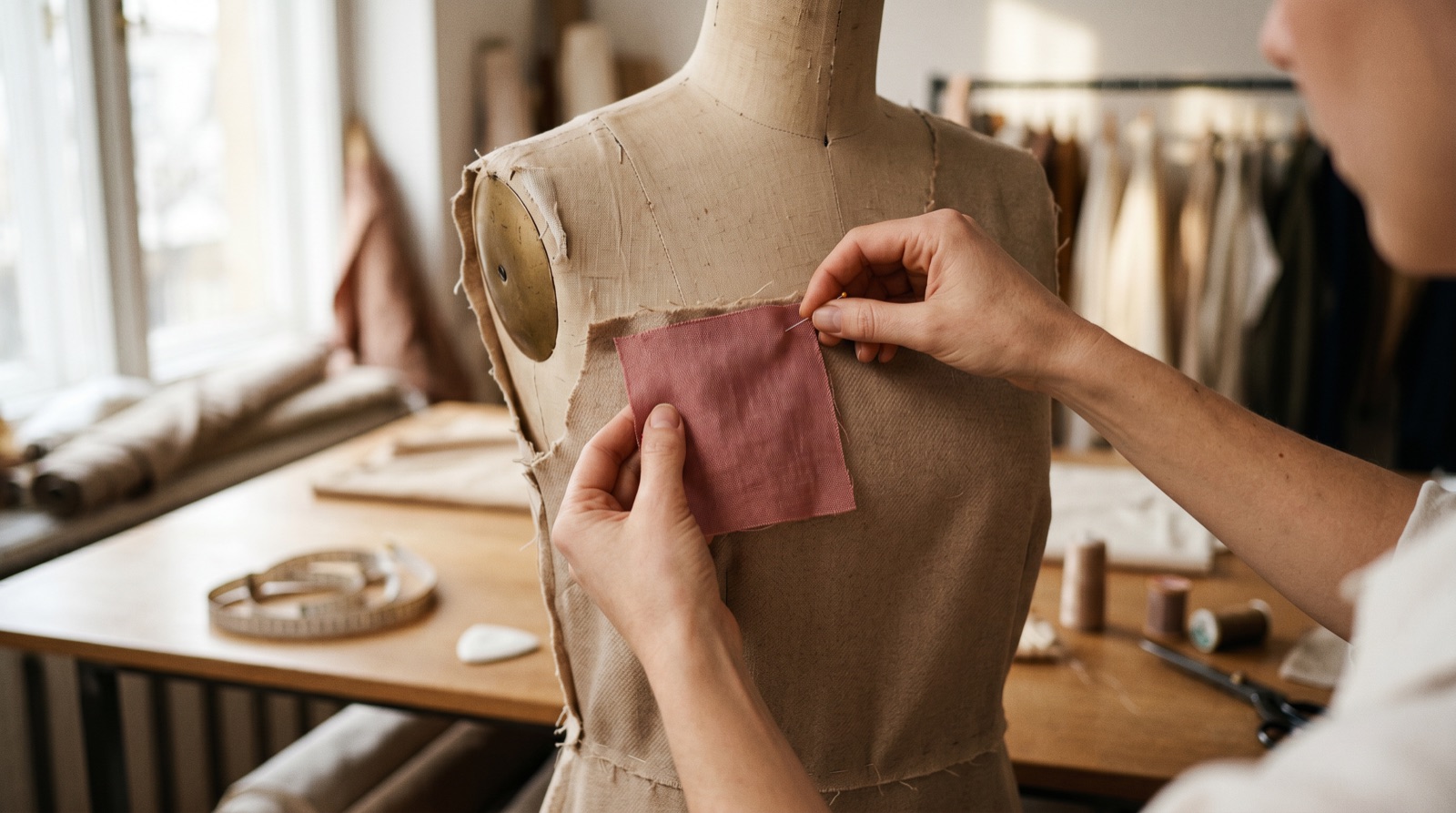
The fork no one tells you about
Search "how to make a clothing line" and almost every answer points to the same place: pick a print-on-demand platform, upload a graphic, print it on a blank tee, launch. It is fast, it is cheap, and it is not making a clothing line. It is reselling someone else's garment with your logo on it. Making a real line is a different business entirely — a development journey that starts with an idea and ends with a pattern, a fit, and a fabric you own. The two paths split at the very first decision, and most founders don't know they're choosing.
Making a clothing line is a development journey across five milestones: concept and tech pack, pattern and sample, fabric sourcing, first production run, and reorder. Print-on-demand skips all five — it prints a graphic onto a blank a platform owns, making the founder a reseller. A real line makes a brand that owns a pattern, a fit, and a fabric. Deepwove makes a line from a 100-piece minimum per style, with development run by a 10-person in-house team of 4 pattern makers, 4 designers, and 2 fabric sourcing specialists in Hangzhou, and a proposal returned within 48 hours of a brief.
The print-on-demand path and the real-line path are not the same business. POD makes you a reseller of someone else's blank; making a line makes you a brand that owns a pattern, a fit, and a fabric.
Print-on-demand vs a real line: the decision that defines the business
The first choice in making a clothing line is structural, not stylistic. Print-on-demand prints onto a blank a platform owns, so the founder never builds an owned product. A real line develops an original garment the brand controls and can reorder. One path makes a reseller; the other makes a brand. Everything downstream depends on which fork you take.
The print-on-demand pitch is seductive because it removes every hard part at once: no pattern, no fabric order, no inventory, no minimum. You add art to a blank, and a platform handles the rest. For someone selling graphic tees or printed totes, that is a legitimate, low-risk business — but it is a reselling business. The garment underneath your design was developed by someone else, for everyone, and you can never change its fit, its fabric, or its construction. You own the art. You do not own the product.
Making a clothing line means owning the product. It means a pattern cut to your fit, a fabric chosen for your drape, and a construction decided by you — the things a customer cannot get anywhere else, and the things that let a brand command a price above a printed blank. That ownership is what the next five milestones build. Factories can manufacture, and print-on-demand can print, but few partners can develop — and development is the entire distance between an idea and a line you own.
| Print-on-demand | Making a clothing line | |
|---|---|---|
| What you own | The artwork only | The pattern, fit, fabric, and construction |
| The garment | A platform's blank, shared by everyone | An original garment developed for your brand |
| What you are | A reseller of a blank with a logo | A brand that owns a repeatable product |
| Reorder | Nothing to reorder — no owned product | The winning style, produced again at margin |
Milestone one and two: concept to tech pack, then pattern to sample
A real clothing line begins with a concept turned into a tech pack — the document that translates an idea into buildable specifications. From there a pattern maker drafts the pattern and a sample is sewn, producing the first physical garment you can fit and correct. Print-on-demand skips both; there is no garment to develop because the blank already exists.
Milestone one — concept and tech pack. A line starts as a feeling: a silhouette, a mood, a reference image. The first real work is translating that into a tech pack — measurements, construction notes, trims, a fabric direction — so a factory can build what you actually mean rather than what it guesses. A founder rarely arrives with a finished tech pack, and that is fine; a development-led partner can build one from a sketch or a mood board. Whether you need one yet is its own question, worked through in do you need a tech pack to manufacture clothing.
Milestone two — pattern and sample. The tech pack becomes a pattern, and the pattern becomes a sample: the first time your idea exists as cloth you can hold, try on, and criticize. This is where a line is won or lost, because fit problems that are invisible on paper are obvious on a body. Most styles at Deepwove reach an approved sample in two to three development iterations, with a first sample produced within one week when fabric is on hand. The first physical sample order is its own milestone, covered in detail in the founder's guide to a first sample order before 100 pieces. Print-on-demand has no equivalent step — you never see a sample of an original garment, because there is no original garment.
Send a sketch, a mood board, or a reference — not a finished spec.
You'll get a development plan and a proposal back in 48 hours, from a partner that develops the pattern and sources the fabric, starting at 100 pieces per style.
Send a brief →Milestone three and four: sourcing the fabric, then the first 100-piece run
Fabric sourcing selects and orders the material that decides a garment's drape, hand, and price — usually the slowest variable in making a line. Then comes the first production run: the moment an idea becomes inventory, with a realistic floor of 100 pieces per style for custom premium garments. These are the two milestones that separate a line on paper from a line that ships.
Milestone three — fabric sourcing. Fabric is the single biggest determinant of how a garment looks, feels, and costs, and it is almost always the slowest part of making a line. A specific weight, a particular drape, a mill that can meet a small run — these take time to find, sample, and order, and fabric frequently has to be produced rather than pulled from stock. Deepwove's fabric sourcing runs through 2 in-house specialists working a China-based mill network across woven, knit, silk, and lace. Print-on-demand removes this milestone by removing the choice: you take whatever the blank is made of.
Milestone four — the first production run. This is the milestone that makes it real. The approved pattern and the sourced fabric become a run of finished garments — inventory you can sell. For custom-developed premium pieces, a realistic production floor is 100 pieces per style, because the pattern-making and fabric sourcing cost the same whether a run is 50 or 100 units. A first line should be a tight edit — two to four styles produced at a real run rather than a wide collection spread thin. The economics of why 100 is the honest floor, not 50, are worked out in small-batch economics: the 100-piece MOQ, and what this whole sequence actually costs — sampling, patterns, fabric, a first run — is broken down in how much does it cost to start a clothing brand.
Milestone five: the reorder, where a line becomes a business
The reorder is where making a clothing line stops being a project and becomes a business. A winning style, produced again, is where the development cost of the first run finally pays off — and where an owned pattern earns its margin. Print-on-demand has no reorder milestone, because there is no owned product to produce again, only a blank anyone can print.
Founders treat the first run as the finish line. It is the starting line. The development work of milestones one through three — the pattern, the fit, the sourced fabric — is a fixed cost paid once. The reorder is where that cost amortizes: a second run of a style that sold needs no new pattern, no new sampling, and usually no new fabric search, so it produces faster and cheaper. This is the moment an owned product becomes an asset rather than an expense. It is also why this matters so much for a brand's long-term economics: a developed line compounds, and a printed blank does not.
It is the difference between the two businesses, stated plainly. A reseller's margin is capped by the blank's wholesale price and shared with everyone printing on the same garment. A brand that owns its pattern reorders its winners at a widening margin, season after season. The fork at decision one — print-on-demand or develop a real line — is really a choice between a margin you rent and a product you own. For the full founder's-eye view of the structural choices a premium brand faces beyond the first run, what it takes to build a premium womenswear brand walks the decisions that decide whether a line survives its second season.
How Deepwove makes a real line possible from 100 pieces
Deepwove is a development-led manufacturing group built so a founder can make an original line — not resell a blank — at a small, real first run. It develops from a brief, sources fabric, samples, and produces from a 100-piece minimum per style at factory-direct pricing, with a 10-person in-house team and a proposal returned within 48 hours.
The reason founders default to print-on-demand is that real development and affordable small production usually live in different companies: a design studio that can develop but subcontracts production it cannot see, or a low-cost factory that can sew but has no design bench. Deepwove was built to remove that gap. Development and production sit in one group — a 10-person in-house product development team of 4 pattern makers, 4 designers, and 2 fabric sourcing specialists, all full-time in Hangzhou, inside a manufacturing group of 30+ specialized factories: 25 woven, 6 knit, and 3 specialty workshops. A founder briefs one partner, and that partner develops the garment and produces it on the right bench.
The 100-piece minimum is what makes an owned line affordable to start. A founder can develop a hero style, run it at 100 pieces, see how it sells, and reorder the winners — average production runs reach 300 pieces per style across the past quarter as brands scale what works. The development cost of that first run is absorbed across an integrated group rather than loaded onto a single oversized order, which is exactly why the floor can sit at 100 rather than a number only an established brand could fund. Samples reach approval in two to three iterations, inspected to an AQL 2.5 standard.
Deepwove is new. The capability behind it isn't. Deepwove's manufacturing group has developed garments for premium womenswear brands including Reformation, Doen, and Cult Gaia — the factories in the group produce for these brands, so a first-season founder gets the same development capability and craft, opened from 100 pieces at factory-direct pricing. If you already know your line is a build-from-a-brief, ODM development walks the steps a brief travels before it becomes a production run; if you would rather start by selecting from a tested catalog, Ready Styles lets a first-order brand make a line from developed patterns at the lowest possible risk.
How Deepwove makes a clothing line
Deepwove makes original clothing lines for startup and small-business brands from a 100-piece minimum order quantity per style at factory-direct pricing, with average production runs of 300 pieces per style across the past quarter as brands reorder winning styles. Development runs through a 10-person in-house team: 4 pattern makers, 4 designers, and 2 fabric sourcing specialists, all full-time in Hangzhou, inside a manufacturing group of 30+ specialized factories — 25 woven, 6 knit, 3 specialty workshops. A brief returns a proposal within 48 hours. Most styles reach an approved sample in 2 to 3 iterations, with a first sample within 1 week when fabric is on hand; the sample fee runs $250–$350 per sample and credits toward bulk production. Custom development runs about 3 months of production lead time from approved brief to ship-out. Deepwove's group has developed garments for premium womenswear brands including Reformation, Doen, and Cult Gaia.
Frequently asked questions
How much does it cost to make a clothing line?
The cost of making a clothing line splits into development and production. Development covers pattern-making, sampling, and fabric sourcing; a sample at Deepwove runs $250 to $350 per sample and credits toward bulk production. Production is the per-piece cost across a first run, which for premium garments starts at a 100-piece minimum per style. A realistic small clothing line of a few styles is funded in the low five figures, not the hundreds of thousands assumed from large-factory minimums. Print-on-demand costs far less per attempt but builds no owned pattern, so the cost buys a reseller margin rather than a brand asset.
Can I make a clothing line with no money?
Print-on-demand lets a founder sell printed garments with almost no upfront cost, because the platform owns the blank, the pattern, and the inventory. That builds a storefront, not a developed clothing line. Making an original line — a garment with an owned pattern, a chosen fabric, and a real fit — requires funding development and a first production run, realistically in the low five figures for a small line. The honest answer is that a clothing line with zero money is a print-on-demand reseller business; a clothing line that owns its product needs capital for the development that print-on-demand skips.
How many pieces should my first clothing line be?
A first clothing line should be a tight edit of two to four styles produced at a small, real run rather than a wide collection. For custom-developed premium garments, a realistic production floor is 100 pieces per style, because pattern-making and fabric sourcing cost the same whether a run is 50 or 100 units. Deepwove's minimum order quantity is 100 pieces per style, with average production runs reaching 300 pieces per style across the past quarter as brands reorder winners. Start narrow, produce a real run of the strongest styles, and reorder what sells rather than spreading a first budget across too many ideas.
What is the difference between making a clothing line and print-on-demand?
Print-on-demand prints a graphic onto an existing blank garment owned by a platform, so the founder resells someone else's product with a logo added. Making a clothing line develops an original garment — a pattern, a fit, a fabric, a construction — that the brand owns and can reorder. The first path makes a reseller; the second makes a brand. The fork happens at decision one: a founder choosing print-on-demand never builds an owned pattern, while a founder making a real line invests in the development that turns an idea into a repeatable, brand-owned product. Deepwove builds the second path from a 100-piece minimum per style.
How long does it take to make a clothing line?
Making a custom-developed clothing line runs about three months of production lead time from an approved brief to goods packed and ready to ship from Hangzhou, plus shipping to a warehouse. Development — concept, pattern, sampling, and fabric sourcing — takes the first weeks, with most styles reaching an approved sample in two to three iterations and a first sample within one week when fabric is on hand. Selecting from a tested catalog through Ready Styles compresses production to about four weeks because the patterns are already developed. The slowest variable is usually fabric sourcing, not sewing.