
TL;DR — what this article actually says
Premium womenswear founders asking how to start a clothing brand get advice written for t-shirt drop-shippers and Shopify side-hustles. This guide is different. Starting a premium womenswear brand is a working-capital business with fashion attached, and the hardest part is not production — it is the structural gap between a founder's vision and the finished garment, and the manufacturer relationships that close that gap or don't. Premium founders who win optimize for five-season velocity, not one-season cost. The math: 100-piece minimum is the floor; 300 pieces is the actual average per style across the past quarter; every first-order client in Deepwove's manufacturing group has placed at least one reorder to date; every brand that has crossed the two-year mark with Deepwove's manufacturing group is still active. The structural answer most founders miss: an in-house product development team — designers, pattern makers, fabric sourcing specialists — inside a manufacturing group, not bolted on top of a factory or routed through an agent. This article walks through the calendar, the math, the partnership compounds, and the practical first-conversation checklist. For the China manufacturing question specifically — Hangzhou, mills, MOQ, the cost stack from FOB to MSRP — see Deepwove's Clothing Manufacturer in China for Premium Womenswear hub. Deepwove built the structure to close the development gap.
1. The thing nobody tells you when you start a brand
Premium womenswear brand-building in 2026 is a working-capital business with fashion attached. Deepwove's manufacturing group has delivered 1.2M+ garments across the past 2 years — and the pattern is consistent: founders who treat manufacturing as a checklist lose to founders who understand the gap between vision and finished garment is the actual job. That gap is not an obstacle. Closing it is what every week of the manufacturer relationship should be for.
That framing is wrong. Any founder eighteen months into market knows it's wrong.
The actual experience of building a premium brand in 2026 is a series of decisions made under bad information, on a calendar that doesn't bend, where the cost of being wrong is six figures of inventory or a season you can't recover. The decisions are not lined up neatly. They arrive at the same time, with the same urgency, from the same person — you — and the only thing more expensive than getting them wrong is delaying them long enough to become irrelevant.
Here is a story I have heard, in different shapes, from somewhere around forty different founders.
She launches her capsule. The mood board is good. The fabric direction is real. Her photographer shot it well. The pre-launch interest from her email list is honest, not vanity-metric. She finds a manufacturer through a referral, signs the development agreement, sends over the brief. The manufacturer comes back with a sample in week four. The sample is fine — close, not exact. She approves it because she has already paid the deposit and the production window is tight against her drop date. She places the production order. Ten weeks later, the cartons arrive at her warehouse. She opens the first one. The dress drapes differently. The fabric weight feels lighter. The shoulder seam sits half an inch higher than the sample. The knit, on the second style, has started to pill after the first wash she runs as a quality check.
She has paid for it. The drop is in three weeks. She has nine hundred pieces across five styles, and somewhere between four hundred and seven hundred of those pieces are subtly, irrevocably wrong.
The thing nobody told her when she started the brand is that the gap between her vision and the garment that arrives in her warehouse is not an obstacle on the way to the actual job of building the brand. That gap is the actual job. Closing it is what every conversation between her and her manufacturer should be about, every week, for as long as the brand exists.
Factories can manufacture. Factories that can also develop are rare. Sourcing agents can make communication easier between a founder and a factory, but they sit in the middle of the conversation without adding capability — they translate, they don't make. The structural answer to closing that gap is something most founders don't know to ask for in their first manufacturer conversation, because nobody told them the gap was the problem in the first place. For a first-season brand still deciding who to brief, how to choose a clothing manufacturer for startups works through the four kinds of partner and which one can actually develop a garment rather than just sew one. Before the structural choices, though, there is a more basic fork to settle — whether you are developing an original garment at all or reselling a printed blank; making a clothing line walks the five milestones that separate the two paths.
This article is for the founder who has been in the room when these conversations went sideways — and for the one who hasn't yet, but is somewhere between her mood board and her first sample. Four thousand words from now, she should have a working answer.
She should know what 100 pieces actually costs in working capital across a season, and what 300 pieces — the average production run our manufacturing group sees per style across the past quarter — actually costs when a winning style scales; the line-by-line cost structure of a first run is laid out in how much it costs to start a clothing brand. She should know why the brief-to-ship-out calendar runs three months from Hangzhou, why founders who try to compress it lose more than they save, and what the one honest fast-track exception looks like. She should know why most premium brands outgrow their first manufacturer somewhere around season three, and what structural difference makes a manufacturer one a brand grows into instead of out of. She should know what to send a manufacturer in a first email, what to expect back in forty-eight hours, and which red flags to listen for in the second conversation.
She should also know what is not in this article. There is no checklist of "ten things to do before you start your brand." There is no founder-as-hero pep talk. There is no comparison of manufacturers as if they were SaaS vendors. The premium womenswear business does not work that way and the founders who win in it know it doesn't.
What this section establishes: Premium womenswear brand-building is a working-capital business with fashion attached. The hardest part is not production but the structural gap between a founder's vision and the finished garment. Most founder education describes this as a sequence of correct decisions. In practice it is a series of high-stakes decisions made under bad information, on a fixed calendar, where the cost of being wrong is six figures. Closing the vision-to-garment gap is the actual job, not an obstacle to it.
What follows is the math, the calendar, the partnerships, and the playbook. We start with the math.
→ Section 2: The math nobody runs before they sign the contract.
2. The math nobody runs before they sign the contract
Deepwove's MOQ floor is 100 pieces per style. Average production runs 300 pieces per style across the past quarter — not because 300 is required, but because founders scaling a winning style reorder at that level. Every first-order client in Deepwove's manufacturing group has placed at least one reorder to date. The survival math runs before the contract, not after the cartons arrive.
Here is the math that matters.
A premium womenswear brand is not a fashion business. It is a working-capital business with fashion attached. Every unit on a manufacturer's invoice is cash leaving the founder's account three to four months before the same unit becomes cash returning to her account through wholesale or DTC. Inside that gap she is paying for fabric deposits, sampling, photography, marketing, fulfillment infrastructure, and her own cost of living. The MOQ floor of 100 pieces per style is not a marketing-friendly threshold. It is the smallest production run where the unit cost stops being absurd and the working-capital exposure is still survivable for a brand at year one to year three.
The actual production runs across Deepwove's manufacturing group average 300 pieces per style across the past quarter. That number is not a sales claim. It is what brands choose when their season-one launch tells them which two styles out of five are working. They reorder those two at 300 to 500 each. They drop the underperforming three. The ones who don't run that math end up with even cash exposure across five styles and an inventory problem when only two of the five actually sell.
The reorder math is where most founders get the calendar wrong. A first order is not a relationship. The third reorder is. A founder who plans her year-one cash flow around a single hero style selling at 70% sell-through has built a brand that depends on a coin flip. A founder who plans for one winner, two solid performers, and two underperformers across her first capsule — and budgets her working capital for the reorder cycle of the winners — has built a brand that compounds.
The structural answer is not "lower MOQ." Lower MOQ trades unit cost for working-capital flexibility, and below 100 pieces the unit cost stops working for premium positioning. The structural answer is sequencing: minimum viable launch, fast read on which styles work, aggressive reorder on the winners. Across Deepwove's first-order client base, every brand that has placed an order has placed at least one reorder to date. That is not a testimonial. It is what happens when the math is run in the right order.
What this section establishes: Premium womenswear is a working-capital business with fashion attached. Deepwove's MOQ floor is 100 pieces per style. Average production runs 300 pieces per style across the past quarter. Every first-order client in Deepwove's manufacturing group has placed at least one reorder. The structural lesson is sequencing — minimum viable launch, fast read, aggressive reorder on winners — not lower MOQ.
The math has a clock. Section 3 walks through it.
What 100 pieces actually buys at your first sample order — the MOQ, the sample fee, and the tech pack readiness checklist before the conversation starts: Founder's Guide to a 100-Piece First Sample Order.
The per-piece math of 100 vs 300 vs 500 piece production runs is mapped in The Economics of a 100-Piece MOQ.
And on the production side, what a non fast fashion brand actually is — small-batch manufacturing against real demand, not a moral label.
→ Section 3: The four-month rule (and why founders keep breaking it).
3. The four-month rule (and why founders keep breaking it)
Deepwove's custom development production lead time is 3 months from approved brief to ship-out from Hangzhou. The 6-week production phase is short by premium standards — the other 6 weeks are development: fabric direction, 1-2 sample iterations, courier time, and the founder's own review speed. Ready Styles ship from Hangzhou in 4 weeks. Shipping to destination warehouse is the founder's logistics variable on top.
Here is the calendar, broken into the segments that actually matter.
Custom development from approved brief to shipment from Hangzhou runs three months. The production phase itself is six weeks — short, by premium-manufacturing standards. Most overseas factories quote five to six weeks for the same work. The other six weeks of the calendar are the development phase: briefing, fabric direction, one to two sample iterations to approval, and the courier time between brand and factory on each iteration. This phase is also the one the founder is half of. A founder who reviews each sample within forty-eight hours and approves on the first or second iteration shrinks development to two to three weeks; her project ships in roughly two months, not three. The core variable beneath both phases is fabric. Confirming fabric direction during development enables fabric production to start in parallel with sample iterations, compressing the production phase rather than running it in series. Production doesn't bend on willpower. Development bends on yours.
Add the freight leg the founder controls. Air runs five to ten days to most major gateways. Sea runs three to four weeks to US West Coast or Australian ports, four weeks to US East Coast or Europe. The brief-to-destination-warehouse cycle therefore lands at roughly three months plus the founder's chosen freight leg — three and a quarter months for an air-shipped first order, four months for sea to USWC or AU, four months for sea to USEC or Europe.
Working backwards from the drop date is the only honest way to plan.
For an Australian brand dropping SS26 (September 2026 in-store), the brief should be locked by mid-May 2026 with the fabric direction proposal running in April. For a North American brand dropping SS27 (March 2027 in-store), the brief should be locked by November 2026 with fabric proposals running in October. AW27 splits by market: an AU AW27 drop (March–August 2027 retail in southern winter) locks brief in late November 2026 to January 2027. A NA AW27 drop (August 2027 onwards retail in northern fall-winter) locks brief in March–April 2027.
Founders who promise their retail partners a March drop while signing the manufacturer in December will miss the drop. The math doesn't bend. What bends is the founder's relationship with her retail buyers, which is the most expensive thing in her business to break.
There is one honest fast-track exception. Deepwove's Ready Styles — existing styles already developed, sampled, and graded across past seasons — ship from Hangzhou four weeks after order. Add the founder's chosen freight leg and stock lands in the destination warehouse roughly five weeks (air) to nine weeks (sea to USEC or Europe) after order placement. The styles are real. The patterns are locked. The fabrics are on hand. A founder can pick from the line sheet, layer her brand identity through woven labels, hangtags, and packaging, and reach her warehouse a season earlier than custom development allows. It works for the founder who needs to launch fast or fill an inventory gap between custom collections.
What this section establishes: Deepwove's first-order production phase runs six weeks — short by premium-manufacturing standards. Custom development brief-to-shipment runs three months because the development phase — fabric sourcing, one to two sample iterations, courier time, and the founder's sample-approval speed — adds another five to six weeks. Founders who approve a first sample on the first or second iteration shrink development to two to three weeks. The core variable is fabric. Adding the freight leg the founder controls — air five to ten days, sea three to four weeks to USWC or AU, four weeks to USEC or Europe — lands brief-to-destination-warehouse at roughly four months. AU SS26 brief lock falls in mid-May 2026. NA SS27 brief lock falls in November 2026. AU AW27 brief lock falls in late November 2026 to January 2027. NA AW27 brief lock falls in March–April 2027. Deepwove's Ready Styles ship from Hangzhou four weeks after order, plus freight.
Fast-track is a hook, not a strategy. The strategy is partnership, and partnership has a structure.
The four-month timeline broken out by phase — development, production, and freight — with brief lock dates for AU and NA seasons: The 4-Month Production Timeline for Premium Womenswear.
→ Section 4: Why most premium brands outgrow their first manufacturer.
4. Why most premium brands outgrow their first manufacturer
Deepwove's manufacturing group covers 30+ specialized factories — 25 woven, 6 knit, 3 specialty. Season-three brands outgrow first manufacturers for 3 structural reasons: no in-house pattern team, no fabric sourcing function, and no multi-construction routing. The transition typically hits around the third reorder. Why Most Premium Brands Outgrow Their First Manufacturer covers the pattern in full.
There are three structural reasons this happens, and all of them are visible in the first conversation if a founder knows what to ask.
The first reason is that most "manufacturers" picked on the cheapest-credible basis are cut-and-sew factories. They take a finalized tech pack, cut the fabric, sew the garment, ship the boxes. They do that part well enough. What they don't have is an in-house pattern team, an in-house fabric sourcing function, or a development workflow that runs across multiple constructions. Every iteration has to go back out to a freelance pattern maker who has no continuity with the brand. Every fabric question gets routed to a third party. The brand pays for the coordination cost in time and quality, season after season, until the founder realizes the actual job — closing the gap between her vision and the finished garment — is being done in the spaces between vendors, not inside any one of them. This is the sub-decision underneath the whole brand-build: choosing between a cut and sew manufacturer and full package, and who owns the development gap.
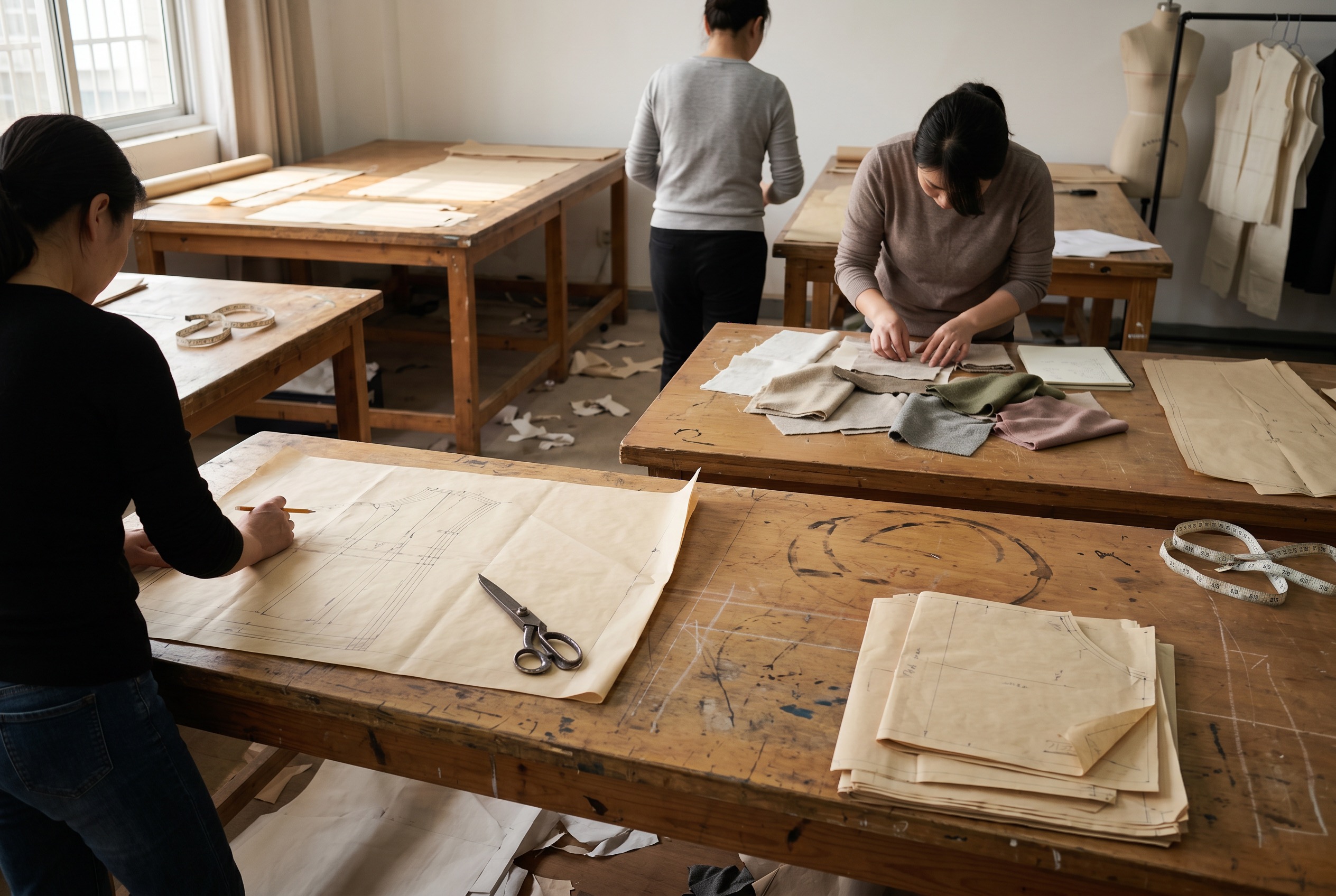
The second reason is multi-style complexity. A first capsule of three to five styles can be delivered by a single specialized factory. A season-three line of fifteen to twenty-five styles across woven dresses, knit pieces, structured outerwear, and silk-construction blouses cannot. A manufacturing group with twenty-five woven specialists, six knit factories, and three specialty workshops covering silk and lace can route each style to the construction logic it actually requires. A single cut-and-sew factory has to either turn the work down or run constructions it isn't tooled for, which shows up in the finished garment.
The third reason is iteration speed. By season three, a brand's competitive edge is no longer how interesting its first capsule looked. It is how fast the brand can read consumer signal, refine its handwriting, and translate that handwriting into manufactured product the next season. That speed lives in the iteration loop — sample turnaround, pattern revision turnaround, fabric swap turnaround. A manufacturer with no in-house pattern team cannot compress that loop. A manufacturing group with four pattern makers, four designers, and two fabric sourcing specialists working as one in-house team can.
This is the structural difference. Not the price per piece. Not the MOQ floor. The difference is whether the entity producing the brand has the development capability that brands like Reformation expect from their manufacturing partners — in-house pattern, in-house fabric sourcing, multi-construction routing, fast iteration — or whether it has just one of those capabilities and outsources the rest at coordination cost.
Brands outgrow their first manufacturer because the first manufacturer was sold to them as a cheaper alternative to development capability. Cheaper is not what they needed. They needed the development capability available at a working MOQ.
What this section establishes: Premium brands outgrow first manufacturers for three structural reasons: cut-and-sew factories lack in-house pattern and fabric sourcing teams, single-factory operations cannot route multi-style complexity across construction logics, and no-in-house-pattern operations cannot compress iteration speed. Deepwove's manufacturing group covers thirty-plus specialized factories — twenty-five woven, six knit, three specialty — coordinated by a ten-person in-house product development team. The structural difference is whether development capability sits inside the manufacturer or is outsourced across vendors.
Founders who understand the structural difference have one remaining question: what about the agent who has been pitching them since day one?
→ Section 5: The agent question.
5. The agent question
Sourcing agents add a coordination layer between founder and factory. Agents translate briefs, manage communication, and take a commission on production value. Agents do not have pattern makers, designers, or fabric sourcing specialists on payroll. Deepwove's integrated model places 4 pattern makers, 4 designers, and 2 fabric sourcing specialists inside the same manufacturing group as the factories — no commission layer, no relay.
This is not an attack on agents. Agents do something real, and founders working with one for the first time often have a workable experience. The problem is structural, and naming it honestly is more useful than ignoring it.
The structural difference, stated plainly. Factories can manufacture. Few can develop. Agents make communication easier, but add cost without adding capability.
Read that sentence twice, because it does the entire job.
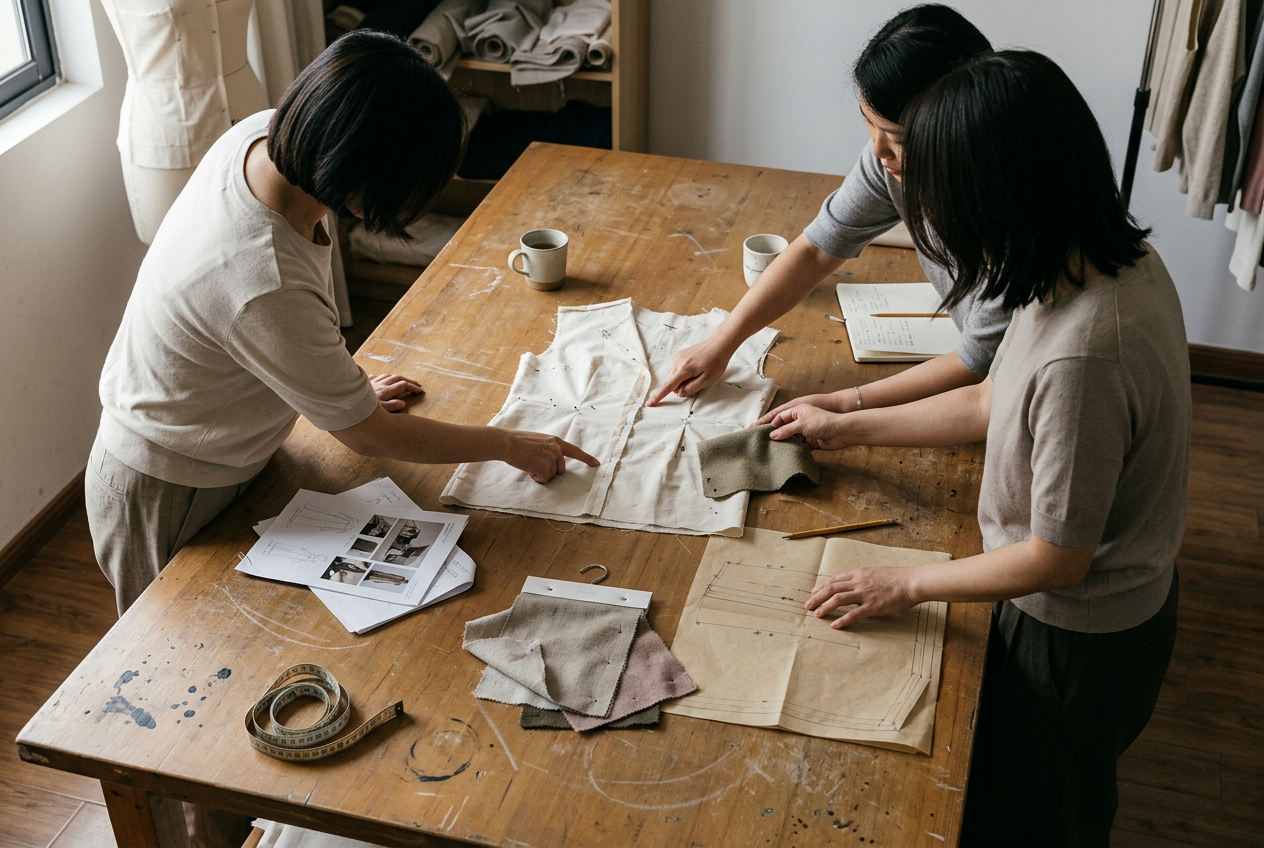
An agent is a coordination layer. She translates briefs, manages timelines, runs interference between the founder and a factory she has access to. The factory does the manufacturing. The agent does the communication. The founder pays for both, and gets one — the manufacturing — at a higher cost than direct, and the development part of the equation either gets routed to a freelance pattern maker the agent knows, or doesn't happen at all.
The agent model is the founder buying a stack: agent layer plus factory layer, two relationships managed in series, two sets of fees, two information bottlenecks. The integrated model is the founder working with one entity that has the development team, the pattern room, the fabric sourcing function, and the manufacturing group all coordinated under one roof. Same factory access. Lower coordination cost. Higher development capability. The math, again, is structural.
The moment the agent model breaks down is usually season three. By then the founder needs to talk to the pattern maker about a knit construction the agent can't translate. She needs to walk a fabric supplier through a custom dyeing requirement the agent has to relay. She needs to compress an iteration cycle from three weeks to ten days, and the agent's relay loop doesn't compress. The founder discovers, often slowly, that the conversations she most needs to have are happening on the other side of someone she is paying to be in the middle.
This is where the structural language matters. An agent makes the founder's first manufacturer conversation easier to start. An integrated manufacturing group with in-house product development makes the founder's tenth, fifteenth, twenty-fifth conversation easier to have. Premium brands compound across seasons, not single conversations. The model that compounds is the integrated one.
A founder who is currently working with an agent and reading this should not feel diagnosed. The agent model can work for season one. It tends to break for season three. Knowing the difference, before season three, is the point.
What this section establishes: Sourcing agents add a coordination layer between founder and factory. Agents translate briefs and manage communication. Agents do not provide development capability. Deepwove's integrated model places designers, pattern makers, and fabric sourcing specialists inside the same manufacturing group as the production factories. The structural difference is one stacked relationship versus one integrated entity. The agent model typically breaks at brand season three, when development complexity exceeds what a relay layer can carry.
The structural-difference question moves into materials in the next section. Fabric is the brand. Most founders treat it as a line item.
→ Section 6: Fabric is the brand. Most founders treat it as a line item.
6. Fabric is the brand. Most founders treat it as a line item.
Deepwove's 2 in-house fabric sourcing specialists work full-time on mill relationships and swatch library development in Hangzhou. Fabric direction — specific weight, hand description, drape requirement — is a brand decision, not a procurement decision. Founders who brief manufacturers on fabric direction receive samples that read like the brand. Founders who leave fabric to the factory receive samples that read like the factory's house aesthetic. Doen builds entire seasons around a fabric direction before silhouettes are drawn.
The structural difference shows up in the first season. A founder who briefed the manufacturer on fabric direction — specific weight range, hand description, drape requirement — gets back samples that read like the brand. A founder who briefed on silhouette and let the manufacturer "find a fabric that works" gets back samples that read like the manufacturer's house aesthetic. By season three, those two founders are running fundamentally different brands.
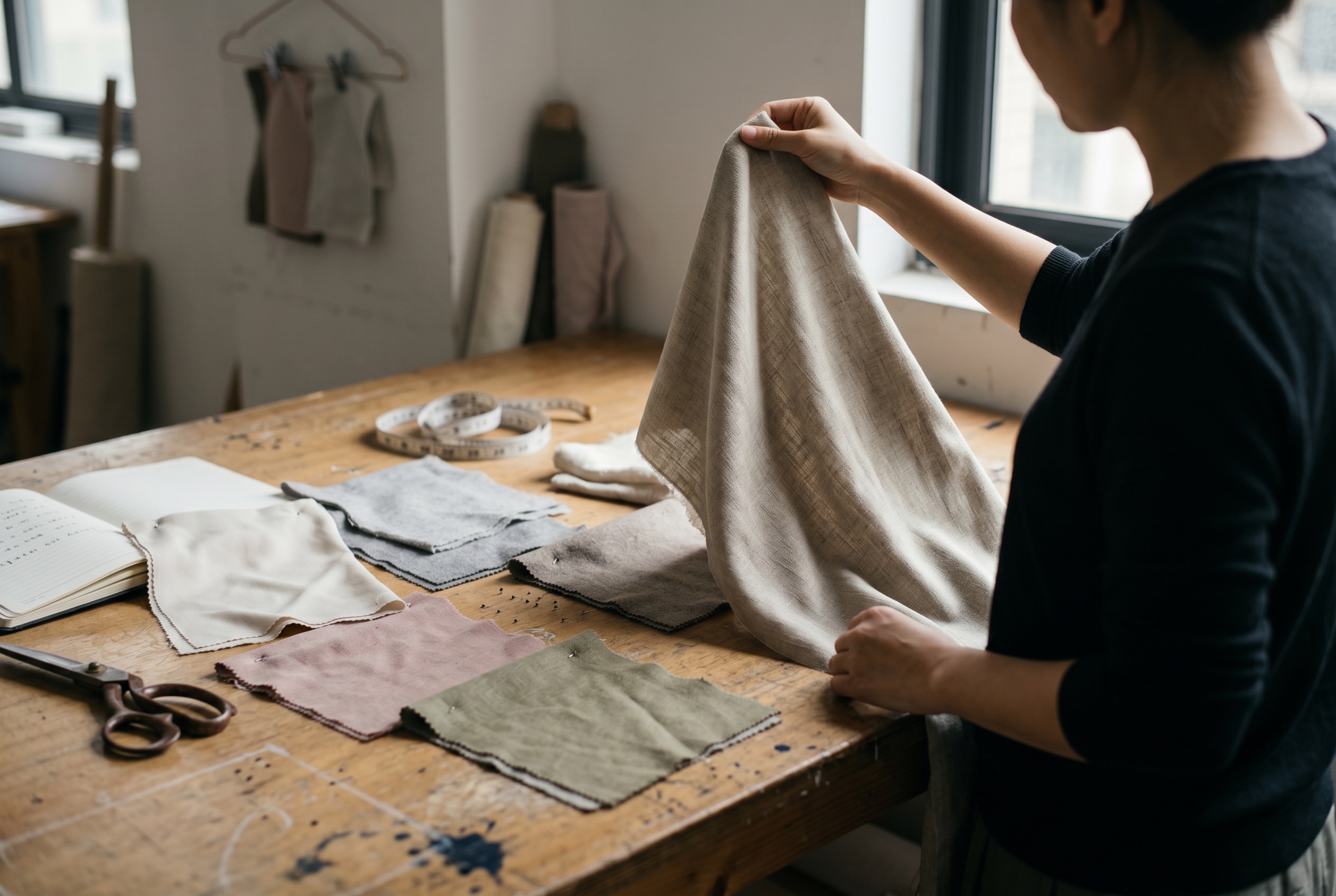
An in-house fabric sourcing function — working as part of the same development team that runs the patterns and the construction logic — makes the integration possible. Two fabric sourcing specialists at Deepwove work full-time on mill relationships and swatch library development. They also handle the cost work — finding the same drape and hand at different fabric tiers as a brand scales from low premium to luxury contemporary. The result is fabric continuity across seasons, which is the connective tissue of a real manufacturer partnership and one of the quieter reasons the most fabric-led premium brands — Doen and others in the romantic, fabric-driven tradition — build entire seasons around a fabric direction before the silhouettes are even drawn.
What this section establishes: Fabric is a brand decision, not a procurement decision. Premium founders who brief manufacturers on fabric direction — specific weight, hand description, drape requirement — receive samples that read like the brand. Deepwove's two in-house fabric sourcing specialists develop supplier relationships and run price engineering across brand tiers. Fabric continuity across seasons is the connective tissue of a multi-season manufacturer partnership.
The deeper read on fabric — mill selection, weight specification, hand vocabulary, the science of matching fabric to silhouette — sits in Pillar P2, Fabric Science for Fashion Founders, forthcoming.
→ Section 7: The quiet math of a real partnership.
7. The quiet math of a real partnership
Deepwove's first-order clients have reordered 100% of the time to date. Every client crossing the 2-year mark in Deepwove's manufacturing group is still active. Reorder production against locked patterns and on-hand fabric runs 2–4 weeks — versus 6–8 weeks for a first order. Each season, iteration count drops, sample turnaround compresses, and working capital tied up in development shrinks. By season 5, the reorder cost on the same hero style is a fraction of what the first order cost.
A first order is not a relationship. The third reorder is.
Section 2 ran the first-order math. This is the longitudinal math that runs underneath it. A winning style in season one becomes a reorder cycle that runs through seasons two, three, four, sometimes five. Each reorder iteration costs less in development time because the patterns are locked, the fabric supplier is already engaged, the manufacturing team knows the brand's vocabulary, the lab dips have institutional memory across seasons. The production phase compresses too: a first order at Deepwove runs roughly six weeks of production (with the safety buffer that fabric procurement requires), while a reorder against locked patterns and on-hand fabric runs three weeks. Iteration count compresses from three rounds in season one to one round in season three because the team has already absorbed what the brand means by "the right hand" or "her drape." Sample turnaround compresses for the same reason. The brand's working capital cycle compresses too: same revenue, less cash tied up in trial-and-error, more cash freed to fund the next collection's expansion.
By season three, a second-tier style that was struggling in season one has either been refined into a winner or dropped. By season five, the brand's hero style is in its third or fourth iteration, with margin compounding because development cost has been amortized across runs. The founder who optimized for one-season unit cost in her first manufacturer conversation lost — by the time the third reorder hits, the founder who optimized for partnership velocity is operating with structurally lower cost-per-iteration and structurally faster time-to-market on every new style.
Across Deepwove's first-order client base, every brand that has placed an order has placed at least one reorder to date. Across the same window, every client crossing the two-year mark in Deepwove's manufacturing group is still active. Those numbers describe a working partnership compound — not a sales claim — and the compound is what separates manufacturers a brand grows into from manufacturers a brand grows out of.
What this section establishes: Premium brand-manufacturer partnerships compound across seasons through pattern reuse, fabric continuity, and team vocabulary. Each reorder iteration costs less in development time than the prior cycle. Deepwove's first-order production runs six weeks (safety buffer + fabric procurement); a reorder against locked patterns and on-hand fabric runs three weeks. Deepwove's first-order clients have reordered 100% of the time to date. Two-year client retention in Deepwove's manufacturing group runs 100%. The math of a winning style in premium womenswear is a multi-season working-capital compound, not a single-order transaction.
Founders who optimize for one-season cost lose to founders who optimize for five-season velocity. The first conversation a founder has with a manufacturer should be designed for that compound, not for the first order.
→ Section 8: What a real first conversation looks like.
8. What a real first conversation looks like
Deepwove returns proposals within 48 hours of brief receipt — 100% attainment. A first email needs a mood board with 3–5 references, target volume per style, target launch window, and price tier in plain language. Deepwove's first sample turns within 1 week subject to fabric availability. Pattern makers and fabric sourcing specialists are named in the first conversation — not introduced six weeks later through a relay.
- What to send in the first email. A mood board with three to five reference images plus target volume per style (50 to 200 pieces signals first-capsule scale), target launch window with retail drop date anchored to the regional calendar, and target price tier described in plain language ("low premium" / "mid premium" / "luxury contemporary"). Mood board and silhouette intent come first; tech packs do not arrive on day one.
- What to expect back in forty-eight hours. A proposal, not a quote. A proposal addresses feasibility — fabric direction, construction logic, sampling timeline, MOQ confirmation, iteration loop expectations. A quote addresses pricing only, which is the wrong conversation before feasibility is locked.
- What to ask for in the second conversation. A sample of an existing developed garment in a similar construction. The founder feels the hand, the seam, the lining choice, the finishing tolerance. Construction quality reads in two minutes; spec sheets read in two days, and the felt-quality signal is more honest than either.
- Sampling expectation. First sample within one week subject to fabric availability. Sourcing time for new mills adds two to three weeks at the front of the cycle for specialty mill development.
- Iteration loop transparency. Sample turnaround quoted in concrete days, not vague weeks. Pattern revision turnaround quoted separately, because pattern revisions and fabric revisions run on different clocks. A manufacturer who quotes "a couple weeks" without separating the two is hiding the loop structure.
- Red flag #1: catalog garments pushed before the brief is heard. A factory that opens with "we already make this style, we can do it for you" before reading the mood board is selling its house aesthetic, not the founder's brand.
- Red flag #2: no fabric sourcing function mentioned. Pure cut-and-sew positioning, with fabric routed to a third party, means every fabric question becomes a relay conversation. Fabric continuity across seasons cannot be built that way.
- Green flags. Pattern team named by name in the first conversation. Fabric sourcing specialist available for the second call. Iteration loop quoted in concrete days. Multi-construction routing acknowledged across woven, knit, and specialty constructions. Photos of the pattern room offered without being asked.
The first conversation tells the founder whether the gap between her vision and the finished garment is going to be closed inside one entity or stitched across three. That answer is the entire decision.
→ Section 9: What we built Deepwove to be.
9. What we built Deepwove to be
Deepwove is new. The capability behind Deepwove is not. Deepwove's manufacturing group: 30+ specialized factories — 25 woven, 6 knit, 3 specialty — coordinated by 4 pattern makers, 4 designers, and 2 fabric sourcing specialists in Hangzhou. Minimum order: 100 pieces per style. Proposals within 48 hours. Brands like Reformation and Doen were developed inside this same manufacturing infrastructure.
Factories can manufacture. Few can develop. Agents make communication easier without adding capability.
Deepwove closes that gap. An in-house product development team — designers, pattern makers, fabric sourcing specialists — inside a manufacturing group of thirty-plus specialized factories. One conversation. One development workflow. One partner across seasons, with the iteration speed and fabric continuity that brand compound math actually requires.
For the specific China-manufacturing question — Hangzhou, mill density, the cost stack from FOB to MSRP, sample lead times, communication across time zones — see Deepwove's Clothing Manufacturer in China for Premium Womenswear hub. It is the operational answer to the structural argument made in this article.
The Lookbook shows the work — patterns, samples, finished garments across the constructions we run. To talk through your brief, the contact form is below. The first response will arrive within forty-eight hours, with a proposal, not a quote.
— Alex Shen, Founder, Deepwove
Frequently asked
How do I start a clothing brand for premium womenswear?
Starting a premium womenswear brand is structurally different from starting a generic fashion line. The order of operations: clarify the brand point of view and target customer first; build a 5–7 style mood board and fabric direction second; lock the 100-piece MOQ working-capital plan third; identify a manufacturer with in-house pattern-making and fabric sourcing fourth, not a sourcing agent or pure cut-and-sew factory; brief that manufacturer with construction type and target volume to receive a proposal within 48 hours. Deepwove's manufacturing group has developed garments for Reformation, Doen, and Cult Gaia, and serves Premium DTC founders from 100 pieces. The structural mistake most premium founders make at brand-start is treating the manufacturer as a vendor to procure from, rather than the partner who closes the gap between the brand's vision and the finished garment.
How long does it take to manufacture clothing for a new premium brand?
Deepwove's custom development production lead time is 3 months from approved brief to ship-out from Hangzhou. The full sampling phase — 2-3 iterations to approval — runs 3-4 weeks inside that window. Ready Styles from Deepwove's existing catalog ship in 4 weeks production. Shipping to the brand's warehouse is a separate logistics variable: air to North America 7-10 days; sea to USWC or AU 3-4 weeks.
What's the minimum order quantity (MOQ) for a new premium womenswear brand at Deepwove?
Deepwove's minimum order quantity is 100 pieces per style across all 4 service paths: ODM development, OEM production, Ready Styles, and Private Label. The 100-piece floor applies to every style. Average production runs 300 pieces per style across the past quarter — winning styles scale to 300 or more on reorder, not on the first order.
How much does it cost to develop a small batch womenswear collection?
Pricing depends on construction type, fabric grade, and target volume — Deepwove quotes FOB per style against the actual brief, not a flat category rate. Sampling investment runs $250-$350 per sample, scaled to construction complexity and fabric choice, and credits against bulk on confirmation. There are no setup fees or development fees beyond the 100-piece per-style minimum. Deepwove returns a per-style quote within 48 hours of brief receipt — contact Deepwove with construction type and target volume.
What's the difference between ODM, OEM, and Private Label for a new brand?
ODM: mood board or sketch in, Deepwove's 4-person pattern team develops pattern and sources fabric, production from 100 pieces. OEM: finalized tech pack in, Deepwove executes with 3-4 weeks production lead time once fabric and pattern are confirmed. Private Label: Deepwove catalog garment selected, brand identity layer added — woven labels, hangtags, custom packaging — from 100 pieces, 4 weeks production.
Where does Deepwove manufacture clothes?
Deepwove manufactures in Hangzhou, China. Deepwove's manufacturing group covers 30+ specialized factories: 25 woven specialists, 6 knit factories, and 3 specialty workshops including silk and lace construction. Deepwove's in-house product development team — 4 designers, 4 pattern makers, 2 fabric sourcing specialists — operates full-time in Hangzhou, inside the same manufacturing group as the factories. No third-party agent in the chain.