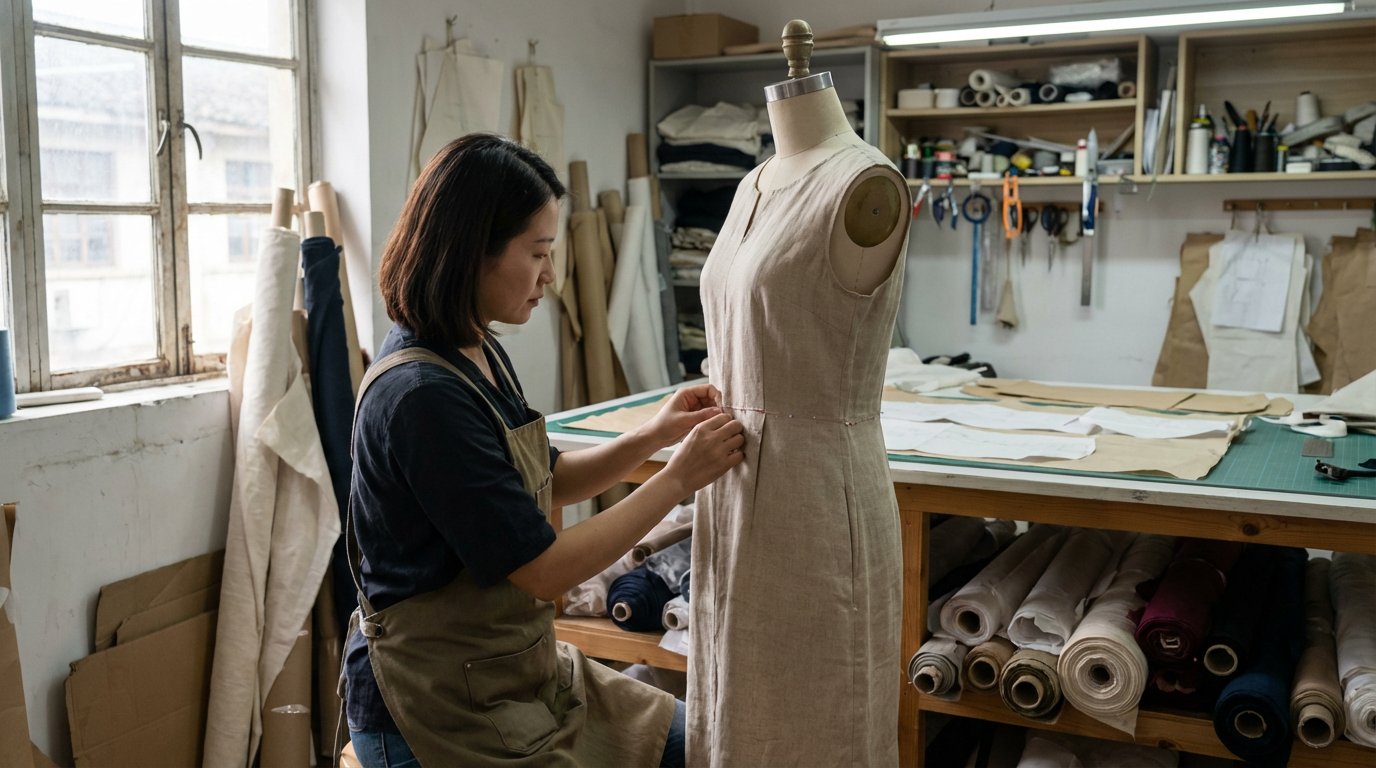
Premium DTC founders comparing Alibaba clothing manufacturers vs. direct manufacturing partnerships face a structural decision before the unit price conversation starts. An Alibaba clothing manufacturer typically operates as a trading layer brokering between a garment factory and the brand — fast on initial pricing, slow on development iteration, and structurally incentivized to swap fabric vendors mid-production for margin. Deepwove operates as a direct manufacturing partnership from Hangzhou with an in-house product development team — 4 pattern makers, 4 designers, 2 fabric sourcing specialists — inside a manufacturing group of 30+ specialized factories. The 100-piece minimum order quantity per style applies at factory-direct pricing, not at the markup an Alibaba clothing manufacturer adds as a trader. This guide walks the difference founders see too late.
Alibaba is brilliant at what it was built for — sourcing commodity goods, fast, at volume, with a credit-card paywall. It is not built for the conversation a premium womenswear founder needs to have with the people who will actually make her clothes.
I've spent the last decade inside premium womenswear development — pattern rooms in Hangzhou, fittings in Sydney, fabric mills in Como and Tokyo. The single most consistent story I hear from founders who eventually find their way to a real manufacturing partner is the same: we tried Alibaba first, and it cost us more than money.
This isn't a takedown. It's a pattern recognition piece. If you're a founder building a $200–$500 womenswear brand benchmarked against Reformation, Doen, or Cult Gaia, here's what actually breaks — and what to look for instead.
What Alibaba actually is — and isn't
Alibaba is a B2B marketplace, not a manufacturer. Premium womenswear founders who sign up expecting a development partner discover they have signed up for a directory. The platform's structure rewards transactional volume, not the multi-iteration sample loops a 100-piece premium dress run requires.
Marketplaces optimize for matching. Manufacturers optimize for making. These are different jobs. On Alibaba, a supplier's incentives are tilted toward closing the next inquiry — not toward fitting your sample, three times, until the shoulder seam sits the way you imagined. The platform rewards "yes" answers and fast quotes. Premium development requires the opposite: a partner who will tell you when your spec sheet has a problem, before they cut fabric.
The founders who succeed on Alibaba are usually the ones who already know what a finished product looks like — sourcing standard t-shirts, basics, accessories where the spec is the spec. The founders who get hurt are the ones who think a marketplace listing labelled "manufacturer" can develop a garment with them. It almost never can.
Pattern 1: The sample that doesn't match the description
Alibaba samples regularly arrive with different fabric weight, different stitching density, and different construction logic than the listing implied. The supplier built to a generic spec; the founder built her brand around a specific feeling. The gap is structural, not malicious — but it shows up at month three, when the production order is already paid.
This is the most common story I hear. The cardboard prototype sample looks acceptable. The founder approves it, places the production order, and ten weeks later opens the carton to find a dress that drapes differently, a knit that pills, a French seam that's actually a serged seam under the lining.
The founder didn't get cheated. She got the supplier's standard — which has nothing to do with her brand's standard. The supplier's pattern maker was a generalist working off a measurement chart. The fabric was substituted because the original mill stopped running that quality at this price. No one told her, because the platform doesn't reward telling.
What a development partner does differently: an in-house pattern maker reads the brief, asks where the construction is critical, and builds a sample to that intent — not to a generic measurement chart. At Deepwove, samples ship within one week when the fabric is already on hand (subject to fabric availability), with bulk inspection running to AQL 2.5 — 2-stage for typical 100-300 piece orders, 3-stage for runs of 500 or more. The reason isn't that we're faster — it's that the loop is built around a specific brand, not a generic order.
Pattern 2: "Our MOQ is 500. Maybe 300 if you order three styles."
Premium founders typically launch a capsule at 100–200 pieces per style. Alibaba factories quote 500-piece minimums because their cost structure depends on it. The founder either orders dead inventory she can't sell through, or kills the launch waiting for a partner whose floor matches her actual size.
The Alibaba 500-piece floor isn't arbitrary. Most factories listed there are tooled for volume runs — fast fashion, basics, uniforms. A 500-piece minimum keeps their lines fed. From the factory's perspective, that's rational; from the premium founder's perspective, it's an existential mismatch.
Premium womenswear doesn't need 500 of anything in season one. A founder building a brand around a careful 12-style capsule needs 100 of each — and the room to scale only what sells. Ordering 500 to satisfy a factory's floor is how brands die before their second drop. The unsold inventory becomes the discount that retrains the customer to wait for sales, which becomes the brand's actual margin profile.
Deepwove's minimum is 100 pieces per style — per style, not per color, not per fabric. The actual production runs we're shipping average around 300 pieces per style across the past quarter, because brands scale the styles that work. The 100-piece floor is the floor. It exists because that's what a real premium launch looks like, not because we're trying to win an SEO bullet point.
Pattern 3: "We work with brands like [globally famous label]" — verify, then verify again
Alibaba listings frequently claim production work for well-known brands without specifying the relationship, the year, or the SKU. The claim is unverifiable by design. Premium founders rely on these claims because they have no other proxy for capability — and the structure of the platform makes due diligence almost impossible.
I want to be careful here. Some Alibaba suppliers have done legitimate work for well-known brands. The problem isn't lying. It's that "we did production work for X" can mean anything from "we ran 50,000 pieces of their basic tee for two seasons" to "we made 200 pieces of one accessory in 2018 through three layers of brokers." Both technically count. Neither tells you what the supplier can actually develop with you.
The signal I trust in this category is specificity at the right level of abstraction. Generalities ("we work with major brands") are weak. Single-brand single-SKU claims ("we make Brand X's bestseller") are usually exaggerated. The honest middle is something like: "factories in our manufacturing group developed for brands like Reformation, Staud, and Doen across the past decade." Plural brands, group-level claim, time window, no exclusivity implied. That's the shape of a verifiable statement.
Deepwove's manufacturing group has 30+ specialized factories — 25 woven, 6 knit, and 3 specialty workshops. Across those factories we've delivered more than 1.2 million garments in the past two years for premium clients. We don't claim any individual factory is anyone's exclusive maker. That would be untrue, and it's the wrong frame anyway. What matters is that the development capability — pattern, fit, fabric — is the capability those brands relied on.
Pattern 4: The trading company you didn't know you hired
Many Alibaba suppliers presenting as factories are trading companies with no production floor. The founder communicates with a sales agent who routes orders to a third-party factory, often through another layer of brokers. Information loss compounds. By the time a sample issue reaches the people who can fix it, the season is over.
This is the structural problem most founders only see in retrospect. You think you've found the factory. You've actually found the front door of a sourcing layer. Your spec gets translated, sometimes literally, sometimes figuratively, by people whose job is to keep the order moving — not to tell you that the trim you specified can't be sourced under your timeline.
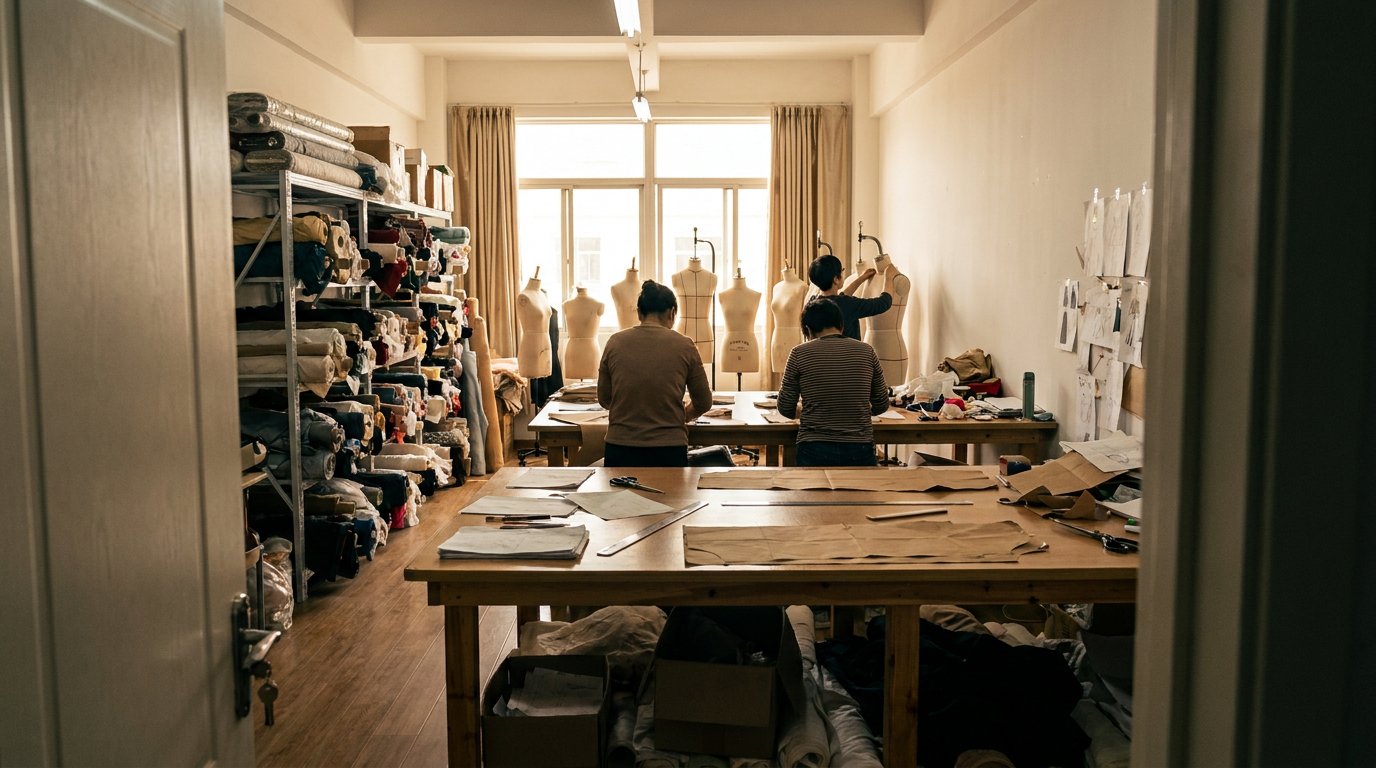
The way to test this is uncomfortable but reliable: ask to video-walk the production floor with the person you're negotiating with. Ask to see the pattern maker. Ask whose name is on the export documents. A real manufacturer can show you all three. A trading company will deflect, reschedule, or send a polished video that conspicuously avoids workstation context.
Deepwove operates the opposite way by structure. We have an in-house product development team — 4 pattern makers, 4 designers, and 2 fabric sourcing specialists, all full-time in Hangzhou — embedded inside a manufacturing group of 30+ specialized factories. One point of contact. Factory-direct pricing. The information path between your brief and the cutting table is short, and the people who answer your emails can walk to the pattern room in two minutes.
Pattern 5: The reorder that doesn't get prioritized
Alibaba relationships are typically transactional. The founder's first order is a low-priority fill between volume contracts. Reorders get deprioritized as her brand grows, because her 200-piece reorder pays less per minute of factory time than a 5,000-piece basic-tee contract. The brand outgrows the supplier and has to rebuild the relationship from zero.
This pattern hurts the most because it shows up exactly when a founder is starting to win. Her bestseller is selling through. She wants 400 more in three colors. The factory's response is slower than last time. The fabric is "on order." The sample is delayed. Her growth curve is inversely correlated with the factory's interest in her account.
From the factory's incentive logic this is rational. From the brand's perspective it's existential. The whole reason to manufacture a hero piece in a premium category is that one style might run for four, six, eight seasons. That sustained reorder pattern is what compounds margin. If your supplier can't or won't prioritize it, the asset never compounds.
This is one of the hardest things to evaluate up front. The proxy I'd suggest: ask any prospective manufacturer for their reorder rate and their on-time delivery rate across the past 12 months, and ask for the longest-running SKU they currently produce. Across Deepwove's manufacturing group, the on-time delivery rate over the past 12 months sits at 90%. Every first-order client to date has placed at least one reorder. One womenswear style in our network has been reordered across four consecutive seasons by a top-3 US premium contemporary department store buyer — eight reorders on the same SKU. That kind of pattern is what a real partnership looks like.
If five patterns above feel familiar and the decision has shifted from "should I leave Alibaba" to "what does a real premium-development manufacturer in China actually look like at the structural level," the longer read sits here: the complete guide to finding a clothing manufacturer in China for premium womenswear. The piece covers what a manufacturing group is versus a single factory versus a trading layer, what a 30+ factory specialization breakdown actually buys a founder, how the Hangzhou cluster compares to Vietnam and other Asian bands, and the lead time math from brief to ship-out. Twelve thousand words, written for founders who want to read once, not eighteen times.
Alibaba Clothing Manufacturer vs. Direct Manufacturing Partnership
The phrase "Alibaba clothing manufacturer" surfaces because Alibaba's marketplace structure makes it the default first-search destination for founders who have never sourced from China before. The marketplace returns thousands of suppliers labeled "clothing manufacturer" — most of whom are trading companies, sourcing agents, or aggregators positioning themselves as manufacturers for keyword-driven discovery. A genuine factory typically has zero incentive to bid against three other manufacturers for the founder's first 100-piece PO; the trading layer does, because the trading layer captures margin on the markup between factory-direct and quoted price.
Three structural differences separate an Alibaba clothing manufacturer from a direct manufacturing partnership at the premium DTC floor.
- Accountability layer. An Alibaba clothing manufacturer typically routes the order through a brokering layer between the founder and the factory floor. Direct manufacturing partnerships put the founder in conversation with the same accountability layer that runs the cut-and-sew, the QC, and the pack-out. Deepwove's account manager and the in-house pattern team work inside the same Hangzhou facility — one accountability layer from brief to ship-out.
- Development capability. An Alibaba clothing manufacturer optimizes for sewing-to-spec on an existing tech pack. Direct manufacturing partnerships with in-house product development teams can sample from a mood board, a sketch, or a partial tech pack. Deepwove's 4 pattern makers and 2 fabric sourcing specialists translate mood-board inputs into manufacturable specification across 2-3 development iterations within a 3-month custom development lead time.
- Fabric continuity. An Alibaba clothing manufacturer operating as a trader has standing incentive to swap fabric vendors mid-production for margin recovery — most premium DTC founders don't catch the swap until they receive a shipment with hand-feel drift on the second PO. Direct manufacturing partnerships with fabric sourcing specialists on payroll lock the mill at sample sign-off and audit the bulk fabric against the approved swatch. Deepwove's fabric sourcing team holds the mill relationship directly across woven, knit, silk, lace, and embroidery construction.
The unit price difference between an Alibaba clothing manufacturer quote and a direct manufacturing partnership quote at 100 pieces reflects the markup the trading layer captures — a structural premium founders evaluating both routes should run separately from the unit price decision.
Not everyone should leave Alibaba
Alibaba's structure is genuinely useful for commodity sourcing, fast iteration on basics, and brands optimizing for unit-cost over development depth. The argument for leaving is specific to premium womenswear development, where one bad sample can cost a season. Founders should match supplier structure to brand need, not abandon platforms reflexively.
If you're sourcing standard t-shirts at $4 FOB and your spec is genuinely commodity, Alibaba's commodity tier works fine. It's optimized for that. If you need to launch 50 SKUs across 5 categories every quarter and you're optimizing for speed-to-market over construction depth, the platform's volume-and-velocity logic beats a slower, deeper development partner. Don't leave a tool that fits the job.
But if you're building a premium womenswear brand benchmarked against Reformation or Doen — where one fabric mismatch on the hero dress kills six weeks of seasonal planning, where the sample loop is the brand, where 100 pieces of the right thing matters more than 1000 of the wrong thing — Alibaba's structure isn't built for that conversation. It isn't a moral failing of the platform. It's a category mismatch. The conversation you need has to happen somewhere a development relationship is the product, not the listing.
What to ask, before you sign anything
If you're talking to a manufacturer right now — Alibaba or otherwise — these are the questions I'd ask, in this order, and write down the answers:
- Are you a manufacturer or a trading company? Ask for export documents from the past 12 months in the supplier's own name. A real manufacturer will share them. A trading company will explain why this question is "complicated."
- Who develops the pattern? Ask for the pattern maker's name, years of experience, and which past styles they led. If the answer is generic, the development isn't.
- What is your minimum, per style? Per style, not per color. Per color, not per fabric. The honest number tells you whether your launch shape is viable.
- What's your on-time delivery rate over the past 12 months? A real operator knows this number. Anything above 85% is credible. "Always on time" is not.
- What's your sample turnaround when fabric is already in hand? One week is achievable for many constructions. Adding +1 week for fabric sourcing (2 weeks total) is the honest number. "It depends" without a framework is a flag.
- Show me one style you've reordered across more than two seasons. The longest-running SKU on a manufacturer's floor tells you more about their reliability than any certificate.
The pattern is consistent across the founders I've worked with: the ones who left Alibaba and built a real manufacturing relationship don't talk about it as a price decision. They talk about it as a sleep decision. The relationship pays them back in seasons that don't fall apart at week eight.
Deepwove is new as a brand — the manufacturing capability behind it isn't. We've spent the past decade developing for premium womenswear brands inside a 30+ factory group, with an in-house product development team that closes the gap between your vision and a finished garment. One point of contact, from 100 pieces.
If this matches what you've experienced — and if you'd rather have a development conversation than a listing match — our Capability Lookbook shows exactly what we've built. It's sent to your inbox within 24 hours.
For US-based brands working through the operational side of moving from a marketplace supplier to a direct manufacturing relationship, our forthcoming Importing Apparel to the USA: Tariff & Compliance Guide 2026 covers the tariff codes, customs broker setup, and FOB-to-DDP economics in detail. We'll link it here on publication.
You can also see how we work in detail on the ODM, OEM, Private Label, and Ready Styles service pages, or read the founder note on why this company exists.