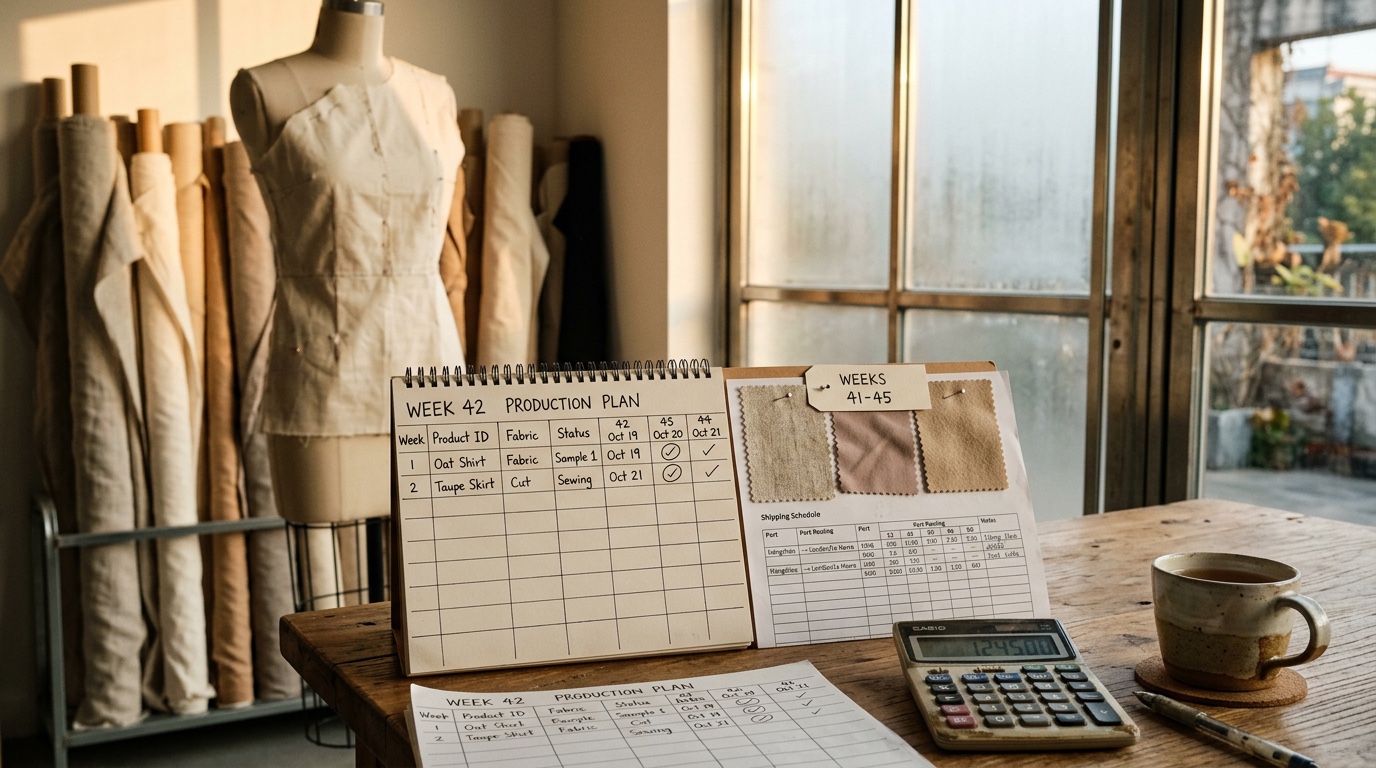
Most US Shopify womenswear founders pick a manufacturing country before they understand the production calendar. Deepwove ships premium garments out of Hangzhou on a 3-month production lead time — 12 weeks from approved brief to goods packed and ready to ship. Sea or air freight to a US warehouse adds another 1 to 6 weeks based on the founder's choice of forwarder and routing. Hangzhou sits 12-13 hours ahead of New York. Section 301 List 4A duties apply on most apparel HTS codes. Shopify Markets handles storefront localization; the production calendar handles whether the launch lands. This guide walks the math before a Shopify founder signs her first PO.
Shopify clothing brand founders evaluating overseas manufacturing typically run three sourcing routes in parallel before locking a vendor: Alibaba aggregator search for fast quotes, sourcing agent referral for managed brokering, and direct inbound to development houses for capability evaluation. Each route returns a different vendor tier. A Shopify clothing manufacturer at the premium DTC floor — like Deepwove from Hangzhou — operates as a development-capable manufacturing group at a 100-piece minimum order quantity per style, with the 12-13 hour Hangzhou-to-New-York time gap structured around weekly written updates and evening-window video calls. The cluster choice precedes the manufacturer choice for any Shopify clothing brand running premium womenswear: silk and dress development concentrates in Hangzhou; knit basics route to Portugal or Vietnam at scale.
What "Manufacturing for a Shopify Brand" Actually Means
A US Shopify womenswear founder typically needs 100-500 pieces per style, 2-4 capsule drops a year, and direct factory communication. Manufacturing geography divides into three honest bands: domestic US (Los Angeles, New York), nearshore (Mexico, Central America, Caribbean), and Asia (China, Vietnam, Bangladesh, India). Each band has a different MOQ floor, lead time profile, and unit cost shape — and a different fit with the Shopify drop cadence.
A Shopify storefront does not constrain where garments are made. Shopify is a commerce layer; manufacturing runs on a different clock. The mismatch is where most first-time founders lose a season.
Shopify Markets, Shopify Shipping, and Shopify Plus let a small team launch and localize faster than they can produce. The platform implies velocity. The factory imposes physics. A brand can run 6-8 week reorder cadences on Shopify — after the first hero capsule is developed and proven. Before that point, the calendar runs at the production line's speed, and the freight leg adds a separate decision on top.
The first PO is the slowest one. Reorders compress to 2-4 weeks of production once fabric and patterns are locked. The mistake most Shopify founders make is benchmarking the first PO against the steady-state PO. They are not the same animal.
The 3-Month Production Lead Time, Phase by Phase
Deepwove's production lead time runs 3 months from approved brief to goods packed and ready to ship from Hangzhou — Phase 1 sampling, fabric sourcing, and approvals across weeks 1-6, then Phase 2 first-order production at 6-8 weeks (typically planned at 8 weeks for buffer). Shipping to a US warehouse is a separate leg the founder controls: air freight runs 7-10 days, sea freight to the West Coast lands at 4 weeks, and East Coast routing also lands at 4 weeks. Samples ship within one week 90% of the time when fabric is on hand, and the 90% on-time delivery rate holds across the past 12 months.
Walk through where the 3 months actually go.
Phase 1, weeks 1-6 — Brief, sampling, fabric, iterative approvals. Deepwove's in-house team reviews construction, recommends fabric direction, pulls headers. When fabric is on hand, samples ship within one week 90% of the time. Fabric sourcing — a specific yarn count, a custom weight, a hand-feel that has to be matched off a swatch, a drape that only reads right on the body — is where the timeline actually breathes. Premium fabric often has to be woven or knit to order; that is a separate production run upstream of the garment, and most founders see this only when their first PO surfaces it. Most styles reach approved sample in 2-3 development iterations. First-round approvals happen when the brief is tight and the tech pack is clean — founders weighing whether they actually need a tech pack first can self-diagnose against the 5-tier readiness ladder before briefing. Three iterations, each with shipping back and forth, takes 3-4 weeks of calendar time even when each iteration is a 5-day cycle.
Phase 2, weeks 6-13 — First-order production. Once samples are signed off, the factory cuts fabric and runs the line. First-order production runs 6-8 weeks, typically planned at 8 weeks for buffer — first POs carry the highest variability because pattern, fit, and fabric are all new at scale. Reorders against locked patterns and fabric on hand compress to 2-4 weeks of production, with most reorders landing around the 3-week mark. The first-PO-vs-reorder gap is the single most under-modeled cost in a Shopify launch calendar. This is also where the production lead time officially ends: at week 12-13, goods are packed, palletized, and ready to leave Hangzhou.
Shipping is the next leg, not the next phase of production. Production lead time stops at the point goods are packed and ready to ship from Hangzhou. Whether they reach a US warehouse 7-10 days later (air freight) or 4 weeks later (sea freight) is the founder's call to make with her freight forwarder, and it depends on margin structure, drop urgency, and customer experience commitments. Air freight from Shanghai or Pudong to a US gateway runs 7-10 days door-to-door for a 100-piece capsule. Sea freight from Shanghai or Ningbo runs 4 weeks all-in to US West Coast or East Coast ports including vessel scheduling, customs clearance, and trucking to the brand's 3PL. Both options ship the same garment at the same FOB cost; the difference is the time variable the brand chooses to spend.
Why production does not compress to 8 weeks. "Rush production" cannot land a first-PO custom development in two months. What can compress to 4 weeks of production is a Ready Styles selection — already-developed catalogue patterns with fabric in stock, no Phase 1 — but that is a season-end fill, not a custom hero capsule.
⚠️ A note on Section 301 tariffs: a founder importing apparel from Hangzhou should build duty cost into landed-cost models from week one. Section 301 List 4A applies on most womenswear HTS codes, on top of the standard MFN rate. We cover the tariff-and-compliance side in detail in a separate guide — the customs broker conversation starts in parallel with the first PO, not after.
Where to Manufacture: The Three Geography Bands
Manufacturing geography for a US Shopify womenswear brand divides into three honest bands: domestic US, nearshore (Mexico, Central America, Caribbean), and Asia (China, Vietnam, Bangladesh, India). Each band has a different MOQ floor, lead time profile, and unit cost shape. The decision is not "which is better." It is which set of tradeoffs fits the brand's margin structure, drop cadence, and customer story.
The honest framing across all three: there is no objectively best country. There is a band that fits a brand's economics, calendar, and creative-direction model — and bands that do not.
If you are considering domestic US manufacturing. Los Angeles and New York anchor the surviving US apparel base. The structural realities: MOQs typically start around 50-200 pieces per style at the development tier, with cut-and-sew operations occasionally accepting lower at premium per-piece cost. Lead times on production-segment work run 6-10 weeks with brand-supplied fabric. Unit costs typically run 2.5x to 4x a Hangzhou equivalent on comparable construction — US labor cost is the primary driver, with fabric sourcing and trim adding secondary multipliers. The Made in USA marketing story resonates with a specific subset of US consumers and matters more for some brands than others. What domestic US typically does not offer at the 100-piece level: a deep in-house pattern team, fabric sourcing across global mills, and the construction depth that comes from running thousands of premium styles a year. The US apparel base contracted between 1995 and 2015; the factories that survived skewed toward commodity basics or top-of-ladder high-end work. The middle — premium dress development at small-batch scale — is where domestic options thin out.
If you are considering nearshore manufacturing. Mexico, Central America (Guatemala, Honduras, El Salvador), and Caribbean operations (Dominican Republic, Haiti) anchor the nearshore band. The structural realities: USMCA and CAFTA-DR duty preferences eliminate or reduce the tariff line that hits Asia imports — a real margin advantage on commodity-tier knits and basics. MOQs typically run 300-1,000 pieces per style for premium development; lower for pure CMT (cut-make-trim) operations supplied with fabric. Lead times on production-segment work run 6-10 weeks; the freight leg back to a US 3PL is short — 5-10 days inland trucking from Mexico, 7-14 days ocean from Central America. Fabric sourcing is the structural constraint — most nearshore factories work CMT and require the brand or a sourcing partner to supply fabric. Mill density does not approach Italian, Japanese, or Chinese cluster depth. Nearshore is a strong fit for brands with established fabric relationships, basics-heavy construction, and proximity-priority logistics.
If you are considering Asia. China, Vietnam, Bangladesh, and India anchor the Asia band, with each country occupying a different position on the cost-versus-capability curve. Vietnam and Bangladesh have absorbed significant share away from China since 2020, primarily in commodity tiers — knit basics, woven basics, mass-market activewear. Premium womenswear development has remained heavily concentrated in established Chinese clusters where the supplier ecosystem is mature. According to the McKinsey State of Fashion report, apparel sourcing diversification away from China has accelerated since 2020, but diversification has concentrated in commodity tiers. Asia carries Section 301 awareness, the longest sea-freight leg, the deepest fabric ecosystems, and the widest variance in development capability. MOQs at the premium-development tier start at 100-500 pieces per style depending on the country and factory.
Where Deepwove fits. We work from Hangzhou, so the rest of this guide reflects that perspective. We are one option inside the Asia band — not a ranking, not a recommendation against any other geography. Deepwove operates an in-house product development team — designers, pattern makers, fabric sourcing specialists — embedded inside a manufacturing group of 30+ specialized factories. Deepwove's factories developed for brands like Cult Gaia, Self-Portrait, and Babyboo across the past decade. Minimum order quantity is 100 pieces per style. Production lead time on custom development is 3 months from approved brief to goods packed and ready to ship from Hangzhou; shipping to a US warehouse runs 7-10 days by air or 4 weeks by sea to the West Coast on top. If your brief points toward Asia and premium-development capability matters more than absolute lowest unit cost, that is the conversation we have every week.
Where Hangzhou Fits
Hangzhou is one of the densest premium womenswear development clusters in the world. Deepwove operates an in-house product development team — designers, pattern makers, fabric sourcing specialists — embedded inside a manufacturing group of 30+ specialized factories. Deepwove's factories developed for brands like Cult Gaia, Self-Portrait, and Babyboo across the past decade. Minimum order quantity is 100 pieces per style.
Hangzhou sits two hours from Shanghai by high-speed train, inside the Yangtze River Delta apparel cluster — the densest concentration of premium womenswear pattern shops, fabric mills, and specialty workshops in mainland's apparel ecosystem. The cluster matters more than any single factory. A smocking workshop, a knit factory, and a silk woven mill can collaborate on a single capsule because they are 20 minutes apart, not 200.
Deepwove's structural difference: an in-house product development team — 4 pattern makers, 4 designers, and 2 fabric sourcing specialists, all full-time in Hangzhou — sitting inside the manufacturing group itself. One point of contact. No translation layer.
This decouples Hangzhou from the trading-company-disguised-as-factory pattern behind most founder horror stories online. Deepwove is not a sourcing agent. Deepwove's factories developed seasonal collections for brands like Cult Gaia and womenswear capsules for brands like Self-Portrait across the past decade. The same group scaled Babyboo into one of Australia's fastest-growing womenswear brands. That capability is now available to a US Shopify founder, from 100 pieces per style.
The 1.2M+ garments Deepwove's manufacturing group delivered in the past two years is one proof point. The 90% on-time delivery rate over the past 12 months is another. The most operationally relevant for a Shopify founder is the boring one: every first-order client to date has placed at least one reorder.
A Shopify-specific deep read sits here for founders whose decision has narrowed to platform-fit details: manufacturer specifically for Shopify-native brands. The page covers the two fulfillment models Shopify founders typically architect — brand-managed 3PL versus freight-forwarder-plus-3PL handoff — with the carton-level handoff point at Hangzhou or the brand's designated port made explicit, since Deepwove ships factory-direct to that handoff and does not run pick-pack-ship from Hangzhou. The piece also covers Shopify-platform-aware production calendar matching, Section 301 cost modeling against Shopify Markets margin math, and the named 3PL partners US Shopify brands typically integrate with.
What Cross-Border Logistics Actually Looks Like
Sea freight from Hangzhou to the US West Coast averages 18-25 days at the port-to-port level — about 4 weeks all-in including customs and inland trucking. Air freight to a US gateway runs 7-10 days door-to-door. The brand of record on the commercial invoice is the importer; a US Customs broker manages classification, duty payment, and entry. Shopify Shipping does not handle inbound international logistics — that is a separate freight forwarder relationship, typically arranged once with the first PO and then reused.
A first-time importer assembles three things she does not need for a domestic order: a US Customs broker, a freight forwarder, and an HTS classification for each style. All benefit from being set up before goods ship, not after.
The US Customs and Border Protection CBP entry process requires a Manufacturer Identification (MID) code on every commercial invoice for apparel. Deepwove issues the MID at production. The customs broker classifies garments under the correct HTS code, applies the MFN rate plus any Section 301 surcharge, and clears entry. A typical 100-piece capsule clears in 2-5 business days with clean documentation.
DDP (Delivered Duty Paid) versus FOB (Free On Board) is a decision a founder makes once. FOB hands ownership at the Chinese port; the brand's freight forwarder takes over. DDP includes door-to-door delivery and duty pre-payment. FOB is more common for brands with even modest import volume; DDP is more common for first-time importers who want a single point of contact.
Three things to set up before the first PO ships:
- A US Customs broker. Many freight forwarders include broker services.
- An EIN for the Shopify business entity. Required for customs entry. The IRS issues this through the EIN application.
- A 3PL for inbound receiving. Shopify Fulfillment Network is one option at scale. Independent 3PLs are more common at the 100-500 piece capsule level.
What Shopify Clothing Brands Need from a Manufacturer
A Shopify clothing brand running premium womenswear has structural requirements distinct from a general DTC brand or a wholesale-led label. Five operational variables shape the right manufacturer fit.
- Minimum order quantity calibrated to Shopify storefront velocity. A Shopify clothing brand running paid acquisition typically launches with 100-300 pieces per style for the first season, then reorders against velocity signal at 200-500 pieces. A manufacturer requiring 500-piece minimums forces upfront inventory commitment that breaks Shopify cash-flow economics. Deepwove operates at a 100-piece floor per style across ODM, OEM, Private Label, and Ready Styles — calibrated to first-season Shopify launches.
- Sample-to-launch cycle compatible with Shopify launch calendars. Shopify clothing brands typically launch on calendar holidays or seasonal drops — a 1-week sample turnaround when fabric is on hand (Deepwove's 90% attainment rate) compresses go/no-go decisions into the founder's launch planning window.
- Direct manufacturer accountability vs. sourcing agent brokering. A Shopify clothing brand running real customer support needs the manufacturer to take direct accountability on QC issues, sizing complaints, and fabric drift on reorders. Deepwove operates as the direct manufacturer with the pattern team and the QC manager inside the same Hangzhou facility — one accountability layer not three.
- Reorder lead time compatible with velocity-based replenishment. A Shopify clothing brand running a hero-SKU strategy needs reorder production at 2-4 weeks when fabric is pre-positioned. Deepwove holds pre-approved fabric for first-order clients and runs reorder production at 2-4 weeks plus the freight leg the founder controls.
- Shipping flexibility across Shopify fulfillment models. Some Shopify clothing brands self-fulfill from a US warehouse, some use 3PL fulfillment centers, some operate hybrid models. Deepwove ships from Hangzhou via air freight to US gateways (7-10 days) or sea freight to USWC/USEC (4 weeks) — the founder picks the freight leg without manufacturer constraint.
A Shopify clothing manufacturer holding all five operational variables is rare. Deepwove holds five out of five from Hangzhou.
For Shopify clothing brand founders evaluating Hangzhou as a development cluster, the full guide to manufacturing in China for premium womenswear walks the Hangzhou-Shaoxing-Tongxiang mill geography, the in-house pattern team, and the cost stack at the 100-piece minimum order quantity per style.
Five Questions to Ask Before Picking a Country
A Shopify founder evaluating manufacturing geographies should test the decision against five questions before signing a PO. The questions cut through marketing claims and force the tradeoffs into the open. Honest answers reveal more than any capability deck.
1. What is your minimum order quantity, per style? Per style, not per color, not per fabric. Deepwove's floor is 100 pieces per style across ODM, OEM, Ready Styles, and Private Label. Manufacturers who quote sub-100-piece "trial runs" usually either struggle when reorder volumes scale, or reset that floor on the second PO once the brand is committed.
2. What is your sample turnaround when fabric is on hand? One week is achievable for many constructions. Adding +1 week for fabric sourcing (2 weeks total) is the honest number. "It depends" without a framework is a flag.
3. Who develops the pattern? Ask for the pattern maker's name, years of experience, and past styles led. An in-house pattern team will answer. A trading company front will deflect.
4. What is your on-time delivery rate over the past 12 months? A real operator knows this number. Deepwove sits at 90% across the past 12 months. Anything above 85% is credible. "Always on time" is not.
5. Show me the longest-running SKU on your floor. Reorder is the test. A factory whose longest run is one season is selling you a transactional relationship. A factory with multi-season SKUs is selling you a partnership.
North American Founder FAQ
What is the actual production lead time from brief to a US warehouse?
For custom development through Deepwove from Hangzhou, the production lead time runs 3 months from approved brief to goods packed and ready to ship — roughly 6 weeks of sampling, fabric sourcing, and approvals, then 6-8 weeks of first-order production (typically planned at 8 weeks for buffer). Shipping to a US warehouse is a separate variable the founder controls: air freight to a US gateway runs 7-10 days; sea freight to the West Coast or East Coast lands at 4 weeks. End-to-end depending on freight choice: air-shipped customers see ~3.5 months total; sea-shipped customers see ~4 months. Ready Styles selections — catalogue patterns with fabric in stock — run 4 weeks of production, plus the founder's chosen freight leg. Reorders against locked patterns and pre-positioned fabric run 2-4 weeks of production, plus freight. Air freight is available for any cycle when timing demands it.
What is Deepwove's minimum order quantity for a first-time Shopify brand?
Deepwove's minimum order quantity is 100 pieces per style across ODM, OEM, Ready Styles, and Private Label. Actual production runs average 300 pieces per style across the past quarter. The 100-piece floor is the floor — no separate "trial" tier.
How does Deepwove handle the time difference between Hangzhou and US time zones?
Hangzhou sits 12-13 hours ahead of New York and 15-16 hours ahead of Los Angeles. Deepwove operates a 24-hour response SLA on all brief and sample-status questions, with weekly written updates. Live calls schedule in evening windows for the Hangzhou team — typically 08:00-10:00 Pacific, which is 23:00-01:00 in Hangzhou.
Are Section 301 tariffs included in Deepwove's pricing?
Deepwove's pricing is FOB Hangzhou by default. Section 301 List 4A duties apply on most apparel HTS codes and are paid by the importer of record at US Customs entry. Deepwove issues the Manufacturer Identification (MID) code on every commercial invoice and supplies the documentation a US customs broker needs. Duty-inclusive landed cost modeling sets up with the customs broker in parallel with the first PO.
Does Deepwove integrate with Shopify directly?
Deepwove is a manufacturer, not a Shopify app. The integration most brands need is between their 3PL warehouse and Shopify — the 3PL receives the inbound container and connects to the Shopify backend for fulfillment. Deepwove provides the manifest, MID, packing list, and customs documentation; the 3PL handles Shopify-side intake.
What does it cost to develop a sample?
Sample development at Deepwove is invoiced at $250-$350 per style for the standard development cycle, with iterations included up to approval. The fee covers pattern work, fabric sample, fitting, and revisions. Production POs carry no separate development charge.
Can Deepwove handle a Shopify brand running 6-8 week drop cadences?
Yes, once the first capsule is developed and approved. Reorders against locked patterns and pre-positioned fabric compress to 2-4 weeks of production — on top of the founder's chosen freight leg. With air freight, a reorder can land in a US warehouse within roughly 3-4 weeks total; with sea freight to the West Coast, within roughly 6-8 weeks total. The first PO carries the full 3-month production lead time because pattern, fit, and fabric have to be developed from zero. Brands building sustained drop cadences typically lock fabric inventory after the first season.
Where to Go from Here
If you are running a US Shopify womenswear brand evaluating manufacturing for a first capsule or season-two scale-up, the practical next step is a capability review against your specific brief — fabric, construction, target landed cost, drop cadence.
Deepwove's Capability Lookbook — 25 pages of construction detail, garment breakdowns, and development process — is sent to your inbox within 24 hours. No commitment.
For the operational side of imports — Section 301 tariffs, MID codes, customs broker setup, FOB-to-DDP economics — our forthcoming Importing Apparel to the USA: Tariff & Compliance Guide 2026 covers it in detail.
For the lead-time side specifically, see our North American Brands page, which walks through how the 24-hour SLA, weekly written updates, and time-zone-bridged sampling cycle actually run.
The math gets clearer once it is on paper.
Brand names referenced are trademarks of their respective owners. Deepwove is not affiliated with these brands. References describe a capability standard, not a current commercial relationship.