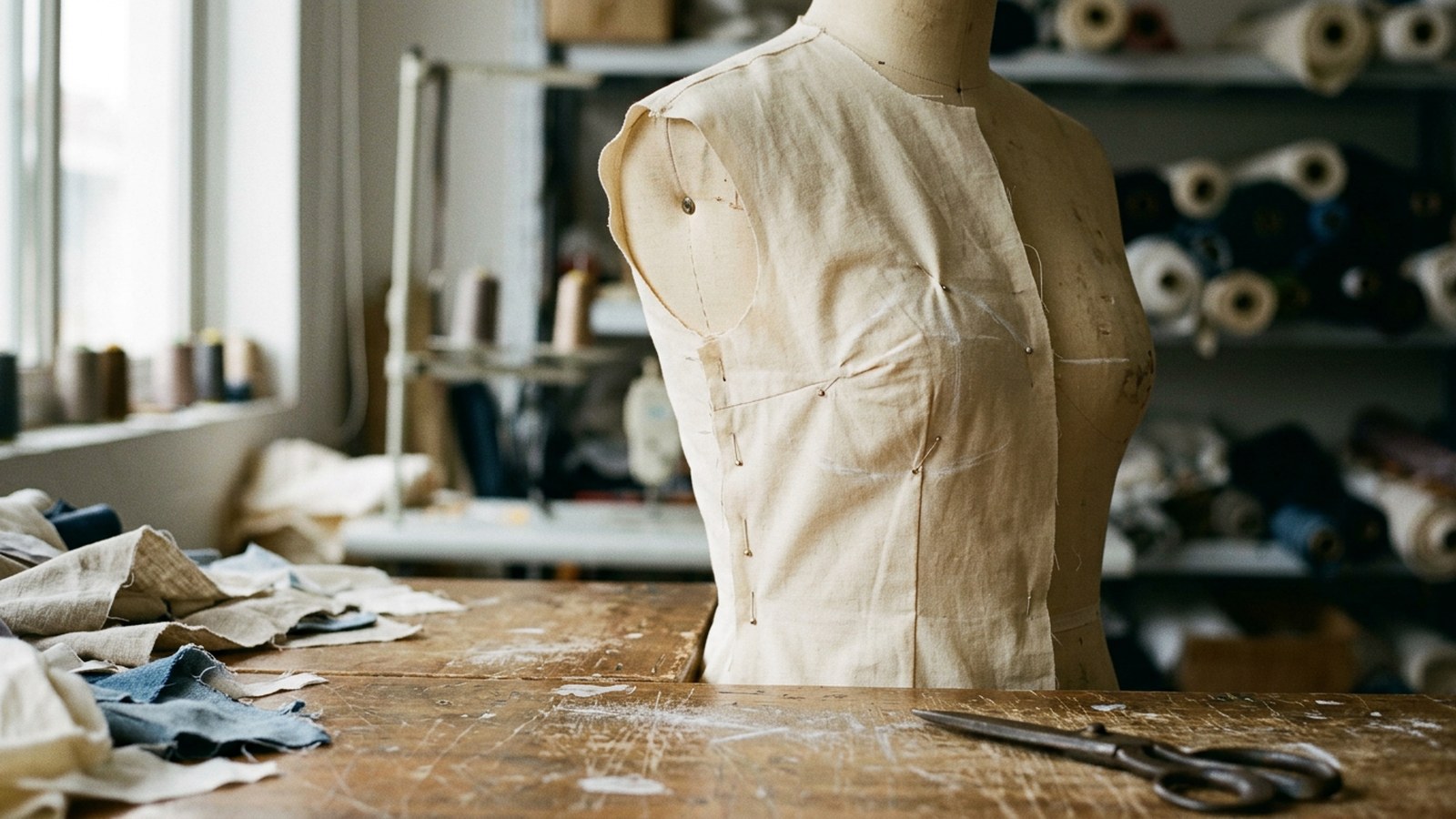
A clothing tech pack is the production-grade document that translates a founder's design intent into manufacturable specification — flat sketches, measurement points, fabric callouts, trim specs, construction notes, grade rules, and quality tolerances. Deepwove's in-house product development team — 4 pattern makers, 4 designers, 2 fabric sourcing specialists, all full-time in Hangzhou — develops samples from mood boards, sketches, or partial tech packs across 2-3 development iterations. Most premium womenswear founders don't arrive with a finished clothing tech pack on day one. This guide walks the 5-tier readiness ladder from mood-board-only inputs through finalized clothing tech pack, the production lead time implications at each tier, and which Deepwove service path each founder should brief.
What Is a Tech Pack? (And Why Factories Ask for One)
A tech pack is the production-grade document that translates a garment design into manufacturable specification. A tech pack tells a factory exactly what to cut, stitch, and grade — without the factory guessing the designer's intent. Premium womenswear factories ask for a tech pack because a tech pack removes interpretation from the sewing floor. Deepwove builds the tech pack as part of ODM development when a founder arrives without one.
Three terms get used interchangeably and shouldn't be. A tech pack is the document. Product development is the process that produces it — pattern drafting, sampling, fabric sourcing, fit correction. ODM is the arrangement under which Deepwove runs that process on the founder's behalf, ending with both the production and the tech pack she did not have at the start. A founder who understands the distinction stops asking "do I need a tech pack" and starts asking "do I need to make one, or will the manufacturer build it with me." The answer depends entirely on whether the factory does development or only execution.
A factory asks for a tech pack for one reason: a tech pack removes interpretation. An OEM-only operation sews to the document and nothing else, so the document has to be complete before a single piece is cut across the 100-piece run. There is no pattern team reading intent, no designer correcting a sleeve at the second sample. The tech pack is the entire brief. This is why an OEM-only factory will turn away a founder holding a mood board — not because the work is beneath it, but because the work it does begins after the specification is locked.
How to Make a Tech Pack — and Why a Deepwove Founder Usually Doesn't
The conventional path is to hire a freelance tech-pack designer who turns sketches and measurements into a formatted document, typically $400 to $2,000 per style depending on category complexity. That path is correct when the founder intends to manufacture with an OEM-only factory that refuses development work. It is the wrong path when the manufacturer is an ODM development partner, because the partner's pattern team builds the same document inside the engagement.
Deepwove's answer to "how to make a tech pack" is that most founders briefing Deepwove do not make one. The in-house pattern team — 4 pattern makers full-time in Hangzhou — drafts the pattern, cuts the sample, and documents the measurement points, grade rules, and construction notes as the work proceeds. The founder receives a finished tech pack at sample sign-off as a manufactured artifact, not a translated guess. Deepwove does not sell a tech pack template, and the reason is a position, not an oversight: a template makes development look like filling in blanks. It is not. A graded measurement set, a fabric callout that survives the mill, a construction note a sewer can actually follow — these are decisions made against real cloth, not fields in a form.
What Goes Into a Clothing Tech Pack
A clothing tech pack at the premium womenswear floor contains eight documented sections: flat sketches with front, back, and detail views; graded measurement points across the size range; fabric callouts with mill name, construction, weight, and finish; trim specifications covering buttons, zippers, labels, and hangtags; construction notes including stitch type, seam allowance, and finish requirements; fit grade rules for sample-to-production scaling; quality control tolerances at the AQL standard (premium womenswear inspects to AQL 2.5 minimum); and a bill of materials mapping each component to a supplier and unit cost. A complete clothing tech pack lets an OEM-only manufacturer sew exactly to specification without development input.
Deepwove's in-house pattern team — 4 pattern makers full-time in Hangzhou — develops the clothing tech pack as part of an ODM engagement when the founder arrives without one. The pattern maker who cuts the first sample is the same pattern maker who documents the measurement points, the grade rules, and the construction notes. The clothing tech pack the founder receives at sample sign-off is a manufactured artifact, not a translated spec from a designer who never touched the fabric. Premium DTC founders briefing Deepwove from mood-board-only inputs typically reach a finalized clothing tech pack across 2-3 development iterations within the 3-month custom development lead time from Hangzhou. For the operational rhythm of Deepwove's ODM development service, including sample iteration cadence and pattern-to-production hand-off, see the dedicated service page.
A Tech Pack Example: What the Eight Sections Look Like
A tech pack example is easiest to read against a single garment. Take a midi dress: each of the eight documented sections holds one category of decision the factory cannot make on its own. A tech pack example shows that the document is not paperwork — it is the founder's intent, made executable across every piece in the run. Deepwove builds this example as the deliverable of ODM development, section by section, against a real sample.
Here is what the eight sections carry for one dress — a self-belted midi in a mid-weight crepe — when Deepwove documents the tech pack at sample sign-off:
- Flat sketches. Front, back, and detail views of the dress — the belt loop placement, the neckline finish, the hem depth — drawn to proportion, not to scale, so the pattern team and the sewer read the same silhouette.
- Graded measurement points. The point-of-measure list — bust, waist, hip, sleeve, length, and the dress-specific points like belt width and skirt sweep — graded across the size range so a size 10 and a size 16 hold the same line.
- Fabric callout. The mid-weight crepe named by mill, construction, weight, and finish — specific enough that a substitution is a decision, not an accident.
- Trim specifications. The belt buckle or D-ring, the invisible side zip, the woven brand label, the care label, the hangtag — each by supplier reference, not "a zipper."
- Construction notes. Stitch type at each seam, seam allowance, the finish on the inside of an unlined skirt, how the belt loops attach — the instructions a sewer follows without asking.
- Fit grade rules. How the approved sample scales up and down so the fit the founder signed off on survives the full size run.
- Quality control tolerances. The inspection standard the bulk is checked against — premium womenswear inspects to AQL 2.5 minimum, with tighter grades available on request.
- Bill of materials. Every component — shell, lining if any, thread, trims, labels, packaging — mapped to a supplier, so the per-unit cost is built from real lines, not an estimate.
The colour names, the trim references, and the mill specifics in a real tech pack are filled against the founder's actual sample, not a fixed list — which is exactly why a finished tech pack is a deliverable of development, not an input a founder is expected to bring. A tech pack example that reads cleanly off a single dress is the document Deepwove hands a Tier 1 founder at the end of the 3-month custom development arc, the same document a Tier 5 founder arrives already holding.
A founder asked me last month whether she needed a tech pack before she could talk to a manufacturer. She had two reference garments, a stack of sketches, and a fabric mill she'd found on Instagram. She was three days from paying $1,200 to a freelance tech-pack designer because someone on Reddit told her every factory required one.
She didn't need the tech pack. She needed someone to read what she already had and tell her where it sat on the readiness ladder. This guide is that conversation, written down.
A founder's tech-pack readiness sits on a five-tier ladder, from mood board to finalized specification. Each tier maps to a different Deepwove service path: ODM, OEM, Ready Styles, or Private Label. Custom development from a mood board runs 3 months production lead time at Deepwove, ending with goods packed for ship-out from Hangzhou. OEM production from a finalized tech pack with fabric on hand runs 3-4 weeks. The 100-piece minimum applies across all four service lines. Deepwove operates an in-house product development team of 4 pattern makers, 4 designers, and 2 fabric sourcing specialists inside a manufacturing group of 30+ specialized factories — 25 woven, 6 knit, and 3 specialty workshops.
The short answer: it depends on what you have, not on what factories require
OEM execution requires a finalized tech pack: the manufacturer sews exactly to a 100-piece specification with no design work. ODM development at Deepwove translates a mood board into specification across 2-3 sample iterations before sewing. Deepwove accepts both inputs at the 100-piece floor. The right answer depends on which artifact the founder already holds — a 5-tier readiness ladder maps each input to a service path.
The question "do I need a tech pack" assumes there is one industry-wide answer. There isn't. There are two different services on either side of the question, and a founder's current readiness decides which one fits her work.
If the founder hands a manufacturer a complete tech pack — tech drawing, BOM, grading rules, point-of-measure list, QA spec, packing instructions — the manufacturer's job is execution. This is OEM execution against a finalized tech pack. The factory's pattern team checks the spec, prepares samples to confirm interpretation, and runs production against the document. There is no design work, because the design work has already been done. Production runs 3-4 weeks once fabric is confirmed.
If the founder hands a manufacturer a mood board, three reference garments, and a fabric direction, the manufacturer's job is development. This is ODM. The pattern team reads the brief, sources or recommends fabric, drafts the pattern, makes samples, iterates against the founder's feedback, and builds the specification on the way. The finished work includes both the production and the document the founder did not have at the start. With Deepwove as the ODM development partner, custom development runs 3 months production lead time, with sampling and fabric work consuming weeks 1-6 and production consuming weeks 6-12.
A founder who arrives without a tech pack is not unprepared. She is asking for a different service. The honest mistake — the one that costs $1,200 and three weeks — is paying a freelance tech-pack designer to translate a mood board into specification before contacting any manufacturer at all. The translation work is what an ODM development partner does inside the engagement. Paying twice is the unforced error.
The five-tier readiness ladder
A founder can self-diagnose her tech-pack readiness in 30 seconds against five tiers. Each tier maps to a different Deepwove service path with a different production lead time. Tier 1 founders arrive with mood boards. Tier 5 founders arrive with finalized tech packs. The five service routes carry the same 100-piece minimum.
Below is the ladder. Read it as a self-assessment. The right column is the Deepwove service line that fits.
Tier 1 — Mood board only. The founder has visual references, a brand identity direction, perhaps a fabric instinct ("I want it to feel like a lived-in linen, not a crisp linen"), and no specifications. There is no sketch, no measurement, no construction note. Tier 1 routes to ODM. The Deepwove design and pattern team translates the mood into a sketch, a specification, a fabric direction, and a sample. Sample fee: $250-$350 per style. Most styles reach approved sample in 2-3 development iterations. Production lead time runs 3 months from approved brief to goods packed for ship-out. Tier 1 founders willing to start from a catalogue silhouette can also consider Ready Styles selections for a faster first capsule.
Tier 2 — Sketches plus reference garments. The founder has flat sketches and one or two physical reference garments she can ship in or describe in detail. She knows the silhouette, the rough proportion, and the construction she's pointing at. She does not have measurements, BOM, or grading. Tier 2 also routes to ODM. The reference garments compress the sample iteration count — first-round approvals are common when the founder's reference is precise. Production lead time: 3 months.
Tier 3 — Spec sheet without full tech pack. The founder has measurements, a fabric callout, and basic construction notes. She does not have grading rules, point-of-measure list, or QA spec. Tier 3 routes to ODM-light or OEM with development support. Deepwove's pattern team completes the missing artifacts as part of the engagement. Sampling time may compress by a week relative to Tier 1 or 2. Production lead time: 3 months.
Tier 4 — Partial tech pack. The founder has a tech drawing, BOM, and most of the spec, but is missing one or more of: grading rules, point-of-measure tolerances, QA inspection criteria, packing requirements. Tier 4 routes to OEM with revision cycle. Deepwove flags the gaps, proposes the missing pieces for the founder's approval, and proceeds. Production lead time: 4-6 weeks once fabric is confirmed and gaps are closed.
Tier 5 — Finalized tech pack. The founder has a complete document — tech drawing, BOM, grading, point-of-measure, QA spec, packing — produced in the format the factory floor reads against. Tier 5 routes to OEM straight execution. Deepwove's pattern team confirms readability, prepares the pre-production sample, and runs the order. Production lead time: 3-4 weeks once fabric is confirmed.
The honest boundary: what Deepwove does not do
Deepwove does not write standalone tech packs for founders intending to manufacture elsewhere. Tech-pack development inside Deepwove sits inside the production engagement at the 100-piece floor. Founders shopping for a tech-pack-only deliverable should hire a freelance tech-pack designer in the $400 to $2,000 range. Deepwove invests development time across the full 3-month production arc, not against an intermediate document.
This is the part of the answer that disqualifies some founders, and it should. If a founder's plan is to commission a tech pack from one party, then take that tech pack to a different factory for production, Deepwove is the wrong partner. The reason is not territorial. It is structural. Deepwove's pattern team is paid against the full development arc — fabric sourcing, sample iteration, production, reorder. The tech pack is one artifact in that arc, not a standalone product.
Founders looking for a tech-pack-only deliverable have good options elsewhere: independent tech-pack designers in the $400 to $2,000 range per style, depending on category complexity. The work is genuine and the deliverable is portable. A founder who knows she wants to manufacture in Vietnam, Portugal, or with a domestic small-batch operator should pay for a portable tech pack from a designer first, then take it to her chosen production house.
A founder who is willing to invest the development arc inside the relationship — meaning the pattern team that builds the spec is the same team that runs the production — fits the Deepwove model. The 100-piece floor and the 3-month production lead time on custom development are priced against that integration, not against piecewise transactions.
What changes when you have a tech pack: timeline, cost certainty, and risk
A finalized tech pack compresses Deepwove production lead time from 3 months to 3-4 weeks once fabric is confirmed. Tier 5 founders see cost certainty improve because the specification is locked across all 100 pieces before production begins. Tier 1 founders absorb 2 additional risks priced into the timeline: fabric sourcing variability and sample iteration variability. The 100-piece minimum is unchanged.
The math on tech-pack readiness is concrete. A founder arriving at Deepwove with a Tier 5 tech pack and fabric on hand sees production complete in 3-4 weeks. A founder arriving with a Tier 1 mood board and no fabric direction sees production complete in 3 months. The 8-to-9 week delta is real time, real cost, and real exposure to seasonal drop windows.
What the delta buys, in the founder's favor, is design surface. A Tier 5 founder is committing to a specification she has already validated. A Tier 1 founder is committing to a direction and trusting the development partner to surface the right specification along the way. For a brand built on aesthetic precision and willing to sit through 2-3 sample iterations, the development arc is the right purchase. For a brand reordering a proven silhouette, the OEM arc is.
Cost certainty also moves with the tier. OEM execution against a finalized tech pack quotes against a known specification — fabric, trim, labor, finishing — and the per-unit price holds across the run. ODM development quotes against a brief, with the per-unit price firming as fabric is locked and sample iterations close. Founders should not expect a hard per-unit number on Day 1 of an ODM engagement; they should expect a firm number by Week 3, when fabric is approved and the second sample lands.
How to brief Deepwove regardless of tier
A founder of any tier can brief Deepwove with the artifacts already in hand. Deepwove's response is a 48-hour proposal regardless of tier, with attainment at 100% across submitted briefs. The Deepwove proposal names the service path, the development cost, the production lead time against the 100-piece minimum, and the fabric strategy.
Whatever tier the founder occupies, the brief format Deepwove asks for is the same: what you have, what you want, and what you cannot move on. A Tier 1 founder sends mood-board imagery, a brand description, a quantity target, and a delivery window. A Tier 5 founder sends the tech pack, the fabric source or sample, a quantity target, and a delivery window. The proposal Deepwove returns within 48 hours states which service line the project falls into, the production lead time against the founder's delivery window, the development cost (sample fee for Tier 1-3, pre-production cost for Tier 4-5), and the fabric strategy — sourced by Deepwove, sourced by the founder, or fabric on hand.
The proposal is not a quote sight-unseen. It is a routing decision based on what the founder actually has. Founders are welcome to send a brief at any tier, and Deepwove's pattern lead reads each brief before the proposal is composed. There is no automated intake.
A note on what the founder should not do
A founder without a tech pack should not pay a freelance designer to manufacture one before contacting Deepwove for ODM. The translation work is part of the Deepwove ODM service across 2-3 sample iterations. The freelance tech pack adds $800 to $2,000 in cost and a handoff seam. Founders should pay for the freelance tech pack only when manufacturing outside Deepwove ODM.
The most common preventable error in this category is the founder who pays $800 to $2,000 for a freelance tech pack, hands the document to an ODM development partner, and discovers the partner's pattern team would have built the same document inside the engagement at no incremental fee. The freelance tech pack was not wasted — it does compress sampling by roughly one iteration — but the cost was double-counted.
The clean rule: pay for an external tech pack only when the manufacturer is OEM-only and refuses to do specification work. Deepwove is not in that category. If you have any doubt about whether your manufacturer does development, ask one question before paying a freelancer: "If I send you a mood board and reference garments, will you build the specification as part of the engagement?" For a deeper checklist, our guide on due-diligence questions to ask before sampling walks through what a real development house answers — and where a production-only operation deflects.
Where to go from here
If you've placed yourself on the ladder, the next step is a brief that matches the tier — not a tech pack, not a freelance translation layer, not more research.
Tier 1, Tier 2, or Tier 3 founders (mood board, sketches, partial spec) route to Deepwove ODM development. Send a mood board, sketches, or reference garments — whatever you actually have in hand. Add a brand description, a quantity target at or above 100 pieces, and a delivery window. Deepwove's pattern lead reads the brief and returns a proposal within 48 hours that names the service path, the sample fee, the production lead time, and the fabric strategy.
Tier 4 or Tier 5 founders (partial or finalized tech pack) route to Deepwove OEM execution. Send the tech pack, the fabric source or fabric on hand, a quantity target at or above 100 pieces, and a delivery window. The proposal returns within 48 hours with production lead time, pre-production sample cost, and gap-closure plan if the pack is partial. If you'd like the Deepwove Capability Lookbook before briefing — full catalog of past development work, factory profiles, and category specializations — request it from the contact form and it lands in your inbox within 24 hours.
The wrong move at any tier is paying a third party to translate the work twice. The right move is sending what you have to the team that will build the rest with you.
Frequently Asked Questions
What is a tech pack?
A tech pack is the production-grade document that translates a garment design into manufacturable specification — flat sketches, graded measurement points, fabric callouts, trim specs, construction notes, grade rules, quality tolerances at AQL 2.5 minimum, and a bill of materials. A complete tech pack lets an OEM-only factory sew to specification without development input. Deepwove's in-house pattern team — 4 pattern makers full-time in Hangzhou — builds the tech pack as part of ODM development when a founder arrives without one.
Do I need a clothing tech pack before working with a manufacturer?
A clothing tech pack is required for OEM-only manufacturers but not for ODM development partners. Deepwove operates as an ODM development partner from Hangzhou, accepting mood boards, sketches, or partial tech packs as the briefing baseline. Founders briefing Deepwove from mood-board-only inputs typically reach a finalized clothing tech pack across 2-3 development iterations within the 3-month custom development lead time. Deepwove's 100-piece minimum order quantity per style applies whether the brief arrives with or without a clothing tech pack.
Do I need a finished tech pack before contacting a manufacturer?
A finished tech pack is required for OEM-only manufacturers, where the factory sews exactly to specification. ODM development partners like Deepwove accept mood boards and reference garments, and build the specification as part of the engagement. Deepwove's 100-piece minimum applies to both routes.
What's the difference between ODM and OEM for a founder without a tech pack?
ODM is the right route when the founder lacks a tech pack. Deepwove's pattern team translates a mood board into pattern, sample, and specification across 2-3 iterations. OEM is the right route only when the founder has a complete tech pack and fabric in hand. Deepwove's production lead time differs: 3 months for custom ODM, 3-4 weeks for OEM execution once fabric is confirmed.
Can Deepwove make samples from a mood board?
Yes. Deepwove's in-house team — 4 pattern makers, 4 designers, 2 fabric sourcing specialists — develops samples from mood boards, sketches, or reference garments. The sample fee is $250-$350 per style. Most styles reach approved sample in 2 to 3 development iterations. Samples ship within one week when fabric is on hand.
How much does it add to the timeline if I don't have a tech pack?
Custom development at Deepwove runs 3 months production lead time from approved brief to goods packed for ship-out from Hangzhou. OEM execution against a finalized tech pack runs 3-4 weeks once fabric is confirmed. The delta is roughly 8 to 9 weeks of additional time, consumed by fabric sourcing and 2-3 sample iterations.
What does Deepwove charge for sample development?
Deepwove's sample fee is $250-$350 per style for ODM development. The fee covers pattern drafting and the first sample. Subsequent iterations during the 2-3 round development cycle are quoted with the production proposal. The 48-hour proposal SLA holds across all brief submissions.
Brand names referenced are trademarks of their respective owners. Deepwove is not affiliated with these brands. References describe a capability standard, not a current commercial relationship.