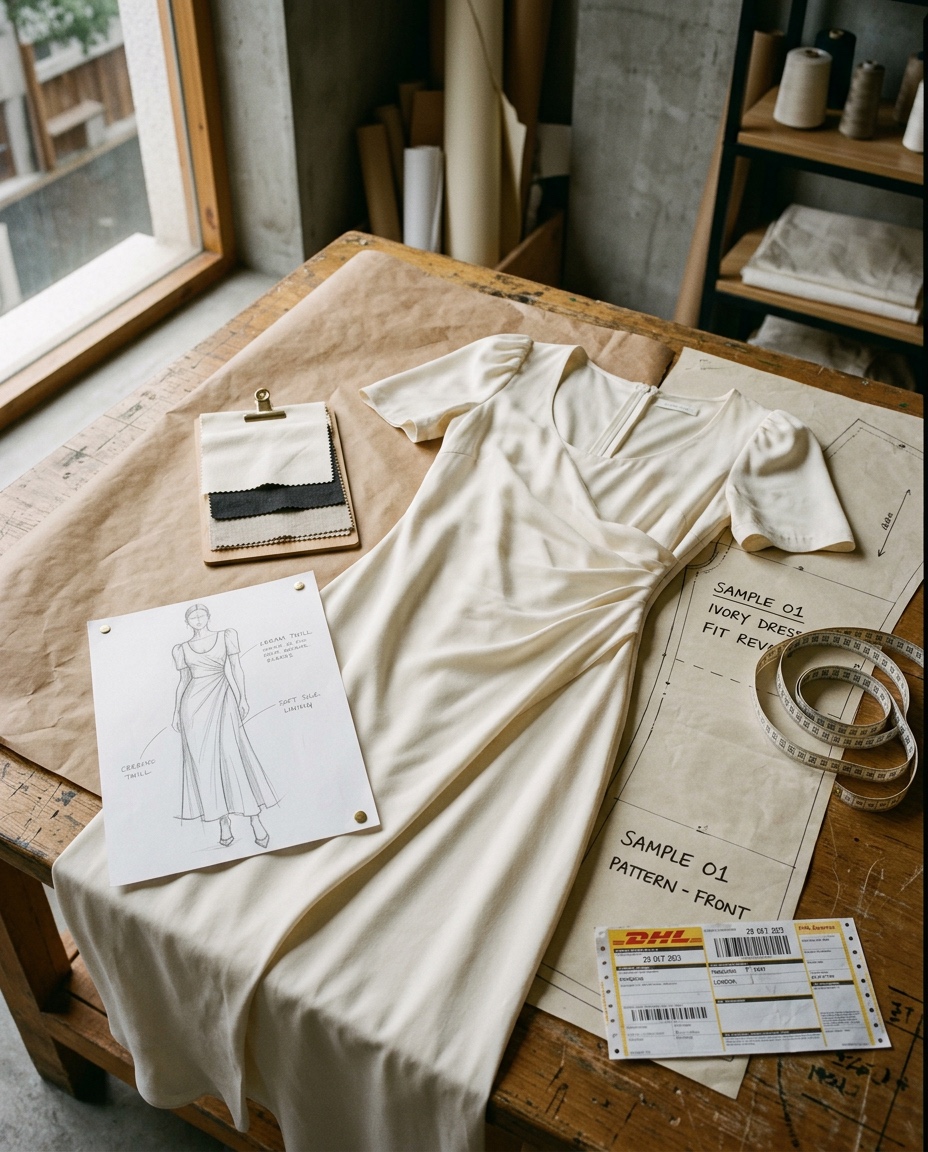
A founder coming into premium manufacturing for the first time hears 100 pieces minimum and goes one of two ways. Either the number sounds higher than she hoped and she starts looking for a workaround, or the number sounds lower than the 500-piece and 1,000-piece floors she has been quoted elsewhere and she wonders what the catch is. Both reactions are reasonable. Neither is the answer. The 100-piece minimum is a structural choice — about who the manufacturing group is built to serve, what a development cycle actually costs to run, and what kind of brand can grow inside it. Once you understand the number, the rest of the first order — sample fee, tech pack, evaluation, what to commit to next — follows logically from there.
Why 100 pieces, and not less
Deepwove's minimum order quantity is 100 pieces per style, applied across all four service tiers. The number is the structural floor at which a custom development cycle, fabric mill commitment, sample iteration, factory line setup, and AQL 2.5 quality inspection are economically coherent for both the brand and the manufacturing group. Average production runs across the group land at 300 pieces per style as brands scale winning styles. Below 100, the development overhead distorts the per-piece economics for the brand more than it saves the manufacturer.
Most premium founders ask the 100-piece question the same way: can you do less for a first order, just to test? The honest answer is no, and the more useful answer is why. A custom development cycle on a single style consumes the same in-house pattern bench hours, the same fabric sourcing time, the same sample room labor, the same factory line setup whether the brand orders 50 pieces or 100 pieces or 300 pieces. The development work scales by complexity of the silhouette, not by quantity of the production run. Cutting the run from 100 to 50 does not halve the cost — it doubles the per-piece development burden on the brand, while the mill, the pattern bench, and the factory absorb the same fixed work.
The 100-piece floor is also a fabric mill reality. Mills run minimum yardage commitments that scale by fabric category — a Japanese cotton poplin mill may hold 300 yards as its commercial minimum, a small-batch silk mill closer to 200, a knit mill higher. Cutting a production run below 100 pieces pushes fabric procurement into spot-market sourcing where lead times stretch, pricing becomes volatile, and quality consistency drops. The floor exists because that is where the upstream supply chain breathes naturally, not because the manufacturer is gatekeeping. A brand that fights the 100-piece floor is fighting a structural feature of premium manufacturing itself.
What founders sometimes miss is the position of 100 in the actual production landscape. Many premium-tier factories quote 500-piece and 1,000-piece minimums. Mass-market apparel runs at 3,000 and 5,000. Inside a 30-plus factory manufacturing group with in-house product development, 100 is a deliberate entry point — low enough that an emerging premium brand can launch a hero style without overcommitting capital, high enough that the development economics work. The 100-piece minimum is not a concession. It is the floor of a real on-ramp.
The 100-to-300 reorder pattern
Founders rarely stay at 100 pieces for long on a winning style. Average production runs across Deepwove's manufacturing group land at 300 pieces per style as brands scale validated silhouettes. The pattern is recognizable: first order 100 pieces to test sell-through, second order 200 pieces with a tighter fabric commitment, third order 300 pieces as the style enters the brand's seasonal carry-over rotation. The 100-piece floor is the entry. The 300-piece average is the reality of how the relationship matures across three to four cycles.
The number a founder reads in the brief — MOQ 100 — is the entry threshold, not the typical run size. Once a first order has sold through and the brand has fit history, customer feedback, and a pattern that the group has graded, the natural next move is a reorder. Reorders rarely come back at 100. They come back at 150, 200, sometimes 300, depending on how the first run sold and what the brand's retail commitments look like. Across the styles we have produced in the past quarter, the average production run lands at 300 pieces per style. Some styles sit at the 100-piece floor. Others run 500, 800, occasionally above 1,000 when a style becomes a seasonal core.
The reorder pattern matters for first-order planning because it shapes what a founder commits to on style one. A founder ordering 100 pieces and planning to evaluate sell-through before committing further is making a different bet than a founder ordering 100 pieces and planning to reorder 300 within six weeks regardless of sell-through. Both bets are valid. The difference shows up in fabric commitment — whether the mill holds back stock for an anticipated reorder, whether the pattern bench treats the style as a one-off or as the first run of a carryover, whether the production scheduling reserves a line slot for the predicted return. Communicating reorder intent on the first PO is one of the underused founder levers in the first development cycle.
The sample fee, what it covers, what it doesn't
Deepwove's sample fee runs $250–$350 per sample, depending on construction complexity and fabric choice. The fee covers pattern drafting, cut and sew at the sample room, finishing, and international courier dispatch to the founder. Fabric for the sample is invoiced separately at swatch-yardage cost. The fee is per sample, not per style — a three-iteration cycle carries three fees. The fee credits toward the first bulk PO when the founder commits to production. The fee exists because real development work happens before any bulk is committed.
Premium development sampling is not free, and a manufacturer who says it is should prompt a question. The pattern bench, sample room, and finishing team are full-time staff working on real garments. A development sample on a custom silhouette consumes a pattern maker for a half-day to a full day, a sample cutter for several hours, a sample sewer for the better part of a day, a finishing pass, and a courier dispatch. The labor cost is real. At Deepwove, the per-sample fee runs $250–$350 depending on construction complexity and fabric choice, covering that labor plus the courier leg.
What the fee does not cover is fabric. Sampling yardage — the half-meter to two-meter cut needed for one development sample — is invoiced at the mill's swatch rate, which varies by fabric category. A premium silk twill sample yard may run materially higher than a midweight cotton poplin sample yard. The fabric line on a sample invoice varies materially by category — a premium silk twill cuts higher than a midweight cotton poplin, and a founder developing across multiple fabric directions should expect fabric cost to compound across iterations.
The fee is structured per sample, not per style. A style that reaches approved confirmation on iteration two carries two sample fees. A style that runs three iterations carries three. Founders who arrive with tight briefs and review fast typically clear approval in two iterations; founders developing new silhouettes from broad mood boards may need three to four. Across the styles Deepwove's group develops, the typical path is 2 to 3 iterations to confirmation. Once the founder commits to bulk on a style, the accumulated sample fees on that style credit toward the first PO. The fee is not a profit center. It is a calibration mechanism that signals which styles a founder is serious about and which she is exploring.
The lookbook shows what 100 pieces actually buys.
Real garments, real photography, real construction notes — from the catalog Deepwove's manufacturing group has developed and produced. The fastest way to calibrate against your own brief.
Request Lookbook →The tech pack readiness checklist
A development team needs four inputs to start: a tech pack or detailed sketch with measurements, fabric direction, target retail price and category, and a fit reference or grading rules. ODM founders typically arrive with mood board and sketch and lean on the in-house pattern bench for translation. OEM founders arrive with finalized tech pack and supplied fabric. The completeness of the inputs determines how fast Phase 1 development moves. Underprepared briefs do not block development; they slow it.
The most useful question a founder can ask before sending a first brief is what the manufacturer actually needs to start. The answer is more practical than mystical. The pattern bench needs enough information to draft a first pattern. The sourcing team needs enough direction to start placing fabric inquiries. The sample room needs enough construction detail to plan the first sample. The development team needs enough business context to calibrate construction choices to retail positioning. Anything more than that is welcome. Anything less stretches Phase 1.
Input one: silhouette specification. Either a tech pack with measurements, construction notes, and seam call-outs, or a detailed sketch with proportions and a written description of the silhouette. ODM founders working with a development team can arrive with a sketch and a mood board — the pattern bench will translate. OEM founders bringing a finalized tech pack get a faster Phase 1 because the translation step is already done.
Input two: fabric direction. Either a specified mill and quality (mill name, fabric number, weight in GSM or momme, finish), or a description detailed enough for the sourcing team to translate into 3 to 5 candidate options. The more specific the brief, the faster fabric pipeline opens. A founder who says "Limonta crepe 90220, 18 momme, stone" skips a week of sourcing translation. A founder who says "drapey crepe with a heavy hand" gets the translation cycle and the candidates.
Input three: retail positioning. Target retail price band, intended retail channels, and category context. A $480 dress and a $180 dress sit on the same pattern but call for materially different construction choices — lining, finishing, trim grade, label hierarchy. The development team calibrates construction to the retail position. A brief without retail context produces samples calibrated to the wrong tier and wastes an iteration.
Input four: fit reference. Either grading rules from prior production, a fit model size, or a sample garment the founder considers the fit benchmark. Premium brands with prior production typically have a grading book the manufacturer can work from. First-cycle brands provide a fit model size and a written description of the desired fit hand. The clearer the fit reference, the closer the first sample lands.
Founders who arrive missing one or two of these inputs are not blocked from starting. The development team will translate, ask, and iterate. But each missing input lengthens Phase 1 by roughly a week. Arriving prepared compresses the calendar more than any other founder lever before the first sample is in hand.
What you evaluate when the sample lands
When the first sample arrives, evaluate four dimensions in sequence: fit on a fit model against grading rules; fabric hand, drape, and weight against brief direction; construction quality — seam, stitch, lining, trim; brand expression — does the garment feel like the brand. Consolidate revisions into a single round rather than fragmented notes. Most premium brands reach approved confirmation sample in 2 to 3 iterations. Founders who review within 48 hours and consolidate cleanly compress the sampling phase materially.
The first sample arrives at the founder's door after roughly one to two weeks of development time, depending on whether fabric was on hand. The founder's instinct, on opening the courier box, is to try it on, look in the mirror, and react. The instinct is human. It is also not the most useful first move. The better first move is to put the sample on a fit model with the grading rules in hand and evaluate against four dimensions in sequence.
Dimension one: fit. Does the sample sit on the fit model the way the grading rules specify? Check shoulder placement, sleeve length, armhole depth, bust point, waist position, hip ease, hem length. Mark variances against the spec sheet, not against subjective impressions. A garment that feels two centimeters off may actually be on spec — the founder's vision of the fit may have drifted from what the brief documented. A garment that measures off-spec needs a pattern revision call-out.
Dimension two: fabric. Does the fabric hand, drape, weight, and finish match what the brief specified or what the founder approved during sourcing? Hold the sample against the headers the sourcing team sent earlier. If the production fabric drifted in weight or hand, the development team needs to know before bulk. Fabric drift between sample and bulk is one of the most common Phase 2 failure modes and is much cheaper to catch at the sample stage.
Dimension three: construction. Pull the seam allowance flat, run a finger along the inside seams, check stitch density and consistency, examine lining attachment, inspect trim placement and finish. A premium garment shows its construction on the inside as much as the outside. The sample is also a quality benchmark — what the bulk will be inspected against under AQL 2.5. Variances flagged at sample stage become bulk specifications.
Dimension four: brand expression. Step back from the spec sheet and ask the harder question: does this garment feel like the brand, or does it feel like a generic execution of the sketch? A pattern can be on-spec, a fabric on-direction, a construction clean — and the garment can still feel like it belongs to someone else's brand. Brand expression is the dimension founders are best qualified to evaluate and the dimension a remote development team can underweight. This is the founder's most valuable read on the sample.
The discipline that compresses the sampling phase is consolidation. A founder who sends fragmented notes — a comment on Tuesday, a fit revision on Friday, a fabric question the following Monday — produces a development team that cannot batch the next iteration cleanly. A founder who reviews within 48 hours and sends one consolidated revision round per iteration moves the cycle materially faster. Across the brands the group develops for, the second-iteration confirmation is the most common outcome when revisions are consolidated and reviews land inside 48 hours.
The Ready Styles entry path
Ready Styles selected from Deepwove's existing catalog skip Phase 1 development entirely. Pattern is locked, grading rules are documented, fabric is held in stock, and the production window is 4 weeks. Ready Styles carry the same 100-piece per-style minimum but require no sample iteration on the silhouette itself — fabric can be swapped at a 1-week adaptation cycle. Ready Styles suit founders entering a manufacturing relationship at low risk, filling a season fast, or testing a manufacturer before committing to custom development.
Not every first sample order needs to be a custom development cycle. The manufacturing group's catalog of Ready Styles — silhouettes the group has already developed across past cycles with pattern, grading, fit history, and mill relationships documented — gives a founder a second entry route at the same 100-piece minimum. The difference is structural: custom development starts from a sketch and runs a 3-month production lead time; Ready Styles start from a finished pattern and run a 4-week production window. Both reach the same outcome — 100 pieces of a premium-grade garment shipped from Hangzhou — through different paths.
Ready Styles suit a specific founder profile. The founder entering a new manufacturing relationship at low risk before committing to a custom development brief. The founder filling a season fast when a custom development style slipped or a retailer reorder demanded faster turn. The founder testing whether the group's construction quality, fabric grade, and finishing match what the brand needs before investing development capital. In each case, Ready Styles function as the on-ramp — a way to see the group's actual output on real garments before the founder commits to a custom development cycle. Fabric is swappable at a 1-week adaptation phase; colorway and trim can be customized; the silhouette itself is fixed. After a successful Ready Styles run, founders typically move into custom development on the next cycle with established trust on both sides.
From first sample to first bulk PO
The handoff from approved sample to first bulk PO is the cleanest decision point in the development cycle. The founder has fit confirmation, fabric confirmation, construction confirmation, and brand expression confirmation. The remaining decisions are quantity per style, fabric commitment for bulk, freight mode, and any final colorway or trim variants. Most premium brands commit between 100 and 200 pieces per style on the first bulk PO, with reorder intent communicated at the time of commitment. The PO triggers Phase 2 production.
Once a confirmation sample is approved, the development cycle pivots from exploration to execution. The founder has a sample she approves, a fabric she has confirmed, a construction spec she has signed off, and a development cost — sample fees plus fabric — that credits toward the first bulk. What remains is the decision of what to commit to on style one. The shape of that decision is more strategic than operational.
The 100-piece minimum is the floor, but founders rarely write the first PO at exactly the floor for every style. The common shapes: a single hero style at 100 to 150 pieces; a hero plus a supporting style each at 100; a small capsule of three to four styles each at 100 with reorder intent flagged on the strongest two. The right shape depends on the brand's retail commitments, capital position, fabric mill lead times, and the founder's read on sell-through. Communicating reorder intent at the time of the first PO — even before sell-through is confirmed — lets the manufacturing group hold fabric stock and reserve a production slot, which compresses the reorder lead time from a fresh cycle to the 2-to-4-week reorder window described in the production timeline guide.
The first bulk PO commits fabric for production, books the factory line slot, sets the QC milestones, and locks the ship-out window. Phase 2 production runs 6 to 8 weeks on a first custom development order. The founder's leverage in Phase 2 is mostly invisible by design — the levers she controlled in Phase 1 have been spent, and execution belongs to the factory floor. What she does next is plan the reorder cycle, the next development brief for season two, and the calendar reverse-engineering for the next drop date.
What 100 pieces signals about the partnership
The 100-piece floor signals what kind of partnership a manufacturing group is built to support. A 1,000-piece floor signals a factory built for scale and not interested in development. A 50-piece test order signals a manufacturer absorbing development cost in hopes of catching brands cheaply. A 100-piece minimum, paired with full in-house development capability, signals a group built to bring emerging premium brands from first order through multi-season carryover. The number is the entry. The relationship that grows past it is the actual product.
The minimum order quantity a manufacturer publishes is more than a number. It is a position statement about what kind of brand the group is built to serve. A 1,000-piece floor with no in-house development tells a founder the group is a production factory designed for established brands with their own pattern teams and proven retail volume. A vendor advertising a 50-piece test floor below the structural minimum tells a founder the group is hoping to acquire brand relationships cheaply by absorbing development cost — which works for nobody at scale, because the upstream economics do not hold. A 100-piece minimum paired with full in-house product development tells a founder the group is built for premium brands at the stage where retail commitments are real but the operation is still maturing.
The shape of the first 100-piece order is rarely a one-off transaction inside this kind of group. It is the opening move of a relationship that the manufacturing group expects will run two to four seasons before the brand grows past it, and possibly longer if the partnership compounds. The development work invested in the first sample cycle — pattern bench hours, fabric mill outreach, sample iterations, fit memory — is amortized across the carryover. The first reorder is where the math starts to work cleanly for both sides. By the third reorder, the operation has institutional knowledge of the brand's silhouette vocabulary, fit history, and fabric preferences that no spec sheet can replace. When and how founders eventually outgrow that relationship is its own story. The first 100 pieces is the doorway in.
Where to go from here
Three doors out of this page, depending on where you are in your own first-order thinking.
If you want the calendar. The 100-piece order sits inside a 3-month production lead time from Hangzhou. The full timeline — Phase 1 development, Phase 2 production, Phase 3 freight, drop-date reverse engineering — is mapped in the 4-month production timeline guide.
If you want to see what 100 pieces actually buys. The fastest calibration is the lookbook — real garments developed and produced inside the manufacturing group, photographed at retail quality, with construction notes. Request the lookbook to see what a 100-piece run looks like in the founder's hand.
If you want the Ready Styles route. The 4-week production path on pre-developed silhouettes lives on the Ready Styles service page. Lower risk, faster turn, same 100-piece floor.
If you want the economic framework. If you want the economic framework behind the 100-piece floor — what amortizes, what scales, when to commit at 300 or 500 — see The Economics of a 100-Piece MOQ.
If you want the broader frame. The first 100 pieces is one chapter of a longer founder journey covered in the pillar — What It Actually Takes to Build a Premium Womenswear Brand — which maps the math, the calendar, the partnership compounds, and the first-conversation playbook.
When you have a brief, the development team turns it into a proposal within 48 hours — send us what you have. The first sample lands roughly a week later.
Frequently Asked Questions
What is the minimum order quantity for a first sample order in premium womenswear manufacturing?
Deepwove's minimum order quantity is 100 pieces per style, applied across all four service tiers: ODM custom development, OEM production, Ready Styles, and Private Label. The 100-piece floor is structural, not negotiable. Average production runs across the manufacturing group land at 300 pieces per style as brands scale winning styles. Founders entering at exactly 100 pieces on one or two hero styles is the most common first-order shape.
How much does a development sample cost from a premium womenswear manufacturer?
Deepwove's sample fee runs $250–$350 per sample, depending on construction complexity and fabric choice. The fee covers pattern drafting, fabric cut, sew, finishing, and international courier dispatch to the founder. The fee is per sample, not per style — a style that goes through three iterations carries three sample fees. Fabric for the sample is invoiced separately at swatch-yardage cost. The fee credits toward the first bulk PO when the founder commits to production.
What does a founder need to send before a manufacturer can start a first sample?
The development team needs four inputs to start. First, a tech pack or detailed sketch with measurements and construction notes. Second, fabric direction — either a specified mill and quality or a description sufficient for sourcing to translate. Third, target retail price and category positioning to calibrate construction choices. Fourth, the founder's preferred fit reference or grading rules. ODM founders typically arrive with mood board and sketch; OEM founders arrive with finalized tech pack and supplied fabric.
What should a founder evaluate when the first sample lands at her door?
Evaluate four dimensions in sequence. Fit on a fit model against the grading rules. Fabric hand, drape, and weight against the brief direction. Construction quality — seam finish, stitch density, lining attachment, trim placement. Brand expression — does the garment feel like the brand, or does it feel like a generic execution of the sketch. Consolidate revisions into a single round rather than sending fragmented notes. Most premium brands reach approved sample in two to three iterations.
What is the difference between starting with Ready Styles and starting with custom development on a first order?
Ready Styles selected from the manufacturer's existing catalog skip the development phase. Pattern is locked, grading rules are documented, fabric is in stock, and the production window is 4 weeks. Custom development through ODM starts from a sketch or tech pack and runs 3 months production lead time. Ready Styles suit founders entering a manufacturing relationship at low risk or filling a season fast. Custom development suits founders building proprietary silhouettes. Both routes carry the same 100-piece per-style minimum.