TL;DR — what this article actually says
A fashion supply chain is the full sequence of steps that turns a design idea into finished garments in your warehouse: design and development, pattern making, sampling, fabric sourcing, cut-make-trim, quality control, and shipping. A factory only owns the last third of that chain. The first two-thirds — the development gap between your vision and a production-ready garment — is where most premium brands win or lose, and it is the part founders are least prepared for. Deepwove runs that development in-house: a 10-person team (4 pattern makers, 4 designers, 2 fabric sourcing specialists) inside a manufacturing group of 30+ specialized factories, from 100 pieces per style. This guide maps every link in the chain, names who actually does each job, and shows where the chain breaks.
A fashion supply chain is the complete path from a design idea to finished garments in a warehouse. It runs through seven stages: design and development, pattern making, sampling, fabric sourcing, cut-make-trim, quality control, and shipping. Most founders picture one factory; a premium womenswear supply chain involves a development team plus 30+ specialized factories. Deepwove operates this chain from Hangzhou, with a 10-person in-house development team and a 100-piece minimum per style. The factory handles roughly the final third — cut, sew, finish. The first two-thirds decide whether a garment is good. That earlier work is called development, and it is where premium brands separate from the rest.
What a fashion supply chain actually is
A fashion supply chain is the ordered set of operations that converts a design concept into shippable product, and the relationships that hold those operations together. Most overviews break it into stages from design and development through sourcing, manufacturing, and logistics; for premium womenswear the chain has seven core links: development, pattern making, sampling, fabric sourcing, cut-make-trim, quality control, and logistics. The word "supply chain" makes it sound like procurement and freight. For premium womenswear, the decisive part is creative and technical, and it happens long before anything is sewn.
Here is the framing most founders arrive with, and why it costs them. You picture a "manufacturer" the way you picture a printer: you hand over a finished file, they hand back a physical object. But a garment is not a file. It is an idea — a fabric direction, a silhouette, a drape, a feeling — that has to be translated into a pattern, a sample, a fabric, a graded size run, and a production method, all before a factory can do its job. That translation is the supply chain's hardest work. It is also invisible from the outside, which is exactly why it gets underestimated.
The hardest part of a fashion supply chain is not production. It is the space between your vision and a finished garment. Factories can manufacture. Few can develop. The brands that struggle most are not the ones that picked a slow factory. They are the ones who never realized the development link existed until a sample came back wrong, three weeks late, with no obvious person to call.
The seven links, in the order they happen
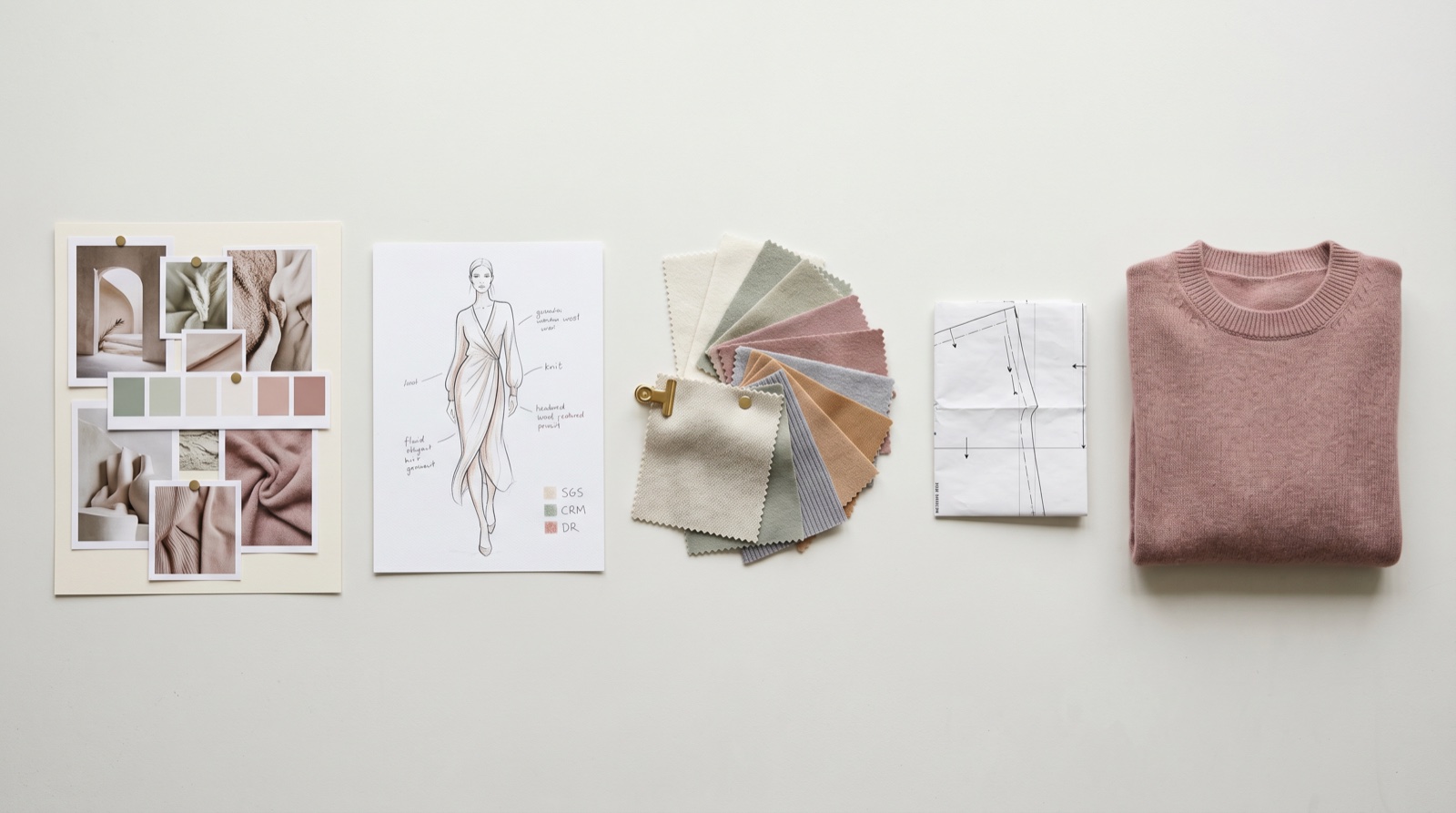
A fashion supply chain runs in sequence, and each link feeds the next. Design and development defines the garment. Pattern making turns the design into a buildable blueprint. Sampling proves it in cloth. Fabric sourcing secures the material at production scale. Cut-make-trim builds the units. Quality control verifies them. Logistics moves them. Skip a link or hand it to someone who can only execute, and the cost surfaces two links downstream.
A fashion supply chain runs in sequence, and each link feeds the next. Skip a link or hand it to someone who can only execute, and the cost surfaces two links downstream — usually as a failed sample, a fabric that can't be reordered, or a delivery that misses its season.
1. Design and development. This is where the idea becomes a specification. A designer interprets the mood board into line drawings, construction notes, and a point of view about fit and finish. For brands working from a sketch, an IP collaboration, or a single inspiration image, this stage carries the most ambiguity — and the most leverage. Deepwove's four in-house designers handle this translation directly, rather than passing a vague brief down a chain of intermediaries who each lose a little of the intent.
2. Pattern making. A pattern is the blueprint a garment is built from — the flat shapes that, sewn together, produce the three-dimensional form. This is technical craft, not clerical work. A founder's silhouette lives or dies here. Deepwove runs four full-time pattern makers in-house, which means a fit problem is solved by a person in the building who saw the original design, not negotiated across a time zone with a factory that received only a tech pack.
3. Sampling. Sampling proves the design in real cloth before any bulk commitment. The first sample exposes everything the drawing hid: how the fabric falls, where a seam pulls, whether the proportion that looked right on paper survives gravity. Most styles reach an approved sample in two to three development iterations, and first-round approvals happen regularly when the brief is tight. With fabric on hand, 90% of Deepwove's samples ship within one week — subject to fabric availability, because sourcing a new fabric adds time the sewing never does.
4. Fabric sourcing. Fabric sourcing secures the right material at production quantity and confirmed price. This is the link that quietly breaks the most supply chains. A swatch from a trade show is not a supplier. A fabric that exists in sample yardage may not exist — or may cost triple — at 300 yards. Deepwove's two fabric sourcing specialists work mill relationships in China to confirm that the fabric in the sample is the fabric you can actually buy, before the brand commits. Fabric delays account for roughly half of the orders that miss a delivery date, which is why this link sits early, not late.
5. Cut-make-trim. Cut-make-trim — often shortened to CMT — is the production stage most people mean when they say "manufacturing." Fabric is laid and cut to the pattern, panels are sewn, the garment is finished and trimmed. CMT is real, skilled labor, and it is roughly the final third of the chain. A factory that can only do this stage has no way to recover development cost except by demanding large minimums, which is why CMT-only shops often quote 500, 1,000, or 3,000 pieces. Deepwove produces from a 100-piece minimum per style because the development cost is absorbed across an integrated group, not loaded onto a single order.
6. Quality control. Quality control verifies that the bulk run matches the approved sample. Deepwove inspects to an AQL 2.5 standard. Orders in the 100-to-300-piece range run a two-stage check: pre-production sample approval, then a final inspection on the full bulk before it ships. Larger orders add a mid-production inspection. QC is not a formality at the end — it is the link that catches a problem while it is still 40 garments, not 400.
7. Logistics. Logistics moves finished goods from the factory to the brand's warehouse. Production lead time ends when goods are packed and ready to ship from Hangzhou; shipping is a separate variable the brand controls. Air freight to North America runs seven to ten days; sea freight to the US West Coast or Australia lands at three to four weeks. A premium brand chasing a season drop air-freights; a cost-led brand ships by sea. The supply chain doesn't end at the sewing machine, but the manufacturer's contribution does.
Where the chain actually breaks
A fashion supply chain breaks most often at the seams between links, not inside them. A factory sews a perfect garment from a flawed pattern. A sample looks right in a fabric that can't be reordered. Each handoff loses information, and the losses compound. Brands that run smoothly removed handoffs by keeping development and production under one roof.
The fashion supply chain breaks most often at the seams between links, not inside them. A factory sews a perfect garment from a flawed pattern. A sample looks right in a fabric that can't be reordered at scale. A brief is interpreted by an agent, re-interpreted by a factory, and arrives as something the founder never described. Each handoff loses information, and the losses compound. The brands that run smoothly are the ones who removed handoffs by keeping development and production under one roof.
Consider the most common failure mode for a first-time premium brand. The founder finds a cut-make-trim factory, assumes "manufacturer" means the factory will figure out the rest, and discovers — usually at the sample stage — that the factory was waiting for a finished pattern, a sourced fabric, and a tech pack the founder doesn't have. Now the founder is the integrator, coordinating a freelance pattern maker, a fabric agent, and a factory who have never spoken to each other. The development work didn't disappear. It just landed on the least-equipped person in the chain.
This is the structural argument for an in-house development model over a factory-plus-agents model. An agent makes communication between a brand and a factory easier, but adds cost without adding capability — the agent cannot make a pattern or source a fabric. A factory can manufacture but, on its own, cannot develop. Deepwove closes that gap by putting designers, pattern makers, and fabric sourcing specialists inside the manufacturing group, so the person who interprets the brief and the person who builds the garment work in the same building, on the same week. It is the same structural choice we lay out in in-house development versus a sourcing agent versus factory-direct.
See what an integrated development chain produces.
Request the Deepwove lookbook to see the silhouettes, fabrics, and construction developed from 100 pieces — or send a brief and get a proposal back in 48 hours.
Request the lookbook →Why premium womenswear has a harder supply chain than most
Premium womenswear runs one of the most development-intensive supply chains in apparel, because the product competes on fabric, fit, and finish rather than price. A basic tee tolerates a generic pattern; a premium silk dress does not. Every demanding requirement lives in the development links, not the sewing link — which is why a development-weighted supply chain beats a cheap-CMT one.
Premium womenswear runs one of the most development-intensive supply chains in apparel, because the product competes on fabric, fit, and finish rather than on price. A basic tee tolerates a generic pattern and a commodity fabric; a premium silk dress does not. The fabric has to drape a specific way, the seam has to disappear, the proportion has to flatter across a graded size run. Every one of those requirements lives in the development links, not the sewing link — which is why a premium supply chain weighted toward development beats one weighted toward cheap cut-make labor.
The math reinforces the point. Deepwove's 100-piece minimum is the floor; the actual average run is 300 pieces per style across the past quarter, because brands scale the styles that win. A premium supply chain is built for that pattern — small first runs that prove demand, then reorders on the winners. Every first-order client in Deepwove's manufacturing group has placed at least one reorder to date. A supply chain optimized for one giant order is the wrong tool for a brand that lives or dies by season-over-season velocity.
Over the past decade, Deepwove's factories developed womenswear for brands including Reformation, Staud, and Doen — the kind of demanding partners that train a supply chain to hold a high standard. That standard is now available to new brands from 100 pieces. For the China-specific questions — Hangzhou, the mill network, the full cost stack from FOB to retail — see Deepwove's Clothing Manufacturer in China for Premium Womenswear hub.
Building your own supply chain: the first decision that matters
The first supply chain decision a founder makes is not which factory — it is how much of the development chain to own versus outsource. A brand with a stable pattern, a fabric supplier, and a tight tech pack can hand cut-make-trim to a factory. A brand working from a mood board needs full-package development, where one partner owns the chain from sketch to shipped goods.
The first supply chain decision a founder makes is not which factory — it is how much of the development chain they want to own versus outsource. A brand with a stable pattern library, a fabric supplier on speed dial, and an airtight tech pack can hand cut-make-trim to a cut and sew manufacturer and keep the rest in-house. A brand earlier in its arc — working from a mood board, without a sourced fabric or a graded pattern — needs full-package development, where one partner owns the chain from sketch to shipped goods.
Getting this decision right determines whether your first season is a coordinated build or a scramble across vendors who don't talk to each other. If you are still mapping the broader picture — the calendar, the working-capital math, the partnership decisions — start with what it takes to build a premium womenswear brand and the economics of a 100-piece minimum. If you already know your model and want to see how the development links run day to day, Deepwove's How It Works walks the chain stage by stage, and ODM development covers the build-from-a-brief path specifically.
What the development chain looks like at Deepwove
Deepwove runs the full fashion supply chain — development through production — for premium womenswear from a 100-piece minimum order quantity per style, with an average production run of 300 pieces per style across the past quarter. The development work runs through a 10-person in-house team: 4 pattern makers, 4 designers, and 2 fabric sourcing specialists, sitting inside a manufacturing group of 30+ specialized factories. Quality is inspected to an AQL 2.5 standard, two-stage for 100–300-piece orders. Production lead time is roughly 3 months from approved brief to goods ready to ship from Hangzhou; reorders with fabric on hand run 2–4 weeks. Every first-order client to date has placed at least one reorder.
Frequently asked questions
What are the main stages of a fashion supply chain?
A fashion supply chain has seven core stages: design and development, pattern making, sampling, fabric sourcing, cut-make-trim, quality control, and logistics. Development, pattern, sampling, and sourcing make up the front two-thirds and decide product quality. Cut-make-trim and QC are production. Deepwove runs all seven, with development handled by a 10-person in-house team.
Is a clothing factory the same as a fashion supply chain?
No. A clothing factory owns one link — cut-make-trim — which is roughly the final third of a fashion supply chain. The full chain also covers design development, pattern making, sampling, fabric sourcing, quality control, and shipping. A factory that only sews requires the brand to source the earlier links separately. Deepwove integrates all of them in one group of 30+ specialized factories.
Why is fabric sourcing part of the supply chain, not a side task?
Fabric sourcing is a supply chain stage because the fabric in a sample often cannot be bought at production scale, or costs far more at quantity. Fabric delays account for roughly half of all late deliveries. Deepwove's two fabric sourcing specialists confirm production-quantity availability and price before a brand commits, placing sourcing early in the chain rather than late.
How long does a premium womenswear supply chain take end to end?
Production lead time runs about three months from approved brief to goods packed and ready to ship from Hangzhou for custom development; Ready Styles run roughly four weeks. Shipping is separate and brand-controlled: air freight to North America is seven to ten days, sea freight to the US West Coast or Australia is three to four weeks. Total time depends on the shipping method the brand chooses.
What's the difference between a development-led and a factory-led supply chain?
A factory-led supply chain optimizes for low-cost sewing and pushes development — pattern, sampling, sourcing — back onto the brand or onto agents, which adds handoffs. A development-led supply chain, like Deepwove's, keeps designers, pattern makers, and fabric sourcing specialists in-house inside the manufacturing group, so the brief-to-garment translation happens without losing information across vendors.