Three founders called me last month. One was paying a sourcing agent a double-digit commission and could not get a sample re-sewn for the third time. One had a factory contact in Hangzhou and a freelance designer in Brooklyn, and the tech pack was three weeks late. One had landed at an in-house product development group, briefed in a mood board, and was approving fit on a second-round sample. Same garment category. Same price tier. The difference between the three was not price. It was where the development capability sat.
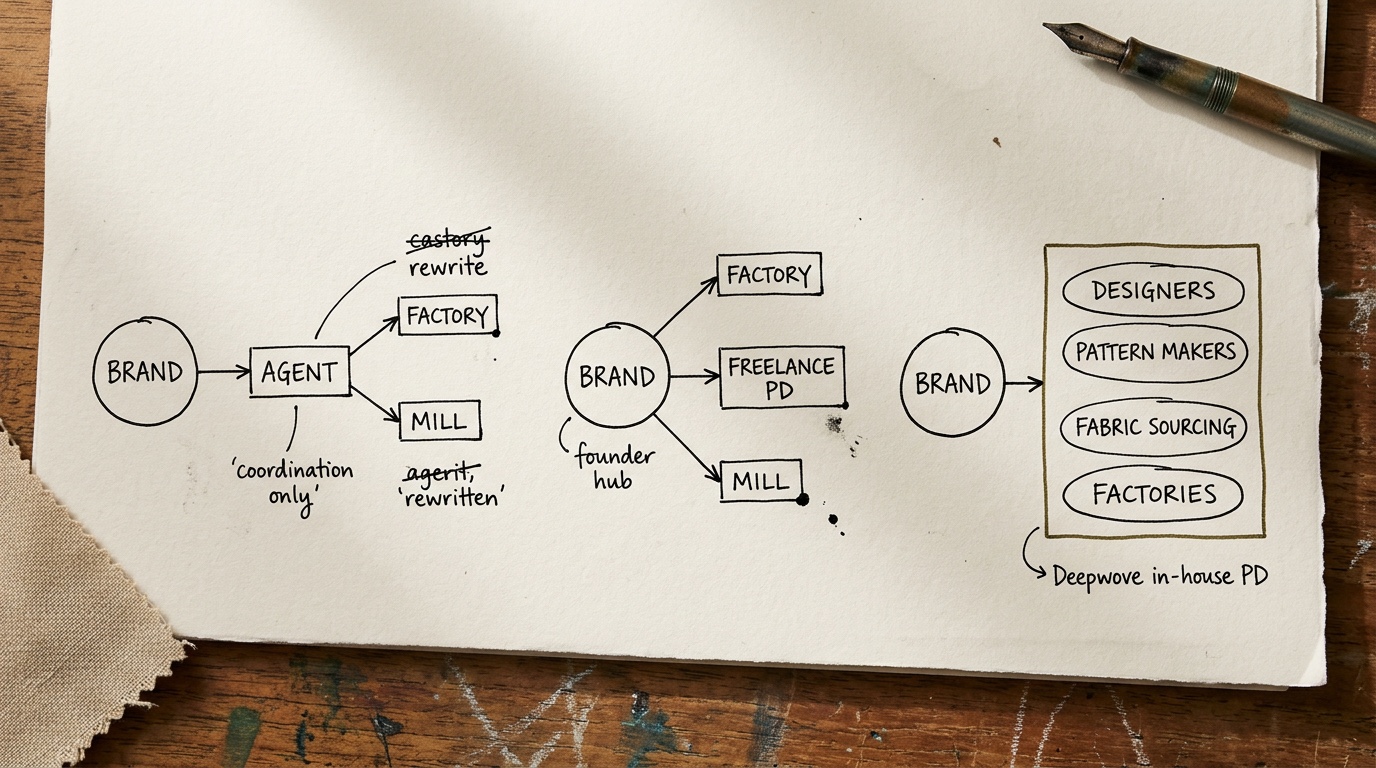
In-house product development, sourcing agent, and factory-direct are three structurally distinct partnership models for womenswear manufacturing. In-house product development integrates designers, pattern makers, and fabric sourcing specialists inside the manufacturing group itself. A sourcing agent operates as a coordination layer between the brand and one or more factories. Factory-direct is a relationship between the brand and a factory with no development team in between. The three models allocate design judgment, pattern making, fabric sourcing, mill negotiation, and QC responsibility to different physical locations. Deepwove operates the in-house product development model with 10 full-time PD specialists across 30+ specialized factories. The right model for a brand depends primarily on production volume and operational stage, not on price.
Who this article is not for
This article is not for founders looking for the cheapest CMT quote on a 200-piece run — a contract cut-and-sew operation overseas will quote lower per-piece than any of the three models discussed here, and the right answer is to take that quote if cost minimization is the only axis. This article is not for founders with a finished tech pack, fabric secured, and a factory contact ready to execute — a factory-direct relationship is already the right structure and there is no problem to solve. This article is not for brands above 50,000 pieces annual volume with the working capital to build their own in-house PD team — that math compounds differently, and a sourcing model becomes a coordination problem, not a capability problem.
This article is for founders running 100 to 10,000 pieces per style annually who are trying to decide whether the gap between their vision and a finished garment is best closed by an agent who manages a factory, a factory contact they manage directly, or an integrated group that develops product and manufactures it inside the same operation.
What each model actually is
A sourcing agent is a coordination layer between brand and factory, typically compensated by a commission on production value, with no in-house pattern making, design, or fabric sourcing capability. A factory-direct relationship is brand-to-factory contact with no intermediary; the factory sews to a brand-supplied tech pack with no development scope. An in-house product development model integrates designers, pattern makers, and fabric sourcing specialists inside the manufacturing group. The three models place development capability in three different physical locations.
A sourcing agent is a person or small firm — sometimes one principal, sometimes a five-person operation — who brokers the relationship between brand and factory. The agent's value proposition is translation: she speaks both founder and factory, she has a Rolodex of factories she has worked with, and she manages the back-and-forth so the founder does not have to sit on WeChat at midnight. She typically takes a commission on production value, occasionally a flat per-style retainer; the exact arrangement varies by agent. What the agent does not do, in almost every case, is develop product. She does not have a pattern maker on payroll. She does not have a designer who can redraw a silhouette. She does not have a fabric sourcing specialist who can call a mill and negotiate a 200-meter sampling order. The agent's capability is communication and access. Development happens somewhere else — usually the brand's freelance designer in New York, or the founder herself on a kitchen-table sketch.
A factory-direct relationship is the brand talking to a factory with no intermediary. The factory sews. The factory has a sample room — often a small one, sometimes a single sample maker — but a sample room is not a product development team. The factory will execute a tech pack that arrives with fabric. The factory will say yes to the brief, will ask clarifying questions, will quote per-piece, and will produce. What the factory does not do, structurally, is develop. Development sits with the brand — whether that is the founder, a freelance designer, an in-house PD lead, or a previous engagement that produced the tech pack the factory is now sewing.
An in-house product development model is structurally different. The pattern makers, designers, and fabric sourcing specialists are full-time employees of the same manufacturing group that owns the factories. Briefs route to the development team first; the team produces a pattern, sources fabric from mill partners with whom the group has ongoing commercial relationships, runs sample iterations until the brand approves, and then routes the finalized pattern to whichever factory in the group is the right specialist for that construction. Deepwove operates this model with 4 pattern makers, 4 designers, and 2 fabric sourcing specialists in Hangzhou — 10 PD specialists sitting inside a manufacturing group of 30+ specialized factories (25 woven, 6 knit, and 3 specialty workshops). The capability is not bolted on top of the factory. The capability is inside the same legal entity as the factory.
The three models look superficially similar from the outside — all three have a factory somewhere in the supply chain. The structural difference is where the development capability lives. That difference shapes everything that happens after the brief lands.
The 8-row comparison: who owns what
A sourcing agent is a coordination layer between brand and factory, typically compensated by a commission on production value, with no in-house pattern making, design, or fabric sourcing capability. A factory-direct relationship is brand-to-factory contact with no intermediary; the factory sews to a brand-supplied tech pack with no development scope. An in-house product development model integrates designers, pattern makers, and fabric sourcing specialists inside the manufacturing group. The three models place development capability in three different physical locations.
| Function | Sourcing Agent | Factory-Direct | In-House Product Development |
|---|---|---|---|
| Brief intake | Agent translates to factory | Founder writes tech pack | PD team intakes mood board or tech pack |
| Design judgment (silhouette, fit, drape) | Brand-side (founder or freelance) | Brand-side (founder or freelance) | PD team in-house, 4 designers |
| Pattern making | Brand-side freelance (billed per style) | Brand-side or factory sample room | In-house, 4 pattern makers full-time |
| Fabric sourcing (mill ID, vetting, sampling) | Agent introduces, brand commits | Brand-side direct | In-house, 2 fabric sourcing specialists |
| Mill commercial negotiation | Agent brokers, brand pays | Brand-side direct | Inside manufacturing group's existing commercial relationships |
| Sample iteration management | Agent passes feedback factory-to-brand | Brand-to-factory direct, often delayed | PD team runs iterations in-house, 2–3 rounds typical to approval |
| QC supervision | Brand-side, agent occasionally inspects | Brand-side third-party or self | In-group QC, AQL 2.5 standard, 2-stage for 100–300 piece orders |
| Communication chain length | 4 nodes (brand → agent → factory → mill) | 2–3 nodes (brand → factory → mill) | 1 integrated node (brand briefs one team) |
The communication chain length matters more than founders typically realize. Each handoff between a brand, an agent, a factory, and a mill is a place where intent gets translated and small details get lost. A four-node chain means a fit comment from the founder at midnight in New York reaches the mill four people later, possibly the next day, possibly with a piece of the comment rephrased somewhere along the way. A one-node chain means the founder briefs the team that will draft the pattern, source the fabric, sew the sample, and inspect the bulk — the same team, in one operation.
What changes as you scale: 100 to 10,000+ pieces per style
Brand scale shifts the right partnership model. At 100–500 pieces per style, a sourcing agent or a factory-direct relationship can work, but the brand absorbs development cost separately. At 500–2,000 pieces per style, the development bottleneck becomes the binding constraint and in-house product development partnership compresses the calendar by weeks per cycle. At 2,000–10,000 pieces per style, the cost of carrying parallel agent commission plus freelance development exceeds the all-in cost of an integrated PD-plus-manufacturing partnership. Above 10,000 pieces per style annually, brands typically build internal PD teams of their own and engage manufacturing groups directly.
Stage one: 100 to 500 pieces per style. This is first-capsule territory — three to six styles, one or two seasons in, the brand is proving the concept and the founder is still doing most of the strategic work herself. At this stage, all three models are operationally viable. A sourcing agent gives the founder a translator and a Rolodex; a factory-direct relationship demands more of the founder's time but cuts the commission line; an in-house product development model gives the founder a team that does the development work she would otherwise do herself or pay a freelancer for. The trap at this stage is comparing per-piece quotes head to head. The honest comparison is the all-in cost including the development cycle the founder is paying for somewhere — agent commission, freelance pattern maker, freelance designer, or her own time at an opportunity cost. For the founder writing the first 100-piece PO, the sample fee, MOQ, and tech pack readiness checklist in full. The question of when to add a second relationship — covered in detail in Multi-Manufacturer Sequencing: When to Add a Second Manufacturer — typically becomes structural by the end of stage one.
Stage two: 500 to 2,000 pieces per style. This is where the brand has product-market fit, a reorder pattern, and a calendar that needs to be hit every season. The bottleneck shifts from "can we get this style made" to "can we get this style developed, sampled, approved, and into production in the 12 to 16 weeks we have before the drop date." The development cycle becomes the binding constraint. A sourcing agent at this stage has the same Rolodex she had at stage one, but she does not have a faster development team — because she does not have a development team at all. A factory-direct relationship at this stage requires the founder to either hire a PD lead at a full loaded annual cost or maintain a freelance roster. An in-house product development partnership compresses the cycle because development happens inside the manufacturing group, with no handoffs and no waiting on third-party freelancers. Brands that hit this stage and stay with an agent typically experience the calendar slipping by weeks per cycle; brands that move to integrated PD typically reclaim that window.
Stage three: 2,000 to 10,000 pieces per style. At this volume, the math on agent commission and parallel freelance development infrastructure stops working. An agent commission on annual production value at this volume runs into tens of thousands of dollars in pure coordination overhead — and it buys no development capability. A freelance PD roster at this volume carries its own annual cost in retainers and per-style fees, and still does not deliver fabric sourcing in the right time window. An integrated PD-plus-manufacturing partnership amortizes the equivalent capability across the manufacturing group's full client base, and the brand pays for it inside the per-piece price rather than as a separate operating line. The decision at this stage is rarely close — almost every brand that crosses 2,000 pieces per style annually moves to an integrated structure if they have not already.
Stage four: 10,000+ pieces per style annually. At this volume, brands typically build their own internal PD team — a head of product, two or three senior pattern makers on payroll, a fabric sourcing director — because the fixed cost of an internal team becomes cheaper than paying it inside the per-piece price. But the manufacturing group access still matters. Brands at this stage do not buy development capability from a manufacturing partner — they buy capacity, factory specialization, and execution reliability. The relationship looks different. The development conversation happens brand-side. The execution conversation happens with the manufacturing group. Reformation, Doen, Cult Gaia, and the brands at this stage typically operate this way — internal PD plus integrated manufacturing group access.
Mid-body: three models, drawn out
What Deepwove actually does, what we don't
Deepwove operates the in-house product development partnership model from Hangzhou, with 4 pattern makers, 4 designers, and 2 fabric sourcing specialists inside a manufacturing group of 30+ specialized factories. Deepwove does not operate as a sourcing agent, does not offer agent-style commission-based introductions, and does not broker brand-to-factory relationships outside the group. Deepwove's manufacturing group has delivered 1.2 million garments in the past 24 months, with 90% on-time delivery across the past 12 months and a 100% reorder rate among first-order clients to date.
Deepwove sits in one specific spot on the partnership map and we are honest about it. Deepwove is an integrated manufacturing group — 4 pattern makers, 4 designers, and 2 fabric sourcing specialists, all full-time in Hangzhou, sitting inside the same operation as 30+ specialized factories. Briefs route to the development team first. The team develops pattern, sources fabric from established mill partners, runs sample iterations, and then routes the finalized pattern to whichever factory in the group is the right specialist for that construction.
Eight things we do, three things we do not:
What we do. One — intake briefs from a mood board, sketches, IP references, or a finished tech pack, and produce a proposal within 48 hours. Two — pattern development from a sketch or a reference garment, with grading and point-of-measure delivered as part of the engagement. Three — fabric sourcing from established mill partners, primarily in mainland Asia, with sample yardage typically arriving within 1–2 weeks. Four — sample iteration, 2–3 rounds typical to approval, with first sample turning within one week when fabric is on hand. Five — production at 100-piece minimum per style; average production run is 300 pieces per style across the past quarter. Six — QC inspection to AQL 2.5 standard, 2-stage for orders in the 100–300 piece range, 3-stage for orders 500+ pieces. Seven — ship-out from Hangzhou via DHL Express by default, with air freight to North America averaging 3–5 working days under DHL service. Eight — long-term partnership: 100% of first-order clients have reordered to date, and 100% of clients who crossed the 2-year mark are still active.
What we do not. One — we do not operate as a sourcing agent. We do not introduce brands to factories outside our group on a commission basis. Two — we do not take CMT contracts where the brand supplies fabric to be sewn against a brand-supplied tech pack with no development scope; the structural answer is that CMT-specific factories do that work better and cheaper. Three — we do not pretend the per-piece quote is the comparison. We will quote per-piece, the proposal will include sample fees and production lead time, but the honest comparison for a founder running through the three models is the all-in cost including the development cycle that has to be paid for somewhere.
Over the past decade, Deepwove's factories developed garments for brands like Reformation — work that ran end-to-end inside this partnership model, not through an agent and not as factory-direct. The structural difference is what made the development calendar work for those brands at the scale they ran.
The 4-criterion diagnostic: which model fits your operation
Four criteria determine the right partnership model: design judgment maturity, fabric vocabulary depth, sample iteration tolerance, and production risk capacity. Brands with mature design judgment and deep fabric vocabulary can run factory-direct effectively at lower volumes. Brands with limited fabric vocabulary or no on-payroll PD lead benefit from in-house product development partnership across all volume stages. A sourcing agent typically fits brands that need a translator without needing development capability — a narrow operational profile in 2026.
Four axes to score your own operation on. Each one points to which model fits.
1. Design judgment maturity. Does the founder or the in-house team have a clear, repeatable sense of silhouette, fit, drape, and proportion across categories? A founder who has launched 3+ successful capsules and can talk to a pattern maker in pattern-maker language has mature judgment. A founder still figuring out what "her" silhouette is, or who has been told her samples come back wrong without being able to articulate why, has developing judgment. Mature judgment can work factory-direct or with an agent and ship outsourced PD execution. Developing judgment benefits enormously from a PD team that lives the development cycle with her.
2. Fabric vocabulary depth. Can the founder distinguish a 220 GSM mid-weight cotton poplin from a 165 GSM lightweight cotton voile? Does she know whether her hero drape needs a 18 momme silk satin or a 22 momme silk twill? Does she have established commercial relationships with 2–3 mills she can call directly? Deep fabric vocabulary plus mill relationships make factory-direct viable. Limited fabric vocabulary makes an in-house fabric sourcing specialist a force multiplier — she will identify mill candidates the founder would never have found alone, vet the yardage before it ships, and shorten the development calendar by removing the founder's learning curve from the critical path.
3. Sample iteration tolerance. What is the founder's tolerance for samples that come back wrong, late, or both? A founder with a calendar that requires hero styles approved by week 12 and shipped to retailers by week 26 has low tolerance — every iteration cycle that slips is a drop date at risk. An agent-managed relationship typically adds 1–2 weeks per iteration cycle versus an integrated PD model, simply because the feedback loop is longer. Low iteration tolerance points strongly toward integrated PD.
4. Production risk capacity. What does the brand absorb financially if a 300-piece order arrives off-spec, late, or with quality issues? A brand at $500K annual revenue absorbing a $40,000 bulk problem is in trouble; the same problem at $5M annual revenue is a margin hit but not existential. Lower production risk capacity points toward integrated PD because the QC and development cycle is tighter and the disasters are less common. Higher production risk capacity gives more freedom to optimize for per-piece cost across all three models.
A founder scoring "mature / deep / high / high" across the four can run factory-direct effectively and pocket the development cost difference. A founder scoring "developing / limited / low / low" is the textbook case for in-house product development partnership. Most premium DTC founders running 100–2,000 pieces per style score somewhere in the middle on three of the four axes — and that is precisely the operational profile where integrated PD compresses the calendar and improves the hit rate.
Where to go from here
If your operation maps to the integrated product development side of the diagnostic, the next step is a brief.
Founders developing from a mood board, sketches, or reference garments without a finalized tech pack route to Deepwove ODM development. Send what you have, target volume per style at 100 pieces or above, and a target launch window with retail drop date. The proposal returns within 48 hours.
Founders with a finalized tech pack and fabric direction locked route to Deepwove OEM execution. Production timeline is 3–4 weeks once fabric is confirmed and pattern is approved.
Founders earlier in brand build who want to start with proven garments before committing to development capital can review Deepwove Ready Styles — catalog garments with fabric substitution at the 100-piece minimum, 4 weeks production.
For the upstream decision on whether you need a finalized tech pack first, the tech pack readiness ladder maps each founder profile to the right service route. For the upstream decision on the cut-make-trim versus full-package service model, the CMT vs Full Package readiness diagnostic walks through the four-criterion infrastructure check. For the broader scale decision in womenswear brand building, the premium womenswear brand pillar covers the calendar, the math, and the partnership compounds across a five-season horizon. Most premium brands hit the model-transition inflection point around the third reorder — see Why Most Premium Brands Outgrow Their First Manufacturer for the pattern.
If you would like the Deepwove Capability Lookbook before briefing — full catalog of past development work, factory profiles, category specializations — request it from the contact form and it lands in your inbox within 24 hours.
The wrong move is comparing per-piece quotes from three models that allocate the development cycle to three different places. The right move is mapping where the capability sits, scoring your own operation on the four axes, and picking the partnership where the calendar pencils.
Frequently Asked Questions
What is the difference between a sourcing agent and a manufacturer with in-house product development?
A sourcing agent is a coordination layer between brand and factory. The agent translates briefs, manages communication, and takes a commission on production value. The agent does not have pattern makers, designers, or fabric sourcing specialists on payroll. An in-house product development manufacturer integrates 10 PD specialists inside the same group as 30+ factories. The structural difference is one stacked relationship versus one integrated entity.
Is factory-direct manufacturing cheaper than working with a sourcing agent?
Factory-direct removes the agent commission line. The honest comparison adds back the development work the agent was coordinating — the freelance PD spend the brand now carries directly. Factory-direct is cheaper only for brands with mature design judgment, deep fabric vocabulary, and existing mill relationships. For brands without that infrastructure, factory-direct shifts cost from a commission line to a freelance line without reducing total cost.
When does a brand outgrow a sourcing agent?
Most brands outgrow a sourcing agent between 500 and 2,000 pieces per style annually. At that volume, the development cycle becomes the binding calendar constraint. The agent has the same Rolodex but no faster development team, because the agent has no development team at all. Brands that stay with an agent past 2,000 pieces per style typically experience the calendar slipping by weeks per cycle relative to brands with integrated product development partnership.
Does Deepwove operate as a sourcing agent?
No. Deepwove operates an in-house product development manufacturing group with 4 pattern makers, 4 designers, and 2 fabric sourcing specialists full-time inside a group of 30+ specialized factories. Deepwove does not broker brand-to-factory relationships outside the group on commission. Deepwove takes briefs, develops product, sources fabric, samples, produces, and ships inside one integrated operation.
How do I decide which model fits my brand?
Run the 4-criterion diagnostic: design judgment maturity, fabric vocabulary depth, sample iteration tolerance, and production risk capacity. Brands scoring high on all four can run factory-direct effectively. Brands scoring lower on fabric vocabulary or iteration tolerance benefit from in-house product development partnership. Brands needing only translation without development capability — a narrow operational profile in 2026 — fit a sourcing agent. Most premium DTC founders running 100 to 2,000 pieces per style fit integrated product development.