A cut and sew manufacturer takes a brand's finished pattern and fabric and turns them into a sewn garment. Full package manufacturing covers the steps before that — pattern making, fabric sourcing, sampling — and the sewing too. The difference is not price. It is who owns the development gap between a design idea and a production-ready garment. Deepwove runs full package development with four full-time pattern makers inside a manufacturing group of 30+ specialized factories, from 100 pieces per style. This post explains which model a premium womenswear brand actually needs.
What a cut and sew manufacturer actually does
A cut and sew manufacturer cuts fabric to a supplied pattern and sews it into a finished garment. The brand provides the pattern, the graded sizes, the fabric, and the tech pack. The factory provides machines, labor, and finishing. Cut and sew is production only — the development work is assumed to be already done.
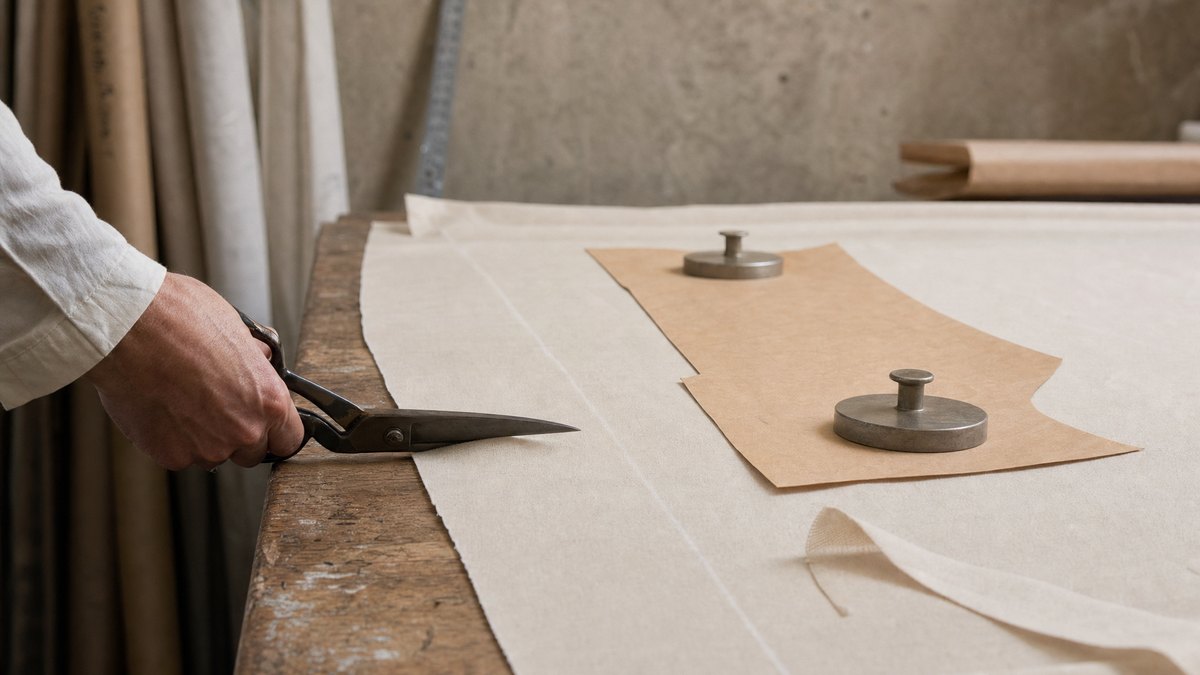
Strip away the jargon and a cut and sew manufacturer does exactly two things its name promises: it cuts, and it sews. In the trade the same model is often called CMT — cut, make, trim, where the brand keeps control of materials and development and the factory handles the labor. You bring a finalized pattern, a fabric you have already sourced and bought, a tech pack that spells out every seam and stitch, and a size run that has already been graded. The factory lays the fabric, cuts the panels, runs them through the machines, finishes the garment, and ships you the boxes.
That is a real, legitimate, useful service. For a brand that already owns its development — a stable pattern library, a fabric supplier on speed dial, a tech pack so tight there is nothing left to interpret — cut and sew is the most direct path from "I have everything ready" to "the goods are in my warehouse." You are paying for hands and machines, not for thinking.
The trap is in the assumption buried in that sentence: the development work is already done. For most brands earlier in their arc, it isn't. The pattern doesn't exist yet, or exists as a shop's house block that was never really yours. The fabric is a swatch from a trade show with no supplier behind it. The tech pack is three reference photos and a paragraph of hope. Hand that to a cut and sew shop and you have not bought a finished garment — you have bought a machine that will sew, very precisely, whatever ambiguity you gave it.
What full package manufacturing actually does
Full package manufacturing handles development and production end to end: pattern making, fabric sourcing, sampling, grading, and sewing. The brand supplies the design intent — a moodboard, a sketch, a reference garment. The manufacturer turns that intent into a production-ready garment. Deepwove runs full package from 100 pieces per style.
Full package — sometimes called full-service or, in the trade, FPP, the full production package — picks up the work that cut and sew assumes you already finished. It starts where your idea starts. A moodboard. A sketch on the back of something. A vintage garment you love and want reinterpreted. From there, a full package partner drafts the pattern, sources and tests the fabric, makes a first sample, iterates it with you until the fit and the hand are right, grades it across your sizes, and then produces it.
The phrase that matters is production-ready. Cut and sew needs you to arrive production-ready. Full package gets you there. That is the entire difference, and it is the reason the two models are not really competitors — they serve brands standing at different points on the same road.
This is also where the honest version of "full package" separates from the marketed one. Plenty of factories will call themselves full package because they can put your design onto a block they already own and call it a pattern. That is retrofitting, not development. Real full package means a pattern drafted from your reference, not adjacent to it. At Deepwove, that work runs through four pattern makers and two fabric sourcing specialists working full-time, in-house — not a sales desk that forwards your tech pack to whoever is free. It is the same discipline we describe in ODM development: turning an idea into a finished garment, not just executing one already drawn.
The real difference isn't price. It's the development gap.
The difference between cut and sew and full package is not cost — it is who owns the development gap. The development gap is the distance between a design idea and a production-ready garment: pattern, fabric, fit. Cut and sew hands that gap back to the brand. Full package absorbs it.
Here is the thing nobody quotes you on. The hardest part of manufacturing isn't the sewing. Factories can sew. The hard part is the space between your vision and a finished garment — the pattern that has to be drafted, the fabric that has to be found and tested, the sample that has to be fitted three times before it reads right on a body. Call that space the development gap.
Cut and sew is, by definition, a model that hands the development gap back to you. That is not a flaw — it is the deal. The shop sews; you develop. The problem is that a founder comparing quotes rarely sees that this is the deal. She sees a cut-and-sew price that looks lower than a full-package price and reads it as cheaper. It isn't cheaper. It is unbundled. The development work didn't disappear from the invoice because it disappeared from the work — it disappeared because it landed back on her desk, to be solved in evenings and trade-show aisles and unanswered emails to a fabric agent she found on Alibaba. (If you want that unbundling drawn out as actual numbers, see the precise cost math of CMT versus full package.)
Factories can manufacture. Few can develop. A cut and sew manufacturer is, almost always, the former wearing the latter's name. That is the entire reason premium brands get burned: not because the sewing was bad, but because the half of the work that was never going to be on the cutting floor — the half that decides whether the garment is the one she drew — had no owner. Full package gives that half an owner. That is what you are actually choosing between.
When cut and sew is genuinely the right call
Cut and sew is the right model when a brand owns its development: a stable pattern, a finalized tech pack, and a reliable fabric supply. Established brands reordering a proven style, or brands with an in-house pattern maker, often need only production. For them, full package adds cost without adding capability.
Now the part most manufacturer blog posts skip, because it doesn't sell. There are real situations where cut and sew is exactly right, and paying for full package would be paying for work you don't need.
If you are an established brand with an in-house pattern maker, your own fabric supplier relationships, and tech packs that leave nothing to chance, you have already done the development. Sending that to a full-package factory means paying it to re-do, or supervise, work you already control. Cut and sew is leaner and faster for you. The same is true for a proven reorder — a style you've already sampled, graded, and shipped once, where the pattern is locked and the fabric is on hand. That is a pure production run. It does not need a development team; it needs a cutting table and a sewing line. Deepwove itself runs those reorders in two to four weeks of production, because there is nothing left to develop. Producing strictly to a finished tech pack like this is what the industry calls OEM, as distinct from development from a brief; if you're weighing which manufacturing model fits — ODM or OEM, that distinction is the whole decision.
The test is not "which is better." It is "where is my brand's development right now — done, or undone?" If it is genuinely done, cut and sew. If the pattern, the fabric, or the fit is still a question mark, a cut-and-sew quote is quoting you for half the job. The honest answer changes as a brand matures. Many start needing full package and grow into cut and sew for their staples while keeping full package for new development. The two are seasons, not sides.
See what full package actually produces.
Request the Deepwove lookbook to see the silhouettes, fabrics, and construction standards developed from 100 pieces. Or send a brief — proposal back in 48 hours.
Request the lookbook →Why premium brands get burned by cut-and-sew-only
Premium brands get burned by cut-and-sew-only when they hand an unfinished design to a production-only shop. The pattern drifts, the fabric underperforms, the fit misses — and no single party owns the result. Each failure traces back to development that was never assigned an owner, not to bad sewing.
If you have been let down by a factory before, this is probably the shape of it, even if no one named it at the time. You sent over a design and some references. The shop said yes. A sample came back that was close — the shoulder a little off, the drape not quite the line you drew, the fabric heavier than you pictured. You sent notes. The next sample fixed one thing and broke another. Somewhere in there, the timeline slipped, the cost crept, and the garment that finally shipped was adjacent to your vision rather than your vision. You blamed the factory's quality. The real fault was structural: you bought sewing for a job that was mostly development, and development had no owner.
This is the pattern behind the founder who has now been through three or four suppliers. Each one could sew. None of them could close the gap, because the gap was never in their scope — and a cut-and-sew shop will not tell you it's out of scope, because saying so loses the order. So it takes the order, sews your ambiguity, and the disappointment gets filed under "manufacturing is hard" instead of "I bought the wrong model."
The fix is not a better cut-and-sew shop. It is recognizing that a design which is not yet production-ready needs a development partner first and a sewing line second — and that, done right, those are the same partner.
How to tell which one you're actually talking to
To tell a cut and sew manufacturer from a full package partner, ask what happens before sewing. A cut and sew shop expects a finished pattern, graded sizes, and sourced fabric. A full package partner drafts the pattern, sources the fabric, and samples from a brief. The questions expose which one you have.
Marketing language blurs the line on purpose, so test it with the work, not the website. Ask a prospective manufacturer three concrete questions and listen for who is expected to do the hard part.
First: If I send you a moodboard and no pattern, what happens? A cut and sew shop will ask you for the pattern, or quietly retrofit your design onto a house block. A real full package partner will tell you how they draft a pattern from scratch — and ideally who drafts it, and how pattern making and sample development actually run. Second: Where does my fabric come from? Cut and sew assumes you arrive with fabric bought; full package sources and tests it for you, and can tell you where the mills are. Third: How many sample rounds are included, and who fits them? Production-only shops treat sampling as a favor; development partners treat it as the work, and have an in-house team doing the fitting. The deeper version of this is a question of structure — how in-house development compares to a sourcing agent or buying factory-direct — because that structure is what decides who owns the hard part.
The answers sort the field fast. At Deepwove, the answers are: we draft from your reference, our four pattern makers do it in-house; we source and test fabric through specialists on the team; most styles reach an approved sample in two to three iterations, fitted in the same room they're drafted in. None of that is a generous extra. It is the definition of full package — and the reason the development gap stops being your problem.
Where Deepwove sits
Deepwove is a full package manufacturer, not a cut and sew shop. Deepwove develops patterns in-house, sources fabric, and samples from a brief, then produces from 100 pieces per style inside a manufacturing group of 30+ factories. Cut and sew reorders are produced once development is already done.
So, plainly: Deepwove is not a better cut-and-sew shop. It is the other model. Deepwove exists to own the development gap — to take a moodboard, a sketch, or a reference garment and return a production-ready, sampled, graded garment, then manufacture it from 100 pieces per style. The pattern making happens in-house. The fabric sourcing happens in-house. The sampling happens in a room where the pattern table and the fitting form share a floor, which is why most styles land an approved sample in two to three iterations and a development proposal comes back within 48 hours of a brief.
That said, full package and cut and sew are not mutually exclusive inside one relationship. Once Deepwove has developed a style with a brand — pattern locked, fabric proven — a reorder is a pure production run, two to four weeks, no development required. Brands tend to arrive needing full package for new work and stay because the same partner runs their staple reorders without re-litigating anything. The first season buys the development. Every season after buys the trust.
If your design is still a question mark — pattern, fabric, or fit unresolved — that is exactly the gap Deepwove is built to close, at a scale (from 100 pieces) where it costs little to find out.
What full package development looks like at Deepwove
Deepwove runs full package development and production for premium womenswear from a 100-piece minimum order quantity per style. The work runs through a 10-person in-house product development team — 4 pattern makers, 4 designers, and 2 fabric sourcing specialists — sitting inside a manufacturing group of 30+ specialized factories: 25 woven, 6 knit, and 3 specialty workshops. Most styles reach an approved sample in 2–3 development iterations, and Deepwove returns a development proposal within 48 hours of receiving a brief. Once a style is developed and its fabric proven, a reorder is a pure production run of 2–4 weeks — no development required.
Frequently asked questions
What is a cut and sew manufacturer?
A cut and sew manufacturer cuts fabric to a brand's supplied pattern and sews it into a finished garment. The brand provides the pattern, graded sizes, fabric, and tech pack. The factory provides cutting, sewing, and finishing. Cut and sew covers production only, not development. Deepwove instead runs full package development from 100 pieces per style.
How much does cut and sew manufacturing cost?
Cut and sew manufacturing is priced per garment and varies by fabric, construction complexity, and order quantity. A cut and sew quote covers sewing labor only — pattern making, fabric, and sampling are billed or sourced separately by the brand. Deepwove quotes full package pricing per brief rather than a public rate, since development scope differs by style.
Can I start with a cut and sew manufacturer?
A brand can start with a cut and sew manufacturer if its development is already finished: a stable pattern, a finalized tech pack, and sourced fabric. Brands working from a moodboard or sketch, with no pattern yet, usually need full package first. Deepwove develops from a brief and produces from 100 pieces per style.
Cut and sew vs full package — which do I need?
A brand needs cut and sew when development is done and only production remains. A brand needs full package when the pattern, fabric, or fit is still unresolved. The deciding question is whether a design is production-ready or still an idea. Deepwove runs full package development plus production inside a manufacturing group of 30+ factories.
Is cut and sew more expensive than full package?
Cut and sew is not inherently cheaper than full package — it is unbundled. A cut and sew price covers sewing only, so a brand still pays separately for pattern making, fabric, and sampling. Full package bundles development and production under one partner. Deepwove runs full package from 100 pieces per style, with a development proposal within 48 hours.