PATTERN MAKING & SAMPLE DEVELOPMENT

Pattern Making and Sample Development for Premium Womenswear

This is pattern making seen from inside a working development room — not a tutorial, but a window into how a brand's vision becomes a garment that fits.

Pattern making in apparel is where a brand's vision becomes a three-dimensional garment. At Deepwove, four pattern makers work full-time inside a manufacturing group of 30+ specialized factories — 25 woven, 6 knit, and 3 specialty workshops across silk and lace. First sample ships within one week of pattern release, subject to fabric availability. Deepwove returns a development proposal within 48 hours of a brief, backed by over a decade of premium womenswear development since 2015. Every principle on this page is something Deepwove's pattern team does daily.
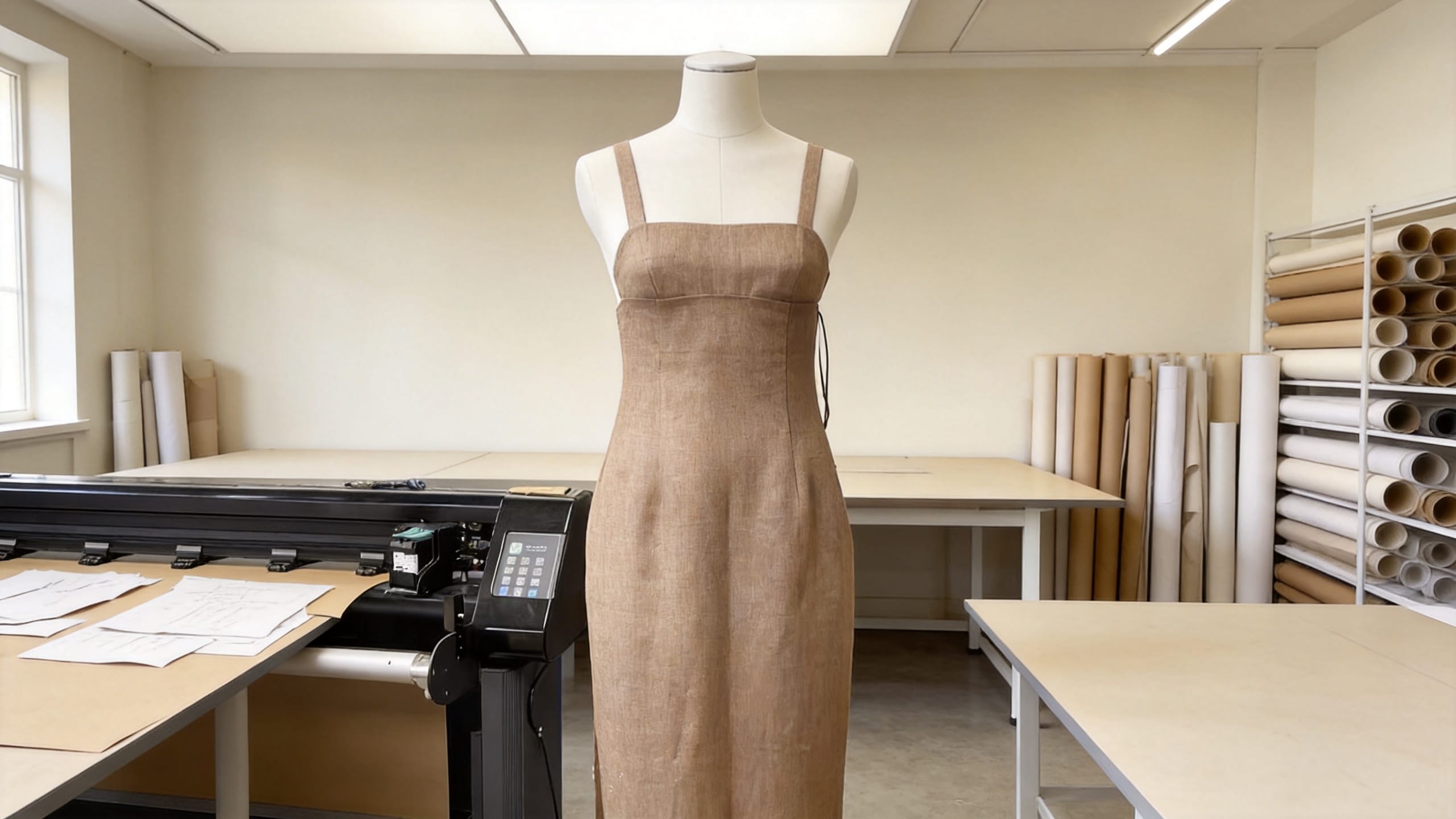
Pattern making cutting room at Deepwove's Hangzhou studio — linen dress on dress form beside an industrial cutting table and paper pattern rolls used during sample development
What it is

What Pattern Making Actually Is

Pattern making in fashion design is the craft of translating a garment idea into flat templates that, when cut and sewn, produce a three-dimensional piece that fits a body. At Deepwove, four pattern makers build these templates from a brand's moodboard or sketch — not from a pre-existing factory block.

A design starts as a feeling. A drape, a proportion, a line that reads a certain way on a moodboard. Pattern making is the moment that feeling has to survive contact with geometry. A pattern maker takes the silhouette in someone's head and works out, panel by panel, how flat cloth must be cut so that it folds into exactly that shape on a real shoulder, a real waist, a real hem.

It is the least visible stage of making a garment and the one that decides everything downstream. Get the pattern wrong and no amount of beautiful fabric or careful stitching rescues the fit. Get it right and a $40 dress and a $400 dress can be cut from the same block — the difference lives in the pattern, the fabric, and the finishing, in that order.

This is where most brands quietly lose control. A factory with no real pattern room will retrofit your design onto a block it already owns — the shoulder shifts, the rise drops, and the garment that comes back is adjacent to what you drew rather than what you drew. At Deepwove, pattern development starts from the brand's reference, drafted from scratch. That is not a generous extra. It is the only honest way to keep a design the designer's.

From sketch to pattern

From Sketch to First Pattern: How a Garment Is Built on Paper

Making a pattern follows a sequence: a pattern maker drafts a base block, develops it into the design's silhouette, then trues every seam so panels join cleanly. At Deepwove, pattern makers draft from a brand's moodboard or reference garment, and draping happens in the same room as the fitting.

There are two routes into a first pattern, and a serious development room uses both. The first is flat pattern making — drafting on paper (now usually on a digital pattern table) by calculating how each panel must be shaped. The second is draping — pinning fabric directly onto a dress form, letting the cloth find the line, then transferring that three-dimensional shape back to a flat pattern. Soft, fluid silhouettes — a bias dress, a draped neckline — are often resolved faster on the form. Structured pieces — a tailored shoulder, a fitted waistband — start flat.

The work moves in stages. A base pattern is drafted, the design lines are developed onto it, then every seam is trued — the deliberate, unglamorous step where a pattern maker checks that two panels meant to be sewn together are exactly the same length along their shared edge. Skip truing and the garment puckers; the factory blames the sewer; the sewer blames the cutter; nobody blames the pattern, which is where the fault actually lives.

When Deepwove's pattern makers draft, the dress form and the fitting bench are in the same room. A line gets questioned, repinned, and re-trued in an afternoon rather than across a week of emailed photographs. That proximity is the quiet reason most styles reach an approved sample in 2 to 3 iterations — and why first-round approvals happen at all.

Pattern grading

Pattern Grading: One Sample, a Full Size Run

Pattern grading is the process of scaling one approved pattern across a full size range while preserving proportion and fit. Grading is not uniform stretching — each measurement grows by a different increment. Deepwove grades approved patterns in-house, so the sample fit a brand signs off carries cleanly into every size produced.

A founder approves a sample in one size — usually a base size, often a medium. Pattern grading is how that single approved pattern becomes the size 4 and the size 16 without the proportion drifting. It sounds mechanical, and the worst grading is: a flat percentage applied to every line. Good grading is not. A bust grows on a different increment than a shoulder; an armhole and a sleeve cap have to grow in agreement or the sleeve won't set; a rise and an inseam move independently. Grade carelessly and the size 4 fits beautifully while the size 16 pulls across the back — same design, ungraded judgment.

This is also where pattern making and grading get confused, and the distinction matters when a founder is briefing a factory. Pattern making creates the shape. Grading scales the shape. A factory that can grade but cannot make patterns can only resize designs it already has — which is the catalog trap dressed up in technical language. Deepwove does both in-house, on approved patterns, so the fit a brand signs off at sample stage is the fit that ships at size 4 and size 16 alike.

Sample development

Sample Development: Where the Pattern Meets Real Cloth

Sample development is where a finished pattern is cut in the chosen fabric and sewn into a first garment for evaluation. At Deepwove, a first sample ships within one week of pattern release when fabric is on hand, subject to fabric availability. Most styles reach an approved sample in 2 to 3 iterations.

A pattern is a hypothesis. A sample is the test. Until cloth is actually cut and sewn, nobody — not the designer, not the pattern maker — fully knows how a fabric will behave in that particular shape. A pattern that looks perfect on the table can fall completely differently once the fabric's real weight, drape, and stretch are in play. That is why the first sample is not a formality; it is the first time the design exists.

The honest part most factory websites skip: a single sample rarely lands first try, and that is normal, not a warning sign. A neckline gapes a millimeter; a hem catches; a seam reads heavy where it should read soft. Each note feeds back into the pattern, the pattern is corrected, the next sample is cut. At Deepwove most styles settle in 2 to 3 iterations — and when fabric is on hand, each sample turns within one week, subject to fabric availability. The qualifier is not boilerplate. When a fabric has to be sourced and produced before a single sample can be cut, sourcing is the real clock — often a longer wait than the sampling itself. A development room that owns its fabric sourcing is the one that keeps that clock honest.

Most brands spend months learning this — or years finding a development partner who already has.
For founders

Do You Need to Know Pattern Making to Start a Brand?

A founder does not need to make patterns to start a clothing brand, but does need to recognize good pattern work to evaluate a manufacturer. Deepwove's in-house team — four pattern makers, four designers, two fabric sourcing specialists — handles pattern development so a brand can direct the vision without drafting it.

The most useful thing a founder can learn about pattern making is not how to do it — it is how to tell when it has been done well, and what questions to ask when it hasn't. Knowing enough to read a fit comment intelligently, to understand why a sample missed, to recognize when a factory is quietly reshaping your design to suit a block it already owns: that literacy is worth more than the technical skill itself.

The skill itself can be partnered out, and for most premium brands it should be. A founder's leverage is the vision, the aesthetic, the read on what her customer wants next season. Spending eighteen months learning to true a seam is leverage spent in the wrong place. The brands that move fastest pair a strong creative point of view with a development partner who already has the pattern room — four pattern makers, four designers, and two fabric sourcing specialists, all full-time, all in one studio in Hangzhou. The founder directs; the room executes; the design stays hers.

This is fashion product development in its honest definition: the bridge between a brand's idea and a garment that can actually be produced at quantity. It is the hardest part to outsource well, because most factories sell production capacity and call it development. The two are not the same.

How it works

How Deepwove's Pattern Making Process Works

Deepwove's pattern making process runs inside one studio: brief intake with a 48-hour proposal, fabric sourcing, pattern drafting from the brand's reference, first sample within one week of fabric arrival, 2 to 3 iterations to approval, then grading and production from 100 pieces. Four pattern makers handle every iteration end-to-end.

The reason most of the principles above are easy for Deepwove to describe is that they are not theory here — they are the daily sequence of one room.

A brief arrives: a moodboard, a sketch, a reference garment. Within 48 hours, a proposal returns covering fabric direction, construction strategy, and a sample timeline. Fabric sourcing runs in parallel — two full-time specialists working the mill network so a season doesn't quietly bleed into the next one. Pattern makers draft from the reference, not from a retrofitted block, with the dress form an arm's length from the drafting table. The first sample ships within one week of fabric arrival, reviewed against the brand's brief rather than a factory archive. Notes feed back; the pattern is corrected; most styles settle in 2 to 3 iterations. The approved pattern is graded across the size range, then routed to the factory in Deepwove's group — woven, knit, or specialty — whose construction discipline matches. Minimum order quantity is 100 pieces per style.

None of this is unusual on paper. What is unusual is having all of it — design, pattern making, grading, fabric sourcing, sampling, and production — inside a single manufacturing group, so the brief never bounces between an agent, a factory representative, and a third-party sourcing house. That is the difference between a factory that can manufacture and a partner that can develop.
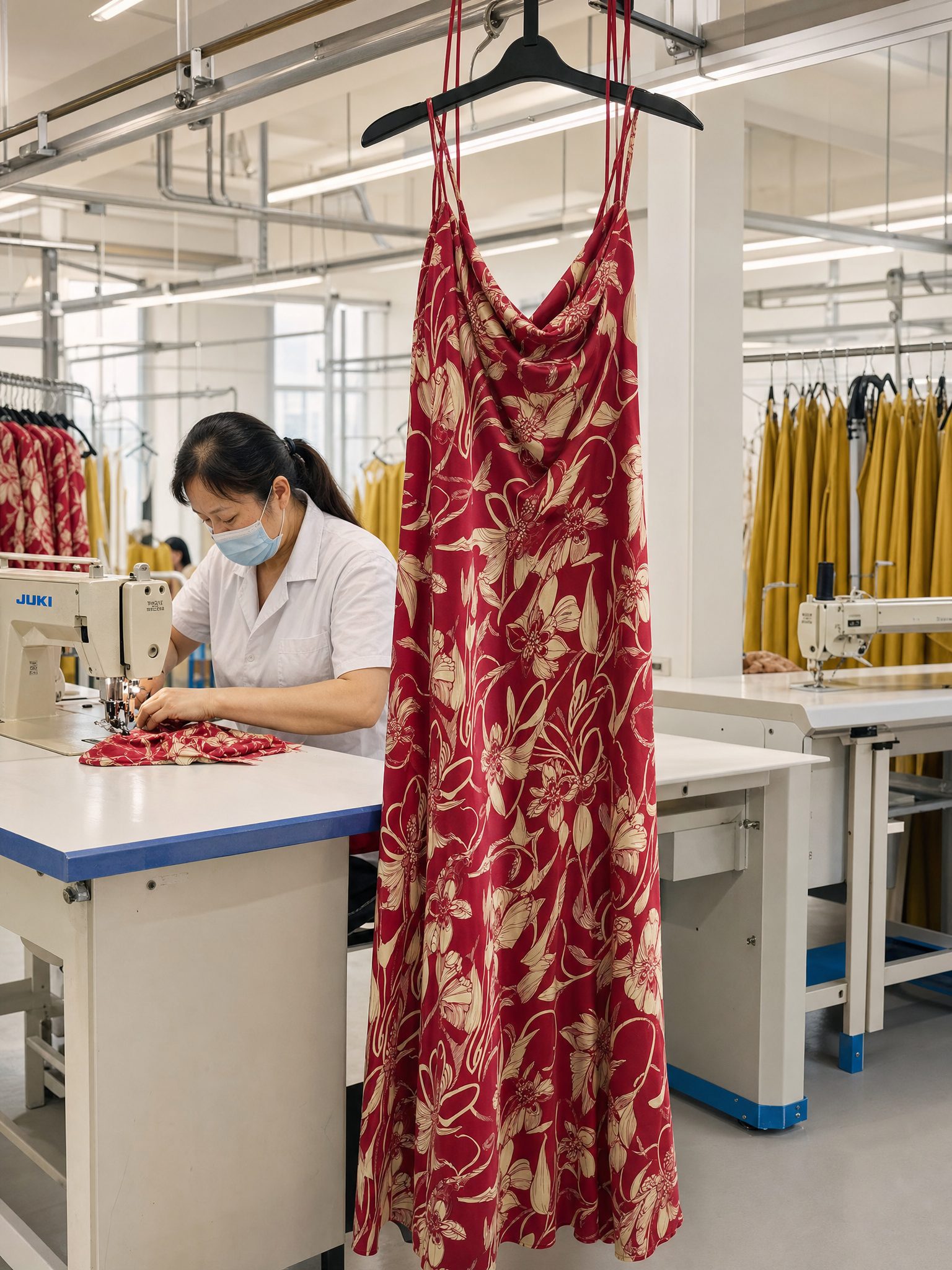
Garment in progress at Deepwove's manufacturing facility — detail of womenswear construction

Inside the Deepwove development process — from fabric and construction to finished sample, evaluated against the brand's brief at every iteration.

Inside the Pattern Room

Deepwove's in-house development team operates full-time in Hangzhou: 4 pattern makers, 4 designers, and 2 fabric sourcing specialists. Pattern development starts from a brand's moodboard, sketch, or design IP — not a pre-existing factory block. Most styles reach an approved sample in 2 to 3 development iterations; first-round approvals occur when the brief is tight.

Deepwove's manufacturing group spans 30+ specialized factories: 25 woven, 6 knit, and 3 specialty workshops across silk and lace construction. First sample ships within one week of pattern release, subject to fabric availability. Deepwove returns a development proposal within 48 hours of a brief, 100% of the time, backed by 90% on-time delivery across the past 12 months.

Pattern Making — Common Questions

What is pattern making in fashion?

Pattern making in fashion is the craft of turning a garment design into flat templates that, when cut and sewn, produce a three-dimensional piece that fits a body. It is the least visible stage of garment development and the one that decides fit. Deepwove's four full-time pattern makers draft patterns from a brand's moodboard or sketch.

How long does pattern making take?

Pattern drafting for a single style takes a few days inside a working pattern room, but the timeline that matters is to an approved sample. At Deepwove, a first sample ships within one week of pattern release when fabric is on hand, subject to fabric availability. Most styles reach approval in 2 to 3 iterations.

What's the difference between pattern making and grading?

Pattern making creates the shape of a garment from a design; pattern grading scales that approved shape across a full size range while preserving proportion. Grading is not uniform stretching — each measurement grows by its own increment. Deepwove handles both in-house, so the fit a brand approves at sample stage carries into every size.

Do I need to know pattern making to start a clothing brand?

No — a founder does not need to make patterns to start a clothing brand, but does need to recognize good pattern work when evaluating a manufacturer. The skill can be partnered out. Deepwove's in-house team of four pattern makers, four designers, and two fabric sourcing specialists handles development, so the founder directs the vision.

How does Deepwove's pattern making process work?

Deepwove runs pattern making inside one Hangzhou studio: a 48-hour proposal on intake, fabric sourcing, drafting from the brand's reference, a first sample within one week of fabric arrival, 2 to 3 iterations to approval, then grading and production from 100 pieces. Four pattern makers handle every iteration end-to-end.

Capability Lookbook

See What Four Full-Time Pattern Makers Produce.

The fastest way to understand a development room is to see its work. Request the Deepwove Capability Lookbook — 25 pages of construction detail, pattern-led garment breakdowns, and the development process behind each style. No commitment required; a 48-hour proposal SLA on any brief that follows.

Request the Lookbook

Same-day response. No commitment required.

Further Reading

For founders who want to go deeper into the craft itself, the standard reference text on pattern making remains the best starting point:

Patternmaking for Fashion Design by Helen Joseph-Armstrong — the long-standing comprehensive text on flat pattern drafting and grading, used in most fashion design programs.

Reference only — Deepwove is not affiliated with this author or publisher. Listed as an authority signal for founders learning the craft.

Also in this series: How Deepwove's full development sequence works →