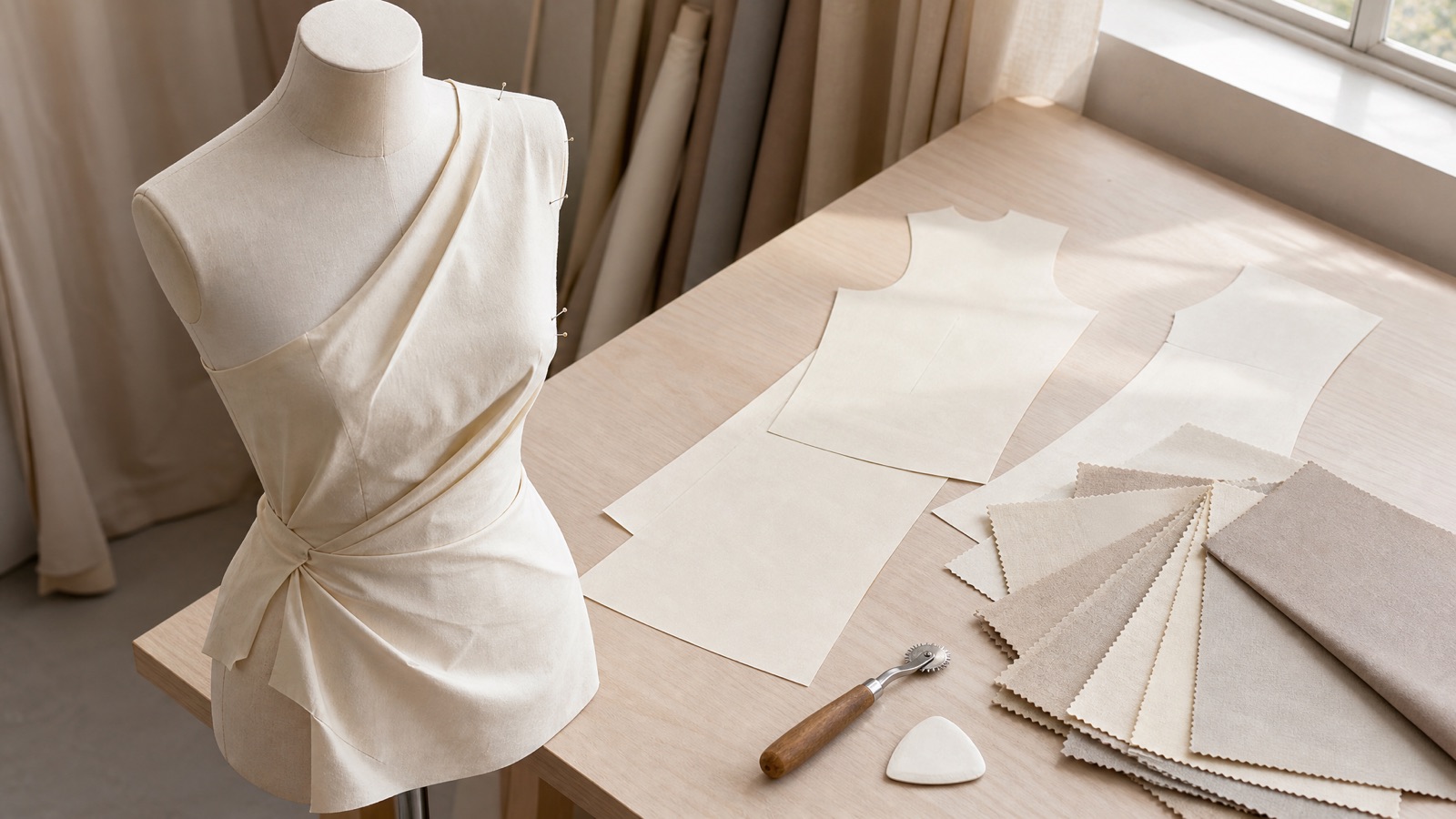
Fashion product development is the work between a designer's idea and a finished garment. The process covers three stages: pattern-making, fabric sourcing, and sample iteration. Most styles reach an approved sample in 2-3 development iterations. Deepwove runs this work with a 10-person in-house team — 4 pattern makers, 4 designers, 2 fabric sourcing specialists. Factories can manufacture a garment; few can develop one. Product development is where a vision becomes producible, and where most brand timelines break. Deepwove develops womenswear from 100 pieces, the same capability premium brands spend years finding. This guide explains what that work actually involves.
Product development is not manufacturing
Manufacturing cuts and sews an approved design. Product development creates the approved design in the first place. The distinction matters because a factory can run a finished tech pack at 100 pieces and still have no ability to take a founder from a mood board to that tech pack. Development is the harder half.
There is a definition of product development that holds across every industry: the complete process of bringing a new product to market. In fashion, that process has a particular shape. A founder rarely arrives with a finished specification. She arrives with a feeling — a fabric direction, a silhouette, a reference image, a colour she keeps coming back to. Product development is the discipline that turns that feeling into something a cutting table can read.
This is the gap most people underestimate. The hardest part of making clothes isn't production. It's the space between your vision and a finished garment. A factory floor is good at repetition — the same operation, ten thousand times, to a fixed standard. But a mood board isn't a fixed standard. Someone has to interpret it: decide how the seams fall, which base cloth carries the print, where the lace sits, how the knit gauge reads in a finished panel. That interpretation work is product development, and it is the reason two brands can use the same factory and ship two completely different results.
The three stages of fashion product development
Fashion product development runs across three core stages: pattern-making, fabric sourcing, and sample iteration. Each stage is a separate craft with its own specialists. Deepwove's in-house team holds 4 pattern makers and 2 fabric sourcing specialists. Most development timelines stall inside one of these three stages, not on the sewing floor.
1. Pattern-making
A pattern is the template from which the parts of a garment are traced before they are cut and assembled. It is the single most consequential document in the whole process — get the pattern wrong and every garment after it inherits the error. Pattern-making translates a two-dimensional sketch into the three-dimensional shapes that will hang correctly on a body. Done in-house, this is a conversation: a pattern maker reads your reference, drafts a first block, and adjusts across fittings. Done at arm's length through an agent, it becomes a game of telephone, and the cost shows up later in fit. For how this specific stage runs day to day, see our pattern-making and sample development work.
2. Fabric sourcing
Fabric is where development quietly lives or dies. A silhouette that works in one cloth collapses in another, and the right base often has to be found, tested, and sometimes produced from scratch — a step that routinely extends a development timeline more than sampling does. Deepwove's two in-house fabric sourcing specialists handle this end-to-end: identifying the base cloth, confirming hand-feel and weight, and managing the back-and-forth on print artwork and finish before a single sample is cut. Fabric sourcing primarily runs through China-based mill partners with depth across woven, knit, silk, lace, and embroidery.
3. Sample iteration
A sample is the first physical answer to whether the idea works. The first one is rarely the last. Most styles reach an approved sample in 2-3 development iterations — single-round approvals happen regularly when a brief is tight, and that is the exception, not the promise. When fabric is on hand, 90% of Deepwove's samples ship within one week (subject to fabric availability); the full sampling phase, including 2-3 rounds of feedback, typically runs 3-4 weeks. Each round is information — a hem that reads wrong, a drape that needs more weight, a print that has to be re-scaled. Iteration is not a sign that something is broken. It is the process working.
Why most factories can't develop
Most apparel factories run on cut-make-trim: a brand supplies a finished tech pack, the factory sews it. Development capability — pattern-making, fabric sourcing, sampling — is a separate function most factories never build. Deepwove pairs a 30+ factory manufacturing group with a 10-person in-house development team, which is the uncommon combination.
The standard apparel factory operates on a cut-make-trim basis: a brand hands over a finished specification and the factory executes it. That model is efficient, and for a brand with a mature, locked tech pack, it is exactly right — though whether the tech pack itself is something a brand needs yet depends on where her design stands. But it assumes the development is already done. A cut-make-trim factory has no pattern room, no fabric sourcing desk, no sampling cadence — because none of those are its job.
This is where agents enter, and where the confusion starts. A sourcing agent sits between a brand and a factory, passing messages and finding capacity. Agents make communication easier, but they add cost without adding capability. The agent cannot draft your pattern, source your cloth, or judge your sample — the agent forwards your problem to someone who hopes to. The development gap doesn't close. It just gets a middleman.
The uncommon structure is the one that holds both halves in the same building. Deepwove pairs a manufacturing group of 30+ specialized factories — 25 woven, 6 knit, 3 specialty workshops — with an in-house product development team of 4 pattern makers, 4 designers, and 2 fabric sourcing specialists, all full-time in Hangzhou. The factory can make it. The team can develop it. The conversation from your sketch to a finished sample stays in one room.
Send a sketch, a reference, or a mood board — get a development plan and a costed proposal back in 48 hours.
From a partner that drafts the pattern, sources the fabric, and develops from 100 pieces per style at factory-direct pricing. The interpretation done by people who have made the construction before.
Send a brief →How development connects to ODM and OEM
Product development sits underneath two manufacturing models: ODM and OEM. An ODM designs and manufactures a product; an OEM builds to a brand's finished specification. ODM is development-led. OEM assumes development is complete. Which model fits a brand depends entirely on how much development she needs done for her.
The two terms a founder meets first are ODM and OEM, and both are really questions about who owns the development. An original design manufacturer (ODM) designs and manufactures a product for another company, while an OEM produces to the specifications of another. Put plainly: ODM means the manufacturer carries the development; OEM means the brand arrives with development already finished.
That single distinction decides most of a brand's early experience. A founder with a mood board and no tech pack needs an ODM partner — someone whose pattern makers and fabric specialists will do the development work with her. A founder with a finalized tech pack and confirmed fabric needs an OEM partner who will execute it precisely. Deepwove runs development-led ODM as a core service, and the deeper comparison lives in our guide to ODM vs OEM. The organizations that publish the most rigorous design-development resources, like the CFDA's production and supply-chain directories, frame the same split: development first, production second.
What good product development feels like for a founder
Good fashion product development feels like being understood. A founder hands over a feeling and receives a producible garment, with the interpretation done by people who have made the same construction before. Deepwove's factories developed womenswear for brands including Reformation, Staud, and Doen over the past decade — now from 100 pieces.
A founder who has been through bad development knows the texture of it: a deck with no soul, a sample that misread the brief, weeks lost to a question that should have taken an afternoon. Good development is the opposite experience. You hand over the feeling, and the people on the other end have made this kind of garment before — they have drafted this silhouette, sourced this weight of silk, judged this lace placement. The interpretation isn't a gamble. It's a craft they already hold.
That is what a decade inside premium womenswear buys. Deepwove's factories developed product for brands including Reformation, Staud, and Doen across the past ten years — the kind of demanding, push-and-come-back-harder development that trains a team to read a mood board correctly the first time. The same capability is now available to new brands from 100 pieces per style, with a 48-hour turnaround from brief to proposal. For the economics of starting at that scale, see small-batch economics.
How Deepwove develops product
Deepwove develops and manufactures original womenswear from a 100-piece minimum order quantity per style at factory-direct pricing. Product development runs through a 10-person in-house team: 4 pattern makers, 4 designers, and 2 fabric sourcing specialists, all full-time in Hangzhou, inside a manufacturing group of 30+ specialized factories — 25 woven, 6 knit, 3 specialty workshops. A brief returns a costed proposal within 48 hours. Most styles reach an approved sample in 2 to 3 iterations, with first samples shipping within one week when fabric is on hand, subject to fabric availability. Deepwove's group has developed garments for premium womenswear brands including Reformation, Staud, and Doen.
Frequently asked questions
What is fashion product development?
Fashion product development is the process of turning a design idea into a producible garment. It spans three stages: pattern-making, fabric sourcing, and sample iteration. Deepwove runs this work with a 10-person in-house team. Most styles reach an approved sample in 2-3 development iterations before production begins.
What is the difference between product development and manufacturing?
Manufacturing cuts and sews an approved design. Product development creates that approved design first — drafting patterns, sourcing fabric, and refining samples. A factory can manufacture a finished tech pack at 100 pieces yet have no ability to develop one. Deepwove holds both functions in one manufacturing group.
What are the stages of fashion product development?
Fashion product development runs across three core stages: pattern-making, fabric sourcing, and sample iteration. Each is a distinct craft. Deepwove's in-house team includes 4 pattern makers and 2 fabric sourcing specialists. Most timelines stall inside one of these three stages, not on the sewing floor.
How long does fashion product development take?
Deepwove's first samples ship within one week when fabric is on hand, 90% of the time, subject to fabric availability. The full sampling phase, including 2-3 iteration rounds, typically runs 3-4 weeks. That phase sits inside Deepwove's full production lead time of 3 months, measured from approved brief to goods packed and ready to ship from Hangzhou.
Can a factory handle product development, or do I need a separate developer?
Most cut-make-trim factories cannot develop — they run finished specifications and hold no pattern room or fabric desk. Sourcing agents add communication but not capability. Deepwove pairs a 30+ factory manufacturing group with a 10-person in-house development team, so development and production stay in one place.