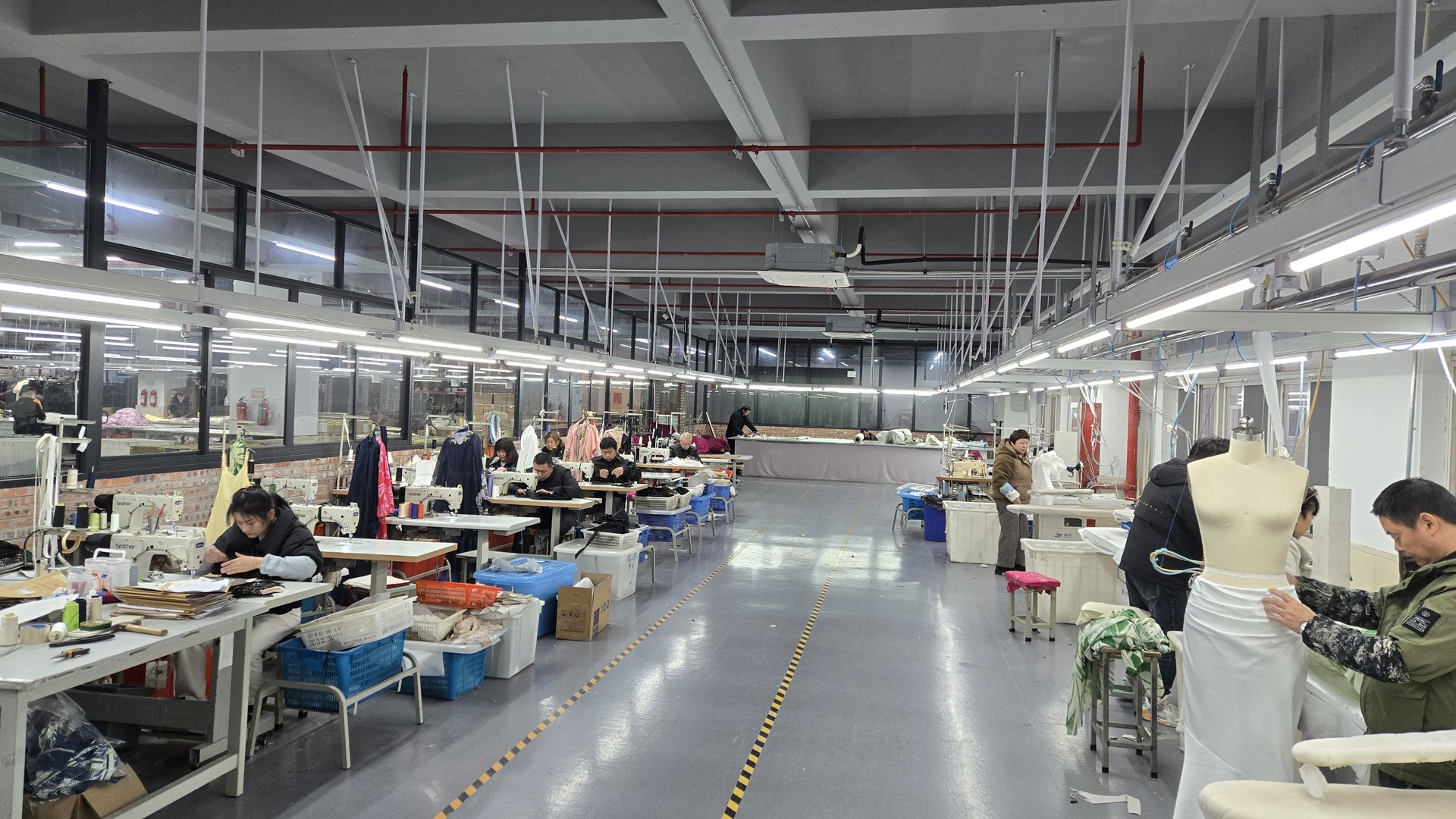
If you are searching for a Hangzhou clothing manufacturer, you have already passed two filters most founders never get past. You know China is the right answer for premium womenswear. And you know that China is not one place — that Guangzhou, Shanghai, and Hangzhou produce structurally different categories, at structurally different MOQs, with structurally different fabric ecosystems behind them. Deepwove is based in Hangzhou. This page covers why that geography matters, what the surrounding mill cluster makes possible, what the workshop looks like, and how a North American or Australian founder works with us in practice.
Why Hangzhou for premium womenswear (vs Guangzhou or Shanghai)
Hangzhou is the historical center of Chinese premium womenswear manufacturing, anchored by proximity to Shaoxing silk mills 30 kilometers south and Tongxiang knit mills 60 kilometers north. Guangzhou specializes in volume and fast fashion at higher MOQs. Shanghai is a brand hub with limited factory infrastructure. Hangzhou is where pattern depth and fabric proximity converge.
The instinct most founders bring to a China geography decision is the wrong one. They start by asking which city has the lowest cost, which is the wrong question because cost varies more between two factories in the same city than it does between cities. The right question is which city has the infrastructure for the category I’m producing. Premium womenswear — dresses, knit, silk, lace — has one answer in mainland China, and that answer is Hangzhou and the corridor around it.
Guangzhou is the volume capital of Chinese apparel. The strengths are denim, outerwear, fast fashion, and high-MOQ knit. The factory infrastructure is enormous — tens of thousands of facilities — and the cost-per-piece at scale is lower than anywhere else in China. The trade-off is that the bench depth for premium womenswear pattern work is thinner, the silk and luxury knit mill clusters are not local, and most factories quote at 500 to 1000 piece minimums because the operational model is built for volume. Premium DTC brands producing in Guangzhou usually do so for a category Hangzhou cannot match — denim, technical outerwear, or large-volume basics — not for dresses or knit.
Shanghai is the brand and design capital of China. International fashion houses, design studios, and creative agencies cluster there. Factory infrastructure inside Shanghai itself is modest by Chinese standards — the city long ago zoned heavy manufacturing out to surrounding regions. Brands operating from Shanghai typically design in the city and produce elsewhere, most often in Zhejiang — Hangzhou or further west. Choosing “a Shanghai manufacturer” usually means choosing a sales office in Shanghai whose production sits a two-hour drive west.
Hangzhou is the operational answer. The city has hosted premium womenswear manufacturing for over thirty years and is surrounded by the silk and knit mill infrastructure that makes premium production possible at small batch. Deepwove is based in Hangzhou for that reason — the same reason the manufacturing group behind Reformation, Doen, Cult Gaia, Staud, Babyboo, Aritzia, and Self-Portrait has produced through Hangzhou-based factories for over a decade. The capability behind Deepwove is not new. Deepwove, as a public brand, is. This page is the geographic argument for why the address itself matters.
For the broader frame — the five tiers of “clothing manufacturer in China,” the cost stack, and where Hangzhou sits inside the larger national picture — the hub page is at Clothing Manufacturer in China.
The 30-kilometer silk-knit-woven mill cluster around Hangzhou
Deepwove’s Hangzhou workshop sits inside a 30 to 60 kilometer radius containing the world’s largest concentration of premium fabric mills. Shaoxing produces mulberry silk, charmeuse, crepe de chine, and woven fabric for global luxury houses. Tongxiang produces cashmere, merino, and cotton knit. The manufacturing group includes 25 woven, 6 knit, and 3 silk factories drawing fabric from this corridor.
The fabric proximity is the single fact that explains why manufacturing inside this corridor operates on a different sample timeline than the rest of Chinese apparel. When a brand approves a silk crepe de chine for a hero dress at Deepwove, the swatch is ordered from a Shaoxing mill in the morning and arrives at the workshop the same afternoon. The first sample cuts the following day. The bulk fabric, when the order confirms, ships in a two-hour truck route rather than a one-week container leg.

Shaoxing sits 30 kilometers south of Hangzhou and produces the majority of the world’s premium silk fabric. Mulberry silk, charmeuse, crepe de chine, habotai, and silk-blend wovens all originate in this cluster. The mills that supply Reformation’s silk styles, Doen’s charmeuse pieces, and Cult Gaia’s silk separates are located here. Deepwove draws silk and woven fabric for 3 silk-specialized factories and 25 woven factories directly from this corridor. The deeper silk story is covered on the Silk Clothing Manufacturer in China page.
Tongxiang sits 60 kilometers north of Hangzhou and produces the bulk of China’s premium knitwear yarn and finished knit garments. Cashmere from Inner Mongolia is spun here. Merino, cotton knit, and blended yarns originate from mills concentrated within a 20-kilometer radius of the town. Deepwove’s 6 knit factories in the group source from this cluster, which is why a knit sample at Deepwove takes one week rather than the four to five weeks it would take a woven-trained factory to produce. The knit story is on the Knitwear Manufacturer in China page.
What this proximity does operationally: it collapses the sample feedback loop. Most China manufacturing operates on a sample cycle of two to four weeks per iteration because fabric has to ship between mill and factory across provinces. At Deepwove, two iterations on a silk dress finish in the same calendar window most factories take for one iteration on a Guangzhou-sourced equivalent. The fabric is local. The relationships with the mills are local. The pattern bench, the sample workshop, and the fabric library all sit in one building, with the mills a truck ride away.
Deepwove’s Hangzhou workshop — what you’ll see if you visit
Deepwove’s Hangzhou central workshop houses 4 pattern makers, 4 designers, and 2 fabric sourcing specialists working full-time alongside the production coordination team. The pattern room, sample workshop, and fabric library occupy one building. Brand visitors are received at the workshop and walked through relevant factories in the surrounding manufacturing group on the same trip.
Founders who fly in for a workshop visit usually arrive with a single expectation: they want to see whether the operation looks like the website says it does. The visit is structured to answer that question without theater. There is no rehearsed factory tour. There is a working workshop, a pattern room with active fit blocks pinned to the walls, a fabric library with swatches catalogued by mill and season, and a sample room where the current week’s development is laid out.
The pattern room. Four pattern makers work full-time at the central workshop. Their benches are visible from the entrance — this is not a back room. Each pattern maker carries roughly 30 to 50 active styles across two or three brands at any given week. The styles in development are pinned to corkboards with marked corrections, fit notes from the brand, and the current iteration’s photograph. Founders who visit see their own brand’s active patterns on the wall, not a generic display. The four pattern makers are the operational reason Deepwove can develop from a mood board or a sketch — most China factories cannot, because most do not house pattern makers at all.
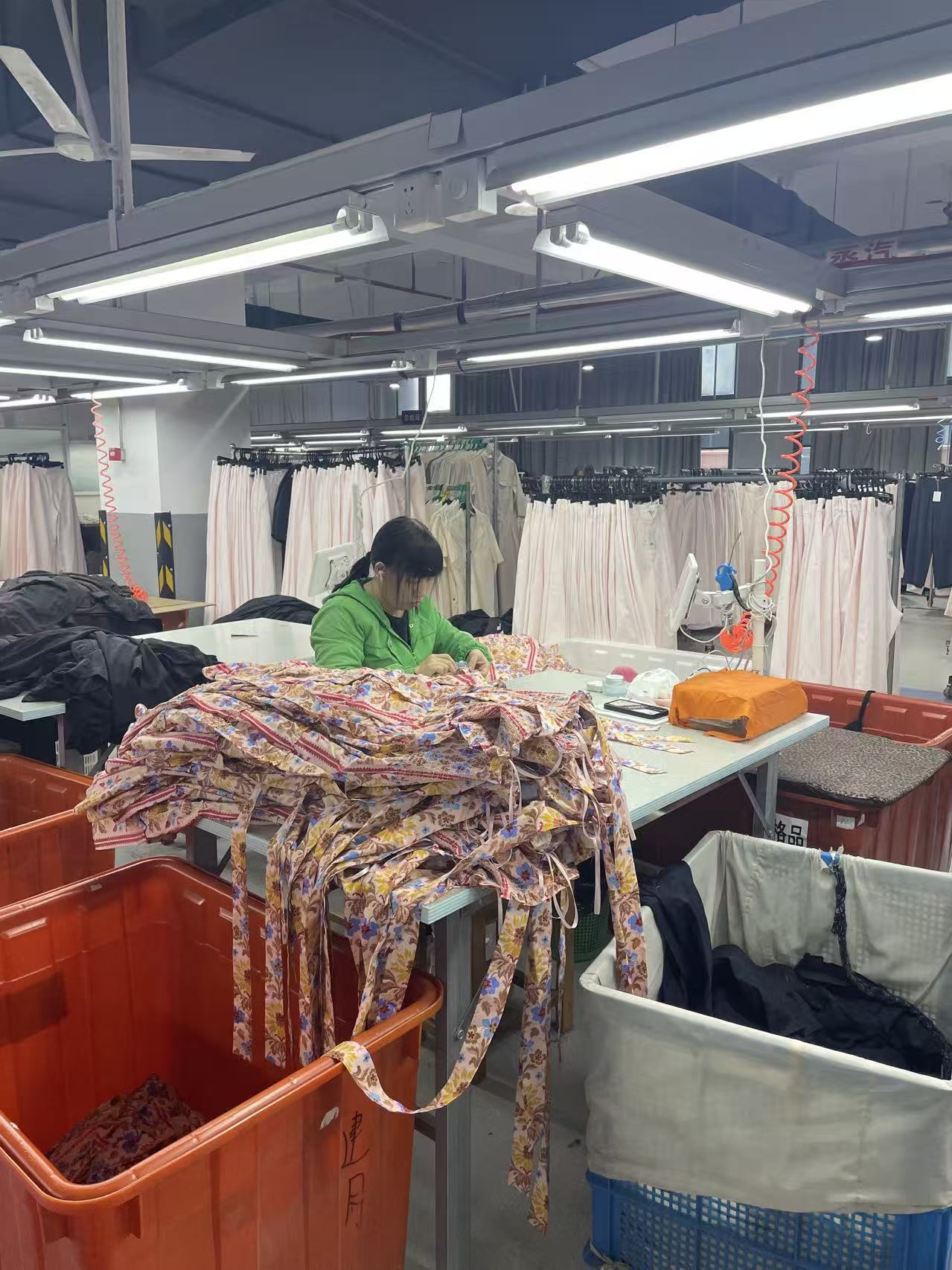
The fabric library. The fabric room holds roughly 8,000 to 10,000 active fabric swatches catalogued by mill, weight, composition, and recent project. The library is the working tool of the 2 fabric sourcing specialists who maintain the relationships with mills in Shaoxing, Tongxiang, and further into Zhejiang. When a brand brief arrives, the first response — usually within 48 hours — includes 3 to 8 fabric options pulled from this library, with sourcing lead time, MOQ at the mill, and a sample swatch dispatched to the brand by courier.
The sample workshop. The sample sewing room sits in the same building as the pattern room. First samples are sewn here, not at the production factory. The reason is iteration speed: the pattern maker can hand a corrected pattern to the sample sewer across the same corridor, watch the first cut, and adjust before the bulk pattern goes to the production factory. This is the structural reason Deepwove’s sample timeline reads one week instead of three.
What the visit feels like. A typical brand visit is one to two full days. Morning at the central workshop — pattern room, fabric library, sample workshop. Afternoon at one or two production-stage factories in the group, usually 30 to 90 minutes drive from the city. Optional half-day in Shaoxing at one of the silk mills if the brand’s production includes silk. Visit requests need at least two weeks of advance notice so the workshop can prepare the right factories and mill relationships for the trip.
The lookbook shows what comes out of this workshop.
Real garments developed and produced inside the Hangzhou-Shaoxing-Tongxiang corridor, with construction notes. The fastest way to calibrate whether Deepwove’s capability fits before the visit conversation.
Request Lookbook →How North American and Australian founders work with a Hangzhou-based manufacturer
Hangzhou operates on China Standard Time, UTC+8. Sydney founders share 6 hours of working overlap daily with Hangzhou. New York founders share 1 to 2 hours each morning. London founders share 3 to 4 hours each afternoon. Deepwove’s workflow is built around asynchronous handoff, weekly video reviews, and shipped physical samples crossing the time gap on courier rather than email.
The time zone question is the one most founders raise first when they hear “Hangzhou.” The answer is structural, not aspirational. Working with a manufacturer in Hangzhou is not the obstacle it appears to be — if the workflow is built for it.
For Australian founders, Hangzhou is the easiest premium manufacturing partner in Asia. The city is behind Sydney, not ahead. A 10am Sydney call is an 8am call on both sides — both sides are in the office. The 6-hour daily overlap is the longest of any premium manufacturing geography accessible to AU brands. AU founders who work with Deepwove typically run two weekly calls — Tuesday morning Sydney for the development review, Friday morning Sydney for production status — and the rest of the week runs asynchronously over shared tech pack platforms and email. The deeper AU-specific operational playbook is on the For Australian Brands sub-page.
For North American founders, the working overlap is narrower but real. New York founders share 1 to 2 hours each morning — a 9am New York call is a 9pm China Standard Time call, which is workable on the brand side and feasible on the manufacturer side. Los Angeles founders share 2 to 3 hours each morning — an 8am LA call is an 11pm local call on the manufacturing side. The Deepwove workflow for NA brands is built around weekly Wednesday-evening NY video reviews, asynchronous tech pack handoff during NA daytime hours when the workshop is offline, and shipped physical samples that arrive at the brand within 4 to 6 business days via DHL or FedEx. The NA-specific operational detail — Section 301 tariff context, MID handling, port-aware shipping — is covered on the For US / North American Brands sub-page.
What does not work asynchronously. Fit-block calibration on the first three styles, color approval on a new fabric, and the first bulk QC reading. These three moments need a synchronous video call — either inside the working overlap window or scheduled as an evening-side accommodation on one end. Founders who try to run these moments entirely over email lose two to three days per iteration to clarification cycles. The workflow at Deepwove assumes roughly six synchronous video moments across a 4-month development-to-shipped cycle. The rest is asynchronous, documented, and time-stamped.
Brand visitors typically come once per year — for the first onboarding, and again roughly twelve months later when the relationship has reached a steady production cadence. Most NA and AU founders never visit the workshop, and most production proceeds normally without a physical visit. The visit is an accelerator on trust, not a prerequisite.
Frequently asked questions
Why is Hangzhou known for clothing manufacturing?
Hangzhou is the historical and operational center of Chinese premium womenswear manufacturing. The city sits 30 kilometers from Shaoxing — the world’s largest silk and woven fabric mill cluster — and 60 kilometers from Tongxiang, the knit and cashmere capital. Premium DTC brands including Reformation, Doen, Cult Gaia, and Staud have produced through Hangzhou-based manufacturers for over a decade.
What makes a Hangzhou clothing manufacturer different from Guangzhou or Shanghai?
Hangzhou specializes in premium womenswear with vertical integration into silk, knit, and woven fabric mills within a 30 to 60 kilometer radius. Guangzhou is the volume capital with strength in fast fashion, denim, and outerwear at higher MOQs. Shanghai is a brand and design hub with limited factory infrastructure. Premium DTC brands choosing Hangzhou are choosing fabric proximity and pattern depth over volume scale.
Where is Deepwove’s Hangzhou workshop located?
Deepwove’s workshop is located in Hangzhou, Zhejiang Province, China. The pattern room, sample workshop, and fabric library are housed in one facility coordinating production across 25 woven factories, 6 knit factories, and 3 silk factories — most within 30 to 60 kilometers of the central workshop. Brand visitors are received at the central workshop and walked through the production network on request.
What is the minimum order quantity for a Hangzhou-based manufacturer like Deepwove?
Deepwove’s minimum order quantity is 100 pieces per style, applied to all three service tiers: Ready Styles, ODM Development, and OEM Production. The 100-piece floor is set deliberately to let premium DTC brands test a first manufacturer relationship without committing to the 500 to 1000 piece minimums most volume-oriented Chinese manufacturers require.
How fast can a Hangzhou manufacturer produce samples?
Deepwove produces first samples within one week of pattern release, subject to fabric availability. The one-week timeline reflects fabric proximity — Shaoxing silk and Tongxiang knit mills sit within 60 kilometers, so swatches and bulk fabric arrive at the workshop within 24 to 48 hours rather than weeks. Pattern release happens within 48 hours of brief intake.
How does a North American or Australian founder work with a Hangzhou manufacturer in practice?
Hangzhou operates on China Standard Time, UTC+8. Sydney founders share a working window of roughly 6 hours daily with Hangzhou. New York founders have 1 to 2 hours of working overlap each morning. Deepwove’s workflow is built around asynchronous tech pack handoff, weekly video reviews, and shipped physical samples — most brand-side decisions happen between Hangzhou’s afternoon and the founder’s morning.
Can a brand visit the Hangzhou workshop before placing an order?
Yes. Deepwove receives brand visitors at the Hangzhou central workshop and arranges tours of relevant factories within the manufacturing group. A typical visit covers the pattern room, the sample workshop, one or two production-stage factories, and an optional half-day at the Shaoxing silk mill cluster. Visit requests are coordinated with at least two weeks of advance notice.
What categories does Deepwove specialize in producing from Hangzhou?
Deepwove’s Hangzhou workshop specializes in premium womenswear dresses, knit garments, silk separates, and lace constructions. The category mix reflects the surrounding fabric infrastructure — Shaoxing for silk and woven mills, Tongxiang for knit and cashmere mills, and Hangzhou itself for finishing and trim. Outerwear, denim, and technical sportswear are deliberately not in the core capability.
Next step
Two ways forward, depending on where the conversation lives in your operation. If you want to see what the workshop produces, the lookbook covers the category range — dress, knit, silk, lace — with construction notes and recent production references. If you have a brief ready, Deepwove’s development team turns it into a proposal within 48 hours — including fabric options, pattern feasibility, MOQ confirmation, and sample timing. The 100-piece floor applies whether this is a first manufacturer relationship or an addition to an existing supply chain.
For the broader frame on Chinese premium womenswear manufacturing — tier definitions, cost stack, vertical integration, and where Hangzhou sits within it — read the full Clothing Manufacturer in China guide. For the founder behind Deepwove, see About Deepwove and How It Works.