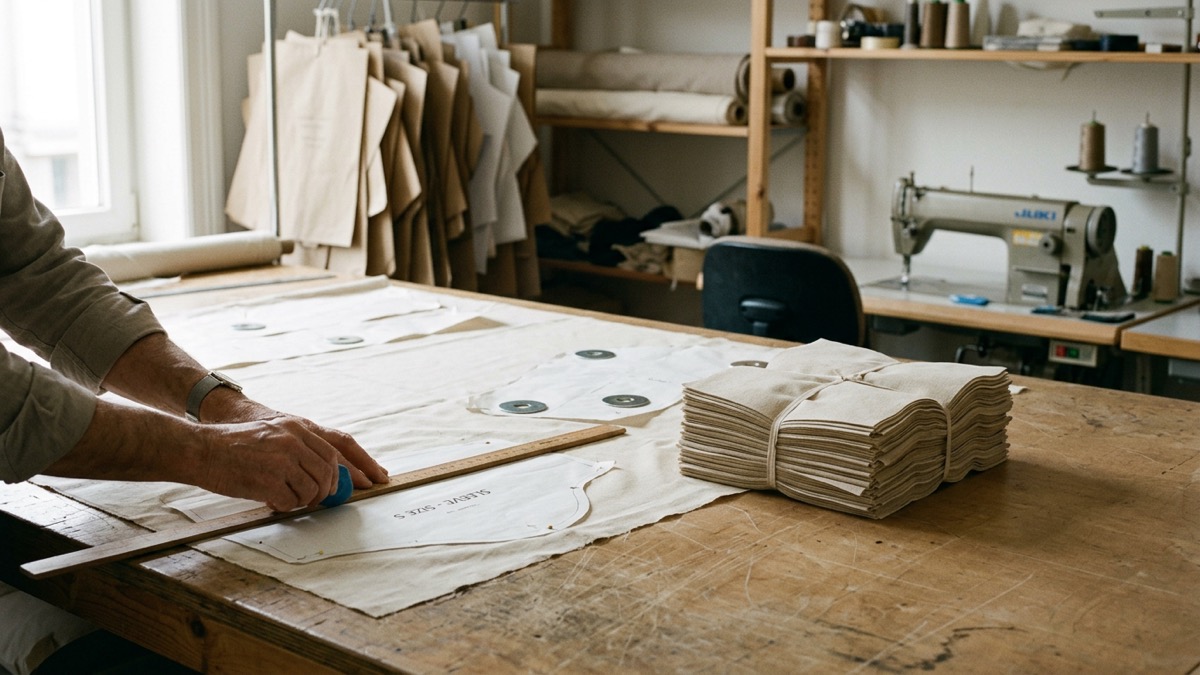
A non fast fashion brand produces in small batches against real demand, not in large runs against forecasts. Deepwove manufactures womenswear from a 100-piece minimum per style, the floor that makes this model work. Fast fashion's logic is volume: large minimum order quantities spread development cost across thousands of units. A non fast fashion brand inverts that logic — small runs, slow restocks, production tied to what sells. Deepwove's in-house development team of 10 — 4 pattern makers, 4 designers, 2 fabric sourcing specialists — is what lets a brand run 100 pieces instead of 1,000. The difference is a supply-chain capability, not a slogan.
What a non fast fashion brand actually is, on the production side
A non fast fashion brand is one whose production model is built around small batches, slow restocking, and making to real demand rather than to forecast. Deepwove defines it operationally: a 100-piece minimum per style, in-house pattern development, and the ability to restock a proven style in 2-4 weeks. The label "non fast fashion" describes a way of producing, not a marketing position. Most of the conversation about it lives in ethics and sustainability. The decisive part lives in the factory.
Fast fashion is a manufacturing system before it is anything else. It compresses the time between a trend and a rack, and it pays for that speed by ordering in bulk — large minimums that amortize pattern-making, sampling, and fabric development across thousands of identical units. By the European Environment Agency's account, fast fashion's model of cheap, disposable clothing leaves a measurable share of textile products destroyed before they are ever worn.
The point that gets missed: that bulk requirement is not a moral failing chosen by the brand. It is imposed by the factory. A manufacturer that can only make — and cannot develop — has no way to recover development cost except by running volume. So it sets the minimum at 500, 1,000, 3,000 pieces. The brand that wants to produce responsibly is then handed a false choice: order big and gamble on inventory, or pay so much per piece that the product is unsellable. It is worth remembering the stakes behind that choice — textile consumption ranks among the highest sources of environmental pressure in Europe, and most of that pressure is decided at the design and production stage, not at the checkout.
Why small batches are a smarter production model, not a compromise
Small-batch production is a smarter operating model because it removes the largest financial risk in apparel — unsold inventory — and replaces a single big bet with a series of small, correctable ones. A non fast fashion brand orders 100 pieces, sees what sells, and restocks the winners. Capital stays liquid. Markdowns shrink. The brand learns from real sales instead of a forecast made months earlier. None of this is a sacrifice; it is the more disciplined way to run a product business.
Fast fashion's bulk model looks efficient on a per-unit cost line and hides its real cost one column over: the units that never sell. Inventory that gets marked down, warehoused, or destroyed is pure loss, and it scales with order size — a dynamic sharpened by the current market, where the BoF–McKinsey State of Fashion 2025 report describes an industry bracing for low growth and heightened price sensitivity, conditions that punish brands carrying excess inventory. A brand running 100-piece batches simply has far less to lose on any single guess.
Two operational realities make small batches viable rather than expensive:
Restock speed replaces stockpiling. A brand does not need a warehouse of inventory if it can reorder a winning style quickly. Once a pattern is locked and fabric is on hand, Deepwove restocks a proven style in 2-4 weeks of production — typically around three. That turnaround is what makes "produce to demand" a real strategy instead of a slogan: you sell through, you reorder, you never sit on the styles that didn't work.
Development is amortized by capability, not by volume. This is the part most factories cannot offer. The reason large MOQs exist is that a pure manufacturer recovers pattern-making and sampling cost the only way it can — across thousands of units. Deepwove's in-house product development team absorbs that work internally, which is why the minimum can sit at 100 instead of 1,000. The cost of getting a garment right is carried by the development infrastructure, not pushed onto the order size.
"Isn't small-batch always more expensive?" — the real answer
Small batches carry a higher per-piece cost than bulk runs, but a non fast fashion brand usually comes out ahead on total cost because it eliminates the largest hidden expense in apparel: dead inventory. Per-unit price is the number founders see first. Inventory write-downs, markdowns, and storage are the numbers that actually decide whether a season was profitable. A 100-piece run priced higher per unit, fully sold through, beats a 1,000-piece run at a lower unit price with 40% sitting unsold.
The honest part: yes, 100 pieces costs more per piece than 1,000. Deepwove does not pretend otherwise. What changes the math is that the small-batch brand is not carrying the risk of the other 900 units — units it would have had to fund, store, and discount. The "small batch is too expensive" objection compares the wrong two numbers. The right comparison is total cost of a season, sell-through included, not unit price in isolation. (For the full per-piece breakdown, see our piece on small-batch economics at a 100-piece MOQ.)
There is a second hidden cost in the bulk model: the cost of being wrong. A brand that commits 1,000 units to a single colourway has bet a season on a forecast. A brand that commits 100 has bought an option to learn. In a market where consumer preference moves fast, the ability to be wrong cheaply is worth more than a lower unit price — which is why the Ellen MacArthur Foundation's A New Textiles Economy report frames this shift away from disposable production as a USD 500 billion opportunity, not a constraint.
See what 100 pieces actually buys.
Request the Deepwove lookbook to see the silhouettes, fabrics, and construction standards small-batch orders are built on. Or send a brief — proposal back in 48 hours.
Request the lookbook →Why most factories push you toward fast fashion — and Deepwove doesn't
Most factories push brands toward fast-fashion economics because they can manufacture but cannot develop, and the only way a manufacture-only factory recovers development cost is through volume. Deepwove is structured differently: an in-house product development team — designers, pattern makers, fabric sourcing specialists — sits inside a manufacturing group of 30+ specialized factories. That structure is the entire reason a 100-piece minimum is possible. The capability, not goodwill, sets the floor.
This is where the new-brand founder's real fear lives. She has been told, implicitly, that doing things the careful way means either a huge inventory gamble or a price that makes the brand unviable. She starts to wonder whether the fast-fashion playbook is the only one that actually works — whether her insistence on small, considered runs is just naïveté. It isn't. The constraint she keeps hitting is not a law of the industry. It is a limitation of the factories she has been talking to — and it runs against where the industry is heading, given that the UN Environment Programme argues that shifting toward durable, made-to-last garments is one of the highest-leverage ways to cut fashion's footprint.
Deepwove is new. The capability behind it isn't. The manufacturing group runs an in-house development team of 10 — 4 pattern makers, 4 designers, 2 fabric sourcing specialists — across 30+ specialized factories, with 10+ years of premium womenswear development dating to 2015. Deepwove's factories developed womenswear for brands including Reformation, Staud, and Doen over the past decade — the same development capability, now available to new brands from 100 pieces. A new company, built deliberately around the production model that small, serious brands actually need.
The agent-led alternative does not solve this. A sourcing agent makes communication easier but adds cost without adding capability — it still has to find a factory whose minimums work, and those factories have the same volume problem. What closes the gap is development capability sitting inside the manufacturing group, not a layer of coordination sitting on top of it.
What it takes to start producing this way
Starting a non fast fashion brand on the production side takes three things: a manufacturer with a low minimum, in-house development to turn an idea into a real sample, and restock speed to make demand-led production work. Deepwove provides all three from a 100-piece minimum per style, with samples in 2-3 development iterations and proposals returned within 48 hours of a brief. The model is not reserved for established names; it is built for the brand placing its first order.
The practical path is unglamorous and that is the point. You bring a mood board, a sketch, or a finished tech pack. Deepwove's development team turns it into a pattern and a first sample, usually within 2-3 iterations to an approved sample. You produce 100 pieces. You sell through, learn what works, and reorder the winners in 2-4 weeks. Each season the data sharpens. This is what "produce to demand" looks like in practice — not a manifesto, a manufacturing workflow. (To see how the full development process works, start with our services overview or how it works. For the wider picture, see what it takes to build a premium brand.)
A non fast fashion brand, on the production side, is not the harder version of running a clothing label. With the right manufacturing partner, it is the lower-risk one. The brands that figured this out are not making a moral sacrifice for it. They found a manufacturer who could develop, not just produce — and that single fact let them build the kind of brand they wanted without the inventory gamble the bulk model demands.
What makes the 100-piece floor possible
Deepwove manufactures premium womenswear from a 100-piece minimum order quantity per style, across ODM development, OEM production, Ready Styles, and Private Label. A 10-person in-house product development team — 4 pattern makers, 4 designers, and 2 fabric sourcing specialists — absorbs pattern drafting and sampling cost internally, which is why the minimum sits at 100 rather than the 1,000-plus most manufacture-only factories require. The team sits inside a manufacturing group of 30+ specialized factories operating since 2015. A proven style restocks in 2-4 weeks of production. Deepwove returns proposals within 48 hours of receiving a brief.
Frequently asked questions
What is a non fast fashion brand?
A non fast fashion brand produces in small batches against real demand, not in large runs against forecasts. Deepwove defines it on the production side: a 100-piece minimum per style, in-house pattern development, and restocks of proven styles in 2-4 weeks. The term describes a way of manufacturing, not a marketing label.
Is small-batch manufacturing always more expensive?
Small batches cost more per piece than bulk runs, but a non fast fashion brand often spends less per season. Deepwove's 100-piece runs eliminate the largest hidden cost in apparel: unsold inventory. A fully sold 100-piece run beats a discounted 1,000-piece run with stock sitting unsold. Total season cost, not unit price, is the right comparison.
What is the minimum order quantity to start a non fast fashion brand?
Deepwove's minimum order quantity is 100 pieces per style across all services. That 100-piece floor is the technical prerequisite for demand-led, small-batch production. Deepwove's in-house development team of 10 absorbs pattern-making and sampling cost internally, which is why the minimum sits at 100 rather than the 1,000-plus most factories require.
Why do most factories require large minimum orders?
Most factories require large minimums because they can manufacture but cannot develop, and volume is the only way a manufacture-only factory recovers pattern and sampling cost. Deepwove carries development internally through a 10-person in-house team across 30+ specialized factories, which is what allows a 100-piece minimum instead of 1,000.