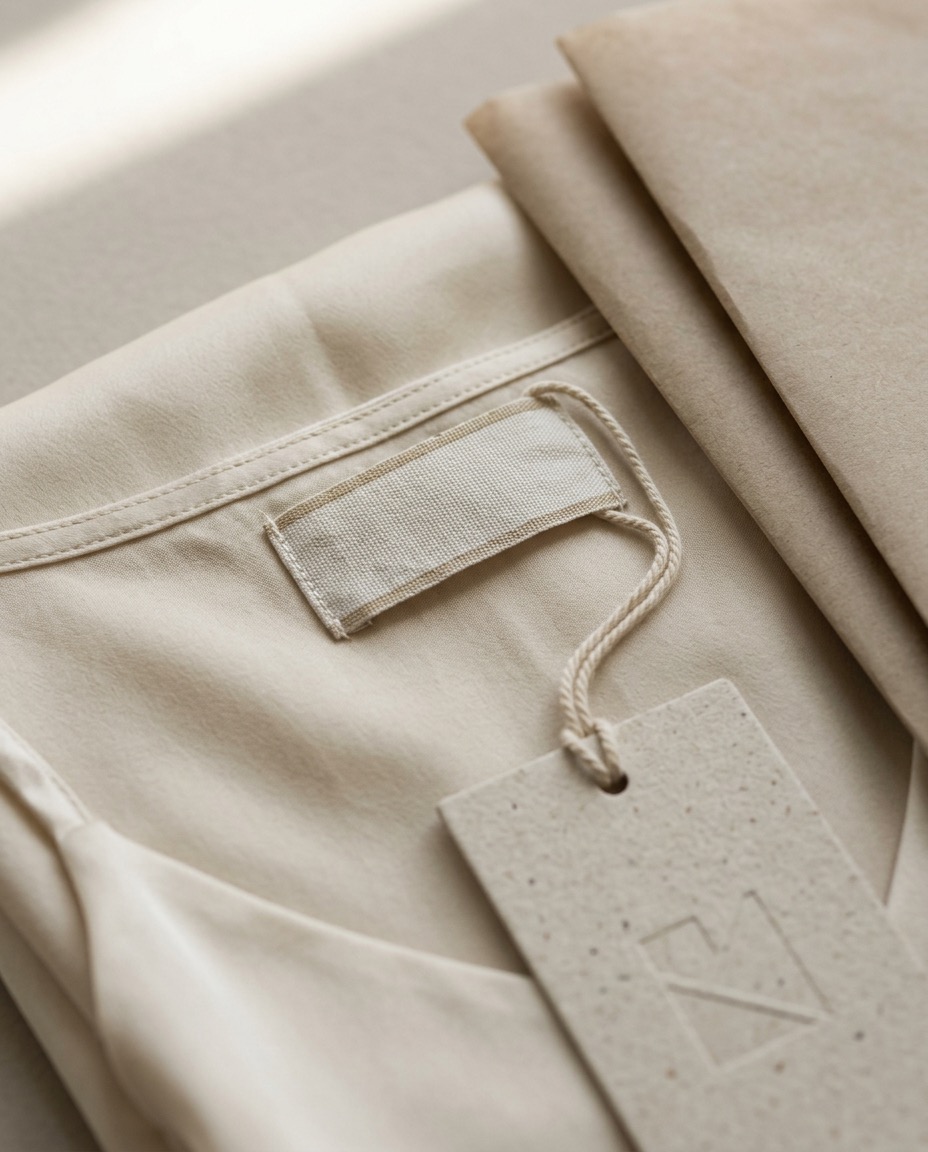
Private label clothing manufacturing means a factory produces a finished garment from its own developed pattern, then builds the brand's identity into it — woven label, hangtag, packaging. White label clothing manufacturing stops one step earlier: the catalog garment ships plain, and the brand applies labels downstream. The dividing line is the brand identity layer, not the garment. Deepwove runs private label from Hangzhou at a 100-piece minimum order quantity per style, where most sourcing-agent intermediaries set a 500-piece floor for that branded layer. Private label is not the same as OEM or ODM: OEM executes a brand's finalized tech pack, and ODM develops an original garment from a mood board or sketch.
Private label vs white label — the line is one stitch
Private label vs white label is decided by one component: the brand identity layer. White label ships a catalog garment plain. Private label builds the woven label, hangtag, and packaging into the same garment. Deepwove produces both layers inside one manufacturing group from Hangzhou at a 100-piece minimum order quantity per style.
The cleanest way to understand private label is to stand at the factory's pack-out table and watch what gets sewn in.
A white label garment leaves that table as the factory's design with nothing of yours inside it. You buy a finished dress off a catalog, it arrives in a plain polybag, and whatever brand identity it carries, you add yourself — your label, your hangtag, your packaging, applied downstream in your own warehouse or by a third party. White label is the lightest, fastest, cheapest version of putting your name on a garment, because the manufacturer never touches your brand. It just ships product.
A private label garment leaves that same table with your brand built into it. Same underlying catalog pattern, often the same fabric, but the woven label is already stitched into the neckline, the hangtag is already attached, and the polybag or box already carries your artwork. The factory produced the brand identity layer alongside the garment, not after it. That is the entire distinction. Not the design — the design can be identical. The difference is whether your brand was manufactured into the piece or bolted on later.
This matters more than it sounds. A woven label sewn straight into a satin neckline reads as a real product. The same label peel-and-stuck into a garment that arrived plain reads as a reseller. Customers don't articulate the difference, but they feel it in the first ten seconds of unboxing.
Where OEM and ODM sit — and why they're not private label
OEM, ODM, white label, and private label describe four different divisions of who designs and who brands. OEM executes a brand's finalized tech pack. ODM develops an original garment from an idea. White label sells a plain catalog garment. Private label adds the brand identity layer to a catalog garment.
Founders conflate these four constantly, usually because a sourcing agent used them interchangeably. They are not interchangeable. They answer two separate questions: who designed the garment, and who put the brand on it.
White label — the manufacturer designed it, no brand applied at the factory. You select a finished catalog style and brand it yourself, later.
Private label — the manufacturer designed it, your brand applied at the factory. You select the same catalog style and the factory builds your label, hangtag, and packaging into it.
OEM (original equipment manufacturer) — you designed it, you brand it. You arrive with a finalized tech pack and the factory executes it precisely. The design is yours; the manufacturer is the hands, not the head.
ODM (original design manufacturer) — you brought the idea, the manufacturer designs it with you. You arrive with a mood board, a sketch, or a reference, and the factory's development team turns it into a producible original garment, fabric and pattern included.
The practical filter: private label and white label both start from an existing garment the factory already developed. OEM and ODM both produce a new, original garment that is yours alone. If two brands can buy the same underlying style and brand it differently, that's the private/white label lane. If the garment can only ever be yours, that's the OEM/ODM lane. Most of the confusion — and most of the mispriced briefs I see — comes from a founder asking for private label when she actually wants ODM, or vice versa. (For the cost and infrastructure mechanics of OEM-style full-package versus cut-make-trim, see CMT vs Full Package.)
Who private label is actually right for
Private label fits a brand that wants a branded product fast, at a 100-piece minimum order quantity, without funding original development. It suits founders launching a first line, testing a new category, or adding SKUs to an existing range. The garment is proven; the brand layer is what's new.
Private label earns its place when speed and capital efficiency matter more than originality. The garment already exists, already has a locked pattern, already has a sampling history. You are not paying for development time or bearing development risk — you are paying to put your brand on a known-good product and get it to market.
The founder it fits best is the one launching a first line who needs proof of demand before she funds custom development. A private label run lets her get a branded, sellable product into the world at a 100-piece minimum order quantity, learn what her customer actually buys, and build the cash and conviction to develop original styles next season. It also fits the established brand adding a quick category — a knitwear brand wanting three branded dresses for a capsule without standing up a whole dress development cycle, or a DTC label filling a gap in the range before the next custom drop lands.
Deepwove built private label as exactly this kind of low-commitment entry point: a brand selects a garment from the developed catalog, adds the woven label and packaging that make it theirs, and gets a real branded product at the same 100-piece floor as everything else — a low-cost way to work with the group before committing to full custom development. To see the program mechanics, components, and how a project runs end to end, see how Deepwove's private label program works.
Who should walk away from private label
Private label is wrong for a brand whose value is an original garment. If the design itself is the differentiator — a silhouette, a construction detail, a fabric story no one else can sell — private label's shared catalog garment undercuts the whole point. That founder needs ODM development, not a brand identity layer.
This is the part most guides won't tell you, because most guides are written by people selling private label.
Private label is the wrong tool when the garment is the brand. If your differentiation lives in the design — a cut nobody else has, a fabric you sourced specifically, a construction detail that is the reason a customer chooses you — then a private label catalog garment defeats the purpose. By definition another brand can buy the same underlying style and brand it differently. You'd be paying to make a shared product look like yours, when your actual value is that the product isn't shared. That founder is not a private label customer. She's an ODM customer, and routing her into private label would be a quiet disservice.
There's a second failure case: the founder who wants private label's price and speed but expects ODM's originality. She asks for a catalog garment, then requests the neckline re-cut, the sleeve re-drafted, the fabric swapped to something off-catalog. At that point it is no longer private label — it is development, and it should be priced and scheduled as development. The honest move is to name it early. If a brand needs original design plus a brand identity layer, that conversation belongs in ODM Development, where the pattern is drafted for her alone. If she's bringing a finalized tech pack and only needs precise execution, that's OEM Production. Private label is the narrow, valuable case in the middle: proven garment, new brand.
How private label clothing actually works at 100 pieces
How private label clothing works in practice: select a catalog garment, confirm the brand identity layer, produce both on parallel tracks, ship as one product. Deepwove runs this at a 100-piece minimum order quantity per style, with production lead time of roughly five weeks from confirmed selection to ship-out from Hangzhou.
The mechanics are simpler than full development, and the timeline is shorter, because the hardest part — designing and proving the garment — is already done.
It runs in four moves. One: select the garment from the developed catalog, with whatever fabric or color adaptation the style allows. Two: confirm the brand identity layer — woven, printed, or satin label for the neckline; hangtag; polybag, garment bag, pack-insert, or custom box for the unboxing. Three: the two tracks run in parallel — the garment goes into a production run while the label and packaging are produced alongside it, not sequentially. Four: they converge at pack-out, where your label sits inside your garment and your packaging closes around it, inspected to an AQL 2.5 standard on both the garment and the trim.
The reason it can run at a 100-piece minimum order quantity is structural. A sourcing agent has to source the garment from one factory, the woven label from a second vendor, the hangtag from a third, the packaging from a fourth — and the branded-customization vendors typically quote 500-piece minimums, because coordinating four small orders through email isn't worth their setup cost. Deepwove keeps the label and packaging suppliers inside the manufacturing group as direct relationships, so the brand identity layer starts at the same 100-piece floor as the garment. Production lead time runs roughly five weeks from confirmed selection and brand-asset hand-off to ship-out from Hangzhou — the catalog garment run takes about four weeks, and the brand layer coordinates in parallel with one additional week of finishing and pack-out. Shipping to your warehouse runs separately and is your choice.
How to start a private label clothing line without overcommitting
Starting a private label clothing line starts with one honest question: is the garment proven, or do you need original design? If proven, select two or three catalog styles, lock the brand identity layer, and run a 100-piece test before scaling. Validate demand on a small branded batch first.
The mistake I watch first-time founders make is starting a private label line the way they'd start a custom collection — too many styles, too much committed capital, before a single branded piece has sold.
A disciplined start looks different. Pick two or three catalog garments that genuinely fit the brand, not ten. Lock the brand identity layer deliberately — the woven label is the piece customers read as "real brand," so specify it properly rather than defaulting to a printed label to save a few cents. Run the first batch at the 100-piece minimum order quantity, treat it as a demand test, and let the sell-through tell you which style to reorder and scale. Brands that reorder and grow a winning style are the ones the economics are built for; the 100-piece floor is the entry, and the average production run across the group lands at 300 pieces per style as brands scale what works.
Then watch the seam where private label ends and development begins. The first time you find yourself wanting a catalog garment re-cut, re-fabricated, or designed from scratch, that's the signal you've outgrown private label and into ODM — and that's a good problem, because it usually means a style sold. Name the transition early so it gets developed and priced as development, not bolted onto a private label order.
What the brand identity layer actually involves
Deepwove produces the private label brand identity layer inside one manufacturing group from Hangzhou: woven labels, printed labels, and satin labels for the neckline; hangtags; polybags, garment bags, pack-inserts, and custom packing boxes. The garment and the brand identity layer both start at a 100-piece minimum order quantity per style. Deepwove's in-house product development team — 4 pattern makers, 4 designers, and 2 fabric sourcing specialists — scopes the garment and the brand layer together, inside a manufacturing group of 30+ specialized factories operating since 2015. Both layers are inspected to an AQL 2.5 standard. Production lead time on a private label project runs roughly 5 weeks to ship-out from Hangzhou. Deepwove returns proposals within 48 hours of receiving a brief.
Frequently asked questions
What is private label clothing?
Private label clothing is a finished garment a manufacturer produces from its own developed pattern, with the brand's identity built in — woven label, hangtag, and packaging. The garment exists in the manufacturer's catalog; the brand adds its identity layer at the factory. Deepwove produces private label clothing from Hangzhou at a 100-piece minimum order quantity per style.
What's the difference between private label and white label clothing?
White label clothing ships a catalog garment plain, and the brand applies its labels and packaging downstream. Private label clothing builds the brand identity layer — woven label, hangtag, packaging — into the same catalog garment at the factory. The dividing line is the brand identity layer, not the garment design. Deepwove produces both layers inside one manufacturing group from Hangzhou.
What's the minimum order for private label clothing?
Deepwove's minimum order quantity for private label is 100 pieces per style, covering both the catalog garment and the brand identity layer. Most sourcing-agent intermediaries set a 500-piece minimum for the branded-customization layer specifically. Deepwove builds the brand identity layer into the 100-piece floor by keeping the label and packaging suppliers inside the manufacturing group as direct relationships.
Is private label cheaper than ODM?
Private label is typically cheaper than ODM because the garment is already developed — the brand pays no development cost and bears no development risk, only the catalog garment plus the brand identity layer. ODM produces an original garment from a mood board or sketch, so it carries pattern drafting, fabric sourcing, and sample iteration that private label skips. Private label suits proven garments; ODM suits original design.
How do I start a private label clothing line?
Start by confirming the garment is proven rather than original — if it must be original, you need ODM development, not private label. Then select two or three catalog garments that fit the brand, lock the brand identity layer, and run a first batch at the 100-piece minimum order quantity as a demand test. Reorder and scale the styles that sell.
If a proven catalog garment with your brand built in is the right move, see how Deepwove's private label program works — components, MOQ, and how a project runs from selection to ship-out. If you're not sure whether you need private label, OEM, or ODM, the difference is whether the garment is proven, executed from your tech pack, or designed from scratch — and that's worth getting right before you brief anyone.