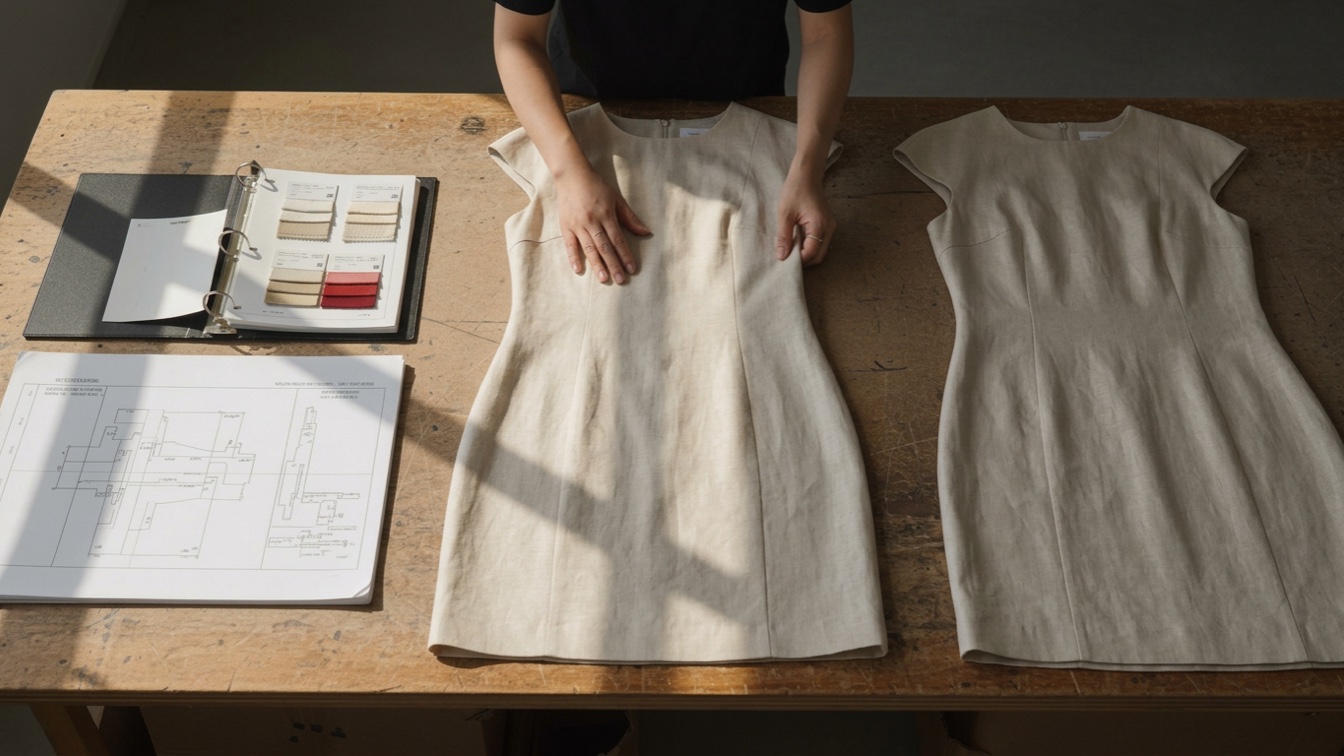
Switching clothing manufacturers fails most often not at the first order, but at the third reorder. A new manufacturer can nail an initial sample and a first bulk run while everyone is watching closely. The harder question is whether quality holds across seasons — when the color lot drifts, the broderie placement shifts, or the cashmere hand softens. Deepwove's first-order clients have reordered 100% of the time, and that reorder consistency is the standard any brand should hold a new manufacturer to. This guide reframes a manufacturer switch as a quality-continuity risk assessment, not a seven-step checklist.
When a manufacturer switch is actually warranted
A manufacturer switch is warranted when the constraint is structural, not situational. The clearest signals are three: reorder quality that drifts season to season, development response times that slow as your range grows, and a minimum order quantity that no longer fits how you buy. One bad delivery is not a switch signal. A pattern is.
If you're reading this, you've probably already had the conversation with yourself — the one where you stop excusing a missed delivery as a one-off and start noticing it's a shape. That distinction matters. A single late order, a single off-shade dye lot, a single slow sampling round — none of those is a reason to move. Manufacturing has variance, and a partner who's mostly excellent is worth more than the disruption of starting over.
What warrants a switch is a structural mismatch — a ceiling your current manufacturer keeps hitting because of who they are, not because of a bad week. Three signals tend to surface together:
- Reorder quality drifts. The first run was beautiful. The second was fine. The third came back with placement that's a centimetre off and a hand-feel you can't quite sign off on. The closer you look at repeat production, the more the consistency frays.
- Development slows as you scale. When you had four styles, response was quick. With twenty, briefs sit. The team that fit your launch range doesn't fit your fourth season.
- MOQ caps your growth. You want to test more styles in smaller runs, or commit deeper on proven ones, and the minimums don't bend either direction.
None of this means your first manufacturer failed you. Outgrowing a manufacturer is a brand achievement, not a manufacturer's fault — a sign you've built demand they were never structured to carry. We've written about that turning point in depth in why most premium brands outgrow their first manufacturer, if you're still deciding whether you've reached it.
This guide assumes you've decided. From here, the question isn't whether to switch — it's how to switch without losing the quality you've spent seasons building.
The real risk isn't picking the wrong manufacturer. It's quality drift.
The real risk in switching clothing manufacturers is not choosing the wrong factory — it is quality drift across reorders. A new manufacturer nailing the first order proves little, because first orders are watched closely on both sides. Quality continuity is only tested by the third or fourth season, when attention relaxes and small deviations compound.
Here's the trap, and almost every guide on this topic walks straight into it: they treat manufacturer selection as the risk. Vet the factory, check the certifications, approve the sample, place the order. As if the danger lives entirely in the choosing.
It doesn't. The first order is the easiest order to get right. Both sides are paying maximum attention. The new manufacturer wants the relationship and runs their best people on it. You're scrutinising every measurement. Of course the first sample is good. Of course the first bulk lands. That's not evidence of anything except that everyone tried hard on the first try.
Quality continuity is a different property entirely, and it doesn't reveal itself until the watching stops. It surfaces around the third reorder — the point where the order has become routine, where it's handled by whoever's available rather than the founder's best line, where the assumptions that were carefully translated at the start have quietly eroded. That's where drift lives:
- A color lot that's a half-tone warmer than season one, because the dye house substituted a base and nobody flagged it.
- A broderie or embroidery placement that's migrated a few millimetres across reorders, because the original mark-up was never properly archived.
- A cashmere or knit hand that's softened or stiffened, because the yarn spec was met on paper but the supplier changed.
None of these show up at AQL inspection on a first order. All of them show up in the mirror, on the shop floor, in the returns, three seasons later.
This is not a knock on any one manufacturer. It's a structural property of switching — true of any new relationship, with any factory, anywhere. The new partner inherits none of the institutional memory the old one accumulated over seasons: the noted exceptions, the "always run this one a touch looser," the dye recipe that was tuned three rounds in. A manufacturer switch resets that memory to zero. The brands that switch well aren't the ones who pick a flawless factory. They're the ones who treat the rebuild of institutional memory as the actual project — and who hold the new manufacturer to a standard of reorder consistency, not first-order polish.
So the right question to carry into every vendor conversation isn't "can you make this beautifully?" Most capable manufacturers can make one thing beautifully once. The question is: "can you make it identically, season after season, after we've stopped watching?"
How to evaluate whether a new manufacturer can hold reorder consistency
To evaluate whether a new manufacturer can hold reorder consistency, ask for multi-season track record on a single style, verify how color lots and embroidery placement are controlled across reruns, and inspect how knit and cashmere hand is specified and re-specified. Reorder behavior, not first-order quality, is the predictive signal.
This is the part the checklists skip, because it's harder than "ask for samples." Anyone can produce a sample. You're assessing a property no sample can show — repeatability. Here's how to interrogate it directly.
1. Ask for multi-season track record on a single style. Not a lookbook of one-off projects — those prove range, not consistency. Ask: which style have you run the most times for one client, across how many seasons? A manufacturer with real reorder depth will have an answer and will be a little proud of it. A manufacturer who only ever runs first orders will pivot to talking about capacity. For reference, Deepwove's manufacturing group has run a single womenswear style across 4 consecutive seasons for a top-3 US premium contemporary department store — 8 reorders on one SKU — and a separate tops style reordered 10 times with the same buyer. Those are the group's top reorder performers, not the average. But they're the shape of evidence you're looking for: proof that the same style holds across years, not just that a factory is busy.
2. Verify how color is controlled across reruns. Ask specifically: when I reorder in six months, how do you guarantee the dye lot matches season one? You want to hear about archived dye recipes, retained lab dips, and a named approval gate on every rerun — not "we'll match the original." "We'll match" is a hope. A documented recipe and a retained physical standard is a system.
3. Pressure-test placement control. For anything with broderie, embroidery, print, or panel engineering, placement is where reorders quietly drift. Ask how the placement is recorded — graded mark-ups archived per size, or a one-time approval that lives in someone's memory? The difference is whether your third reorder's neckline embroidery sits where season one's did, or a few millimetres south.
4. Inspect how hand is specified — and re-specified. Knit and cashmere are the cruelest here, because hand-feel is the thing customers register first and brief-writers describe worst. A capable manufacturer doesn't just hit a yarn count; they pin down the supplier, the spinning, and the finish, and they re-confirm those on every rerun rather than assuming the yarn is "the same." Ask what happens when their yarn supplier substitutes. The good answer involves a re-approval. The bad answer is silence.
If a manufacturer can speak fluently to all four — track record, color, placement, hand — across reorders rather than first orders, you're talking to a partner who understands the actual risk you're managing. If they keep redirecting to price and capacity, you've learned something too.
How to manage QC through the transition
Manage quality control through a manufacturer transition by approving against a physical reference garment, staging the first bulk run, and tightening inspection standards while institutional memory rebuilds. Deepwove inspects to AQL 2.5 with a two-stage QC on typical 100–300 piece orders and a three-stage QC on 500+ piece runs.
The transition window — roughly the first two to three orders with a new manufacturer — is where you spend your attention deliberately, because the institutional memory that protects you later doesn't exist yet. A few practical guardrails:
- Approve against a physical reference, not a tech pack alone. Send the new manufacturer an actual garment from your previous production — your gold seal — and have them match that, not just the spec on paper. A tech pack tells them the measurements. The reference garment tells them the intent.
- Stage the first bulk run. If you'd normally place 300, ask to approve a top-of-production sample pulled from the live line before the rest runs. Catching a placement or shade issue at piece 20 costs nothing. Catching it at piece 300 costs a season.
- Run parallel sampling on your hero styles. For the styles that carry your floor, it's worth having the new manufacturer sample them while you're still producing elsewhere — so you're comparing the new partner's output against a known-good standard, side by side, before you commit the order.
- Set the inspection standard explicitly, up front. Decide your AQL level and your inspection stages before the first PO, not after a problem. For context, Deepwove inspects to AQL 2.5 as standard, with a two-stage QC on typical 100–300 piece orders — pre-production sample approval, then final inspection on the full bulk before ship — and a three-stage QC on 500+ piece runs that adds a mid-production checkpoint. Tighter AQL 1.5 or 0.4 is available on request for higher-grade specifications. The point isn't the specific numbers; it's that the standard is named and agreed before anyone cuts fabric.
The goal of the transition window is narrow and specific: get through it with enough documented, archived, physically-retained reference that the next order doesn't depend on anyone remembering anything. Reliability on the back end is built here. Deepwove's manufacturing group holds 90% on-time delivery across the past 12 months — and that kind of consistency is a transition-window discipline before it's ever a track record.
How to verify the switch actually worked
A manufacturer switch is only verified successful when reorders stay consistent across two to three seasons — not when the first order ships well. The metric to watch is repeat-order stability. Deepwove's manufacturing group reports a 100% reorder rate to date and 100% of clients extending relationships past the two-year mark.
Here's the discipline most brands skip: they declare the switch a success the moment the first bulk arrives clean. But by now you know why that's premature. The first order proves the new manufacturer can start. It proves nothing about whether they can hold.
The real verification runs on a longer clock. Watch the second reorder against the first, and the third against the second. Is the shade still matching the retained lab dip? Is the placement still landing where the archived mark-up says it should? Is the hand still passing the only test that matters — a customer touching it and not thinking about it? A switch has worked when reorder two and reorder three are indistinguishable from reorder one. That's the whole bar. Anything less and you've simply postponed the drift you switched to escape.
This longer clock is also the right lens for choosing the partner in the first place — because a manufacturer's own reorder and retention behavior is the most honest preview of what your relationship will look like. Every first-order client in Deepwove's manufacturing group has placed at least one reorder — a 100% reorder rate to date. And every client who has crossed the two-year development mark is still active — 100% of clients extending relationships past the two-year mark, multi-season partnerships rather than one-off runs. Numbers like those aren't a promise about your order; they're a signal about whether a manufacturer is built for the season-after-season consistency you're switching to find.
Hold your new manufacturer to that clock. If, three seasons in, the work is indistinguishable from the first, the switch worked — and you've rebuilt the institutional memory that makes the next three seasons easy.
When you shouldn't switch — and should add a second manufacturer instead
Sometimes the right move is not switching manufacturers but adding a second one. If your current manufacturer is strong on your core category but can't cover a new one — knit when they're woven specialists, or a higher run when they're built for small batches — the answer is sequencing a second partner, not replacing the first.
Before you commit to a full switch, run one honest check: is the problem quality, or coverage?
If your current manufacturer still produces your core beautifully and consistently but simply can't cover a new direction — they're woven specialists and you're moving into knit, or they're built for 100-piece runs and you need to scale a proven style deeper — then switching is the wrong tool. You'd be tearing out a partner who's serving you well to solve a problem that addition, not replacement, solves cleanly. The move there is to add a second manufacturer for the new lane while keeping the first for what they do best.
That's a genuinely different decision with its own risks — over-fragmenting your supply chain, splitting volume below useful minimums, doubling the relationships you manage. We've mapped out when to add versus when to replace, and which manufacturer to add first, in multi-manufacturer sequencing: when to add a second manufacturer.
Switch when quality is drifting and the relationship can't be repaired. Add when quality is fine but coverage isn't. Confusing the two is how brands end up with two mediocre manufacturers instead of one good one and one specialist.
Frequently Asked Questions
Does switching clothing manufacturers risk losing quality?
Switching manufacturers carries a quality risk, but not where most brands expect it. The first order is usually fine, because both sides watch it closely. The real risk is quality drift across reorders — color lots, placement, and hand-feel deviating by the third or fourth season once attention relaxes. Managing the switch means controlling for reorder consistency, not just first-order quality.
How do I verify a new manufacturer can hold reorder consistency?
Ask for multi-season track record on a single style, not a portfolio of one-off projects. Verify how dye lots are archived and re-matched, how embroidery and panel placement are recorded across reruns, and how knit or cashmere hand is re-specified when a yarn supplier changes. A manufacturer's own reorder rate is the most predictive signal of repeatability.
How long does it take to know if a manufacturer switch worked?
A manufacturer switch is only verified after two to three reorders stay consistent — typically two to three seasons. The first bulk arriving clean proves the manufacturer can start, not that they can hold. Watch whether reorder two and reorder three are indistinguishable from reorder one. That consistency, not the first order, is the real measure of a successful switch.
Should I switch manufacturers or add a second one?
Switch when quality is drifting and the relationship can't be repaired. Add a second manufacturer when your current one still produces your core consistently but can't cover a new category or run size — knit when they're woven specialists, or deeper volume when they're built for small batches. Confusing a coverage gap for a quality problem leads brands to replace partners they should have kept.
What's a low-risk way to test a new manufacturer before fully switching?
Run a parallel sample of your hero styles while still producing elsewhere, so you compare the new manufacturer's output against a known-good standard side by side. Approve against a physical reference garment, not a tech pack alone, and stage the first bulk run with a top-of-production sample approval. Deepwove produces from 100 pieces per style, which makes a low-commitment first run practical.